Recently I undertook a brief trip to the village of Aínsa in Huesca (Aragon); this lovely village with its Medieval arcades, square and fortified walls is well-known in Spain and France for its picturesque situation however its history is also extremely interesting. Legend places its founding in 724 by King Garci Ximénez (about whom many legends exist, including his spontaneous election as king by a gathering of monks who had not conferred about their choice beforehand), following his alleged reconquest of the Cinca Valley from Islamic occupation. It is from this (debated) event that the County of Sobrarbe comes, the name deriving from a red cross appearing to the king above the branches of a holm oak before battle; ‘sobre arbre’, ‘above the tree’. The oak with a fiery cross above it became Aínsa’s coat of arms, and in the seventeenth century a covered cross was built just outside the town’s walls on the alleged site of the oaken vision.

Aínsa (stock photo, as the village was so busy on our visit I could not get a decent picture of the overall square!)
Aínsa is situated on a promontory above the confluence of the Cinca and Ara rivers, making it an ideal location for keeping watch of who is traversing the Cinca valley. Whilst no specific finds have been located on the site of the town, the valley and its surroundings possess a rich archaeological heritage stretching back to the Palaeolithic, particularly in the Vero Cultural Park, where rock art has been dated to 30,000 years BC. There are also a number of megalithic monuments in the broader area and Aínsa’s position is ideal for defence, making it extremely likely that it was settled in some capacity prior to King Garci Ximénez’s military endeavours. The Medieval village (which sits above several modern streets about the rivers’ banks) consists primarily of two parallel streets leading to the main square and the church, all of which are surrounded by eleventh-century walls. The square is arcaded on its northern and southern sides and, following a steep decline into poverty in the twentieth century from emigration, the loss of agricultural lands thanks to reservoirs and dams, the village has enjoyed a renaissance since the 1960s, when cultural and natural tourism begun to flourish in the region. This is also thanks to the creation of several national parks in the broader area, such as that of Ordesa and Monte Perdido, less than an hour’s drive away from Aínsa. Speaking of driving, the journey to and from Andorra was very beautiful, leading over the mountain port from La Seu d’Urgell to Sort, then via Tremp over a winding pass into Huesca, where Puente de Montañana, Benabarre and Abizanda led us through some stunning Autumnal scenery in the mountains, with churches and castles perched on almost every crag.
In Aínsa our first stop was a surprising one, at the Eco Museum. This museum is deeply tied into preservation efforts for the Quebrantohuesos (‘bone-breaker’ or the bearded vulture), and has dedicated many years to reintroducing these birds into various spots in the Iberian Peninsula via a novel system of hand-rearing chicks and using a vulture marionette, then releasing them into the wild at different points to reduce the risk of co-sanguinatity between birds. There were several lovely dioramas of Pyrenean fauna and one could even (quietly) visit an enclosure in which pairs of eagles, owls and vultures were kept whom had been injured, paralysed or in some way would not survive anymore in the wild.

An example of the diorama.
The collegiate church of Santa Maria possesses a very fine bell tower (with the most cramped stairs I have ever encountered, almost a crawl space in some parts), crypt and minute cloister. The church was completed in the mid twelfth century and consecrated in 1181, built in the Romanesque style, whereas the cloister was built in the fourteenth century, with enlargements made to the church in the sixteenth century with various chapels. It is an austere space with a thirteenth-century polychrome Virgin mounted in the apse and the crypt has many carvings on the capitals of its squat, smooth pillars. These are mainly reproductions of the originals, as the crypt was destroyed during the Spanish Civil War, a sad and regrettably not unusual phenomenon. The cloister was damaged at the same time but thankfully much of its original fabric survives and there are several small chapels within its space with central basins collecting water from the roofs, with which the various plants there are watered.
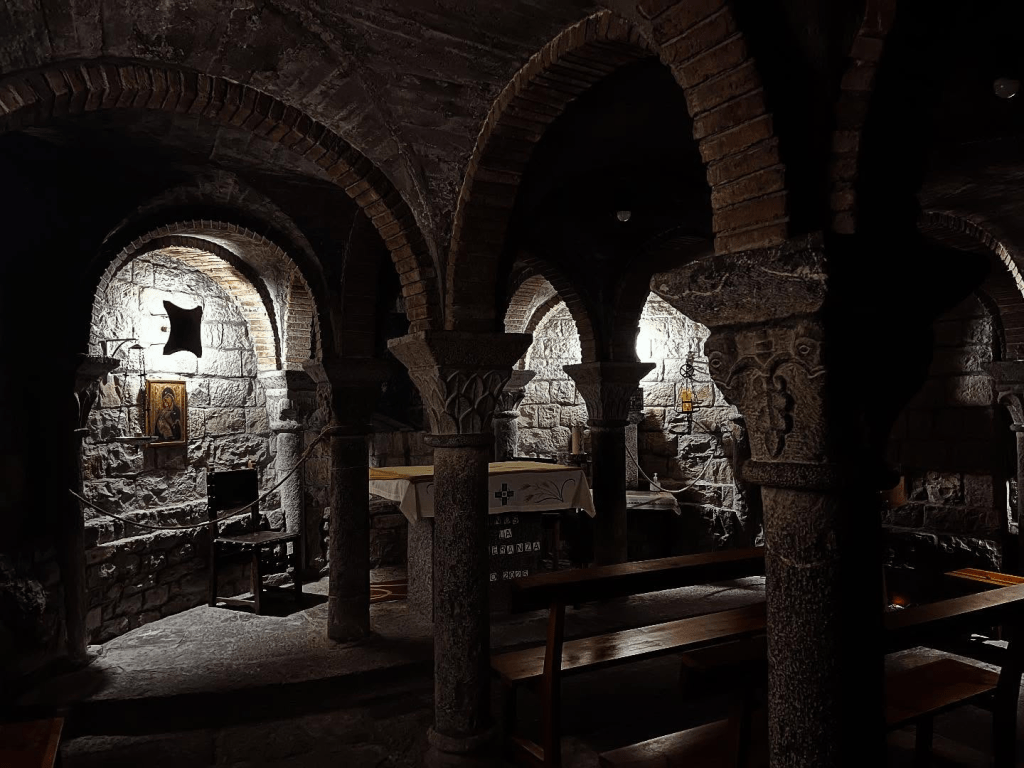
The church crypt with its numerous carved capitals.
The Museum of Traditional Arts and Crafts has an extensive collection of ceramics, ironwork, wooden furniture and rush-woven baskets relating to local crafts and production; perhaps most impressive was the enormous collection of decorated locks and door-knockers, many of which bore decorative styles which have comparisons in Catalonia and Andorra. There were also a great many examples of furniture decorations in the form of symbols which can be found across the Pyrenees, such as the six-pointed Hexafoil, which featured on everything from cheese-presses to door panels and banisters. Finally, we visited the castle walls, the outer part of which can be walked along in the south and north-facing enclosure entrance to the village. The fortifications were first built in the eleventh century and then renovated and expanded in the seventeenth century, prior to the Treaty of the Pyrenees, at a time when the border between Aragon and France was a highly contested and flexible affair.
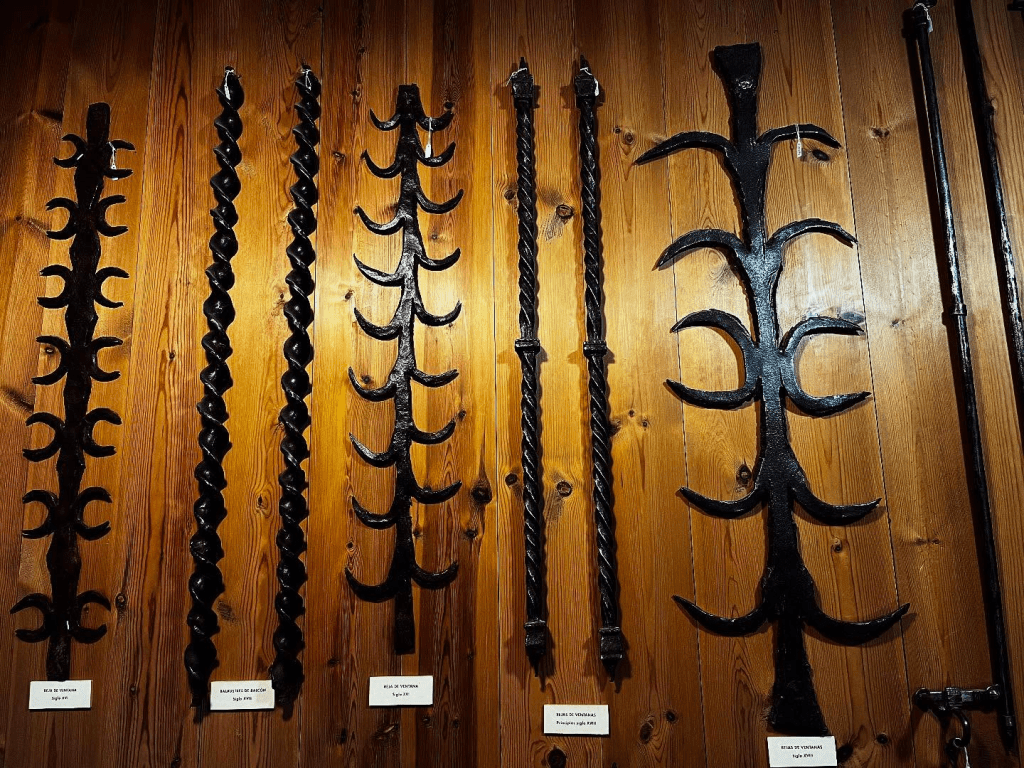
An array of traditional ‘jacket strippers’, used to prevent people gaining entry to a house through the smaller windows.
On the return to Andorra we stopped at the Sanctuary of Torreciudad, a massive complex of monumental brickwork constructed in the 1970s next to the original Medieval hermitage. The name ‘Torreciudad’ derives from an old watchtower built during the Islamic occupation of the region, located a few metres away from the old hermitage, which was constructed in Romanesque period. The Virgin of Torreciudad dates from the period and is now housed in the modern sanctuary; it is one of the ‘Black Virgins’ of the Pyrenees and depicts the Madonna seated with Child, having been venerated by locals for the better part of a millennia. The founder of the Opus Dei, Josemaria Escriva de Balaguer, was taken as an infant to the original hermitage by his mother to cure him from a serious illness; this seems to have worked and he was taken back to his home in Barbastro, where he made a full recovery. In the 1960s Josemaria decided to build a new sanctuary to the Virgin of Torreciudad in gratitude, with construction taking three months, from January to April in 1970. Exposed brick is omnipresent and, to my mind, has a peculiar yet beautiful mix of almost Soviet monumentalism, neo-Byzantine curves and a sort of ‘Church Militant’ effect, like an updated version of those churches and cathedrals built following the Albigensian Crusade, designed to impress strength and order over heresy. The original hermitage is a small, quiet affair on a nearby promontory overlooking the azure waters of a reservoir, with scarred pews and the Moorish watchtower overlooking its vault and bell tower. In the distance, Mont Perdido and other peaks can be seen (with dustings of snow). It is an exceptionally beautiful situation and much recommended for a visit.
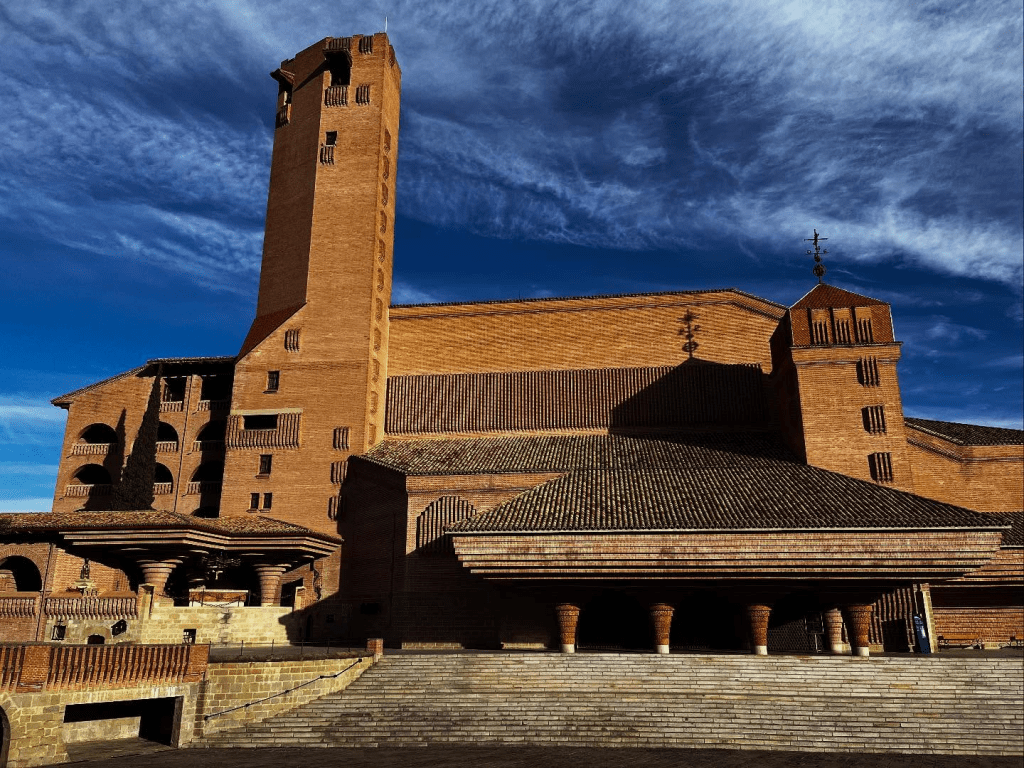
The new sanctuary of Torreciudad.

The original sanctuary of Torreciudad and the tower.

 Perennial Pyrenees
What a wonderful article on a place that we have often visited with friends! You have told us about so much more to explore next visit to Aìnsa from our village through the tunnel and into France. I read recently that the honey one can buy in town is of the best in Europe! We bought a bottle a month or so back and it is really good! Thank you for inspiring us to return!
LikeLiked by 1 person
Thank you, I’m glad you found it interesting! Yes the honey is exceptional, I bought two jars (‘mil flors’ and ‘bosque’); I would really recommend both the museums, they are filled with quiet interest!
LikeLike