Extract (#2) from Chapter Three of ‘Highly Holy’

This month’s extract of ‘Highly Holy’ is also taken from Chapter Three and focusses on the Virgin sites and pilgrimage shrines of the Conflent/Cerdagne region (Pyrenees-Orientales), a borderland area which, although lying inside France, still maintains a sense of Catalan identity. Its geography ranges from mountains to foothills and coastal cliffs; perched and nestled among these are a wide variety of chapels, churches and monasteries which have served the laity for centuries.

Extract II from Chapter Three, Sacred Trails and Marian Tales’

The Abbey of Saint-Martin du Canigou is perched above the village of Casteil in the Canigou Massif and represents one of the first examples of Romanesque architecture in the Roussillon. Built at the request of Count Guifred II in the late tenth century,[1] the initial church was consecrated in 1009 and dedicated to the Virgin Mary, Saint Martin and Saint Michael. The lower church was the first to be consecrated and was dedicated to the Virgin, with the upper church built between 1010 and 1020 and dedicated to Saints Michael and Martin. When the monastery was endowed with the relics of Saint Gaudéric de Viéville a few years later, it was in the upper church that a small side chapel was built to house these relics for veneration and display. The Abbey’s high point was brief, being largely within Count Guifred II’s own lifetime, however the relics of Saint Gaudéric still attracted a sizeable following and donations from locals as well as those pilgrims passing through the Canigou corridor before crossing one of the ports of the Pyrenees. During the twelfth century, it became attached to the nearby Abbey of Lagrasse in the Aude but, due to mismanagement and a papal arbitration, it quickly sank into decline, before being seriously damaged on the 2nd February 1428 by the ‘Candlemas earthquake’, an event which proved devastating for the abbey as well as much of Catalonia and Roussillon, with aftershocks lasting over a year.[2] Reconstruction of the damaged buildings and bell tower lasted for many decades due to poor funding, with the abbey finally secularised by Louis XVI in 1782. During the French Revolution, the last monks residing in the abbey were expelled and the monastic buildings closed, shortly after being transformed into stone quarries for the locals, with several nearby farmhouses still bearing evidence of using robbed-out stonework from the abbey. The abbey remained dilapidated and unused until the dawn of the twentieth century, when the Bishop of Perpignan, Monseigneur de Carsalade de Pont, commissioned its rebuilding and organised an annual pilgrimage to be held on Saint Martin’s day, the 11th of November, both as a tribute to the abbey but also as a method of rallying local identity, for in this region the sense of being Catalan rather than French still holds significant sway.

In 1902, this prelate and his ‘faithful’ from all the Catalan country, in Spain as well as France, made the Fête de Saint Martin (11th November) memorable. To give a poetic and sentimental importance to this occasion the bishop invited the ‘Consistoire’ of the ‘Jeux Floraux’ of Barcelona to hold their forty-fourth celebration here at the same time.

On a golden November sunlit day, amid the ring of mountains all resplendent with a brilliant autumn verdure, this grandest of all Fêtes de St. Martin was held. In the midst of the throne were the Bishop of Perpignan in his pontifical robes, and the mitred Abbé de la Trappe – a venerable old monk with snowy beard and vestments. At the head of the procession floated the reconstituted banner of the Comte Guifred, bearing the inscription ‘Guifre par la gracia de Dieu Comte de Cerdanya y de Conflent’. The local clergy from all over Roussillon and Catalonia were in line, and thousands of lay pilgrims besides. At the church, when the procession finally arrived, was celebrated a Pontifical Mass. At the conclusion of this religious celebration the Catalans of Barcelona took possession of the old basilica and the ‘fête littéraire’ commenced. The emotions throughout both celebrations was profound, and at the end there broke out seemingly interminable applause and shouts of ‘Vive la Catalogne!’, ‘Vive le Roussillon!’, ‘Vive Barcelona!’ and ‘Vive Perpignan!’.[3]

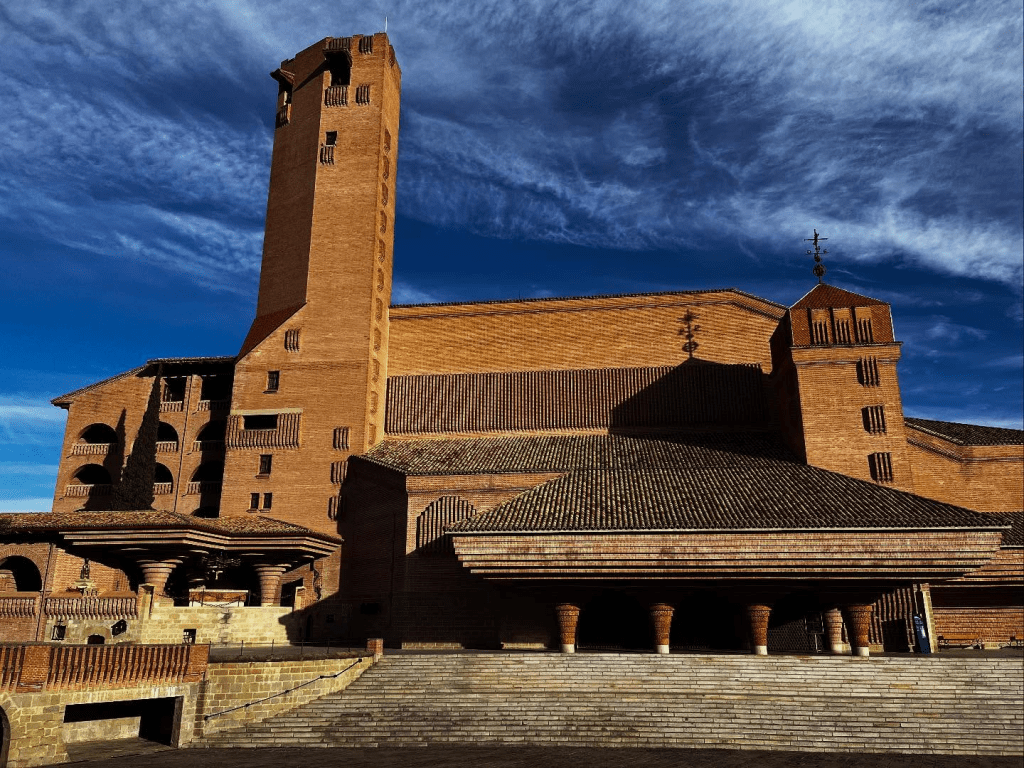
The abbey of Saint-Michel de Cuxa has already been discussed in Chapter One with regard to its architectural importance for the Romanesque in Conflent, and thus only a brief reminder of its history is needed here before passing on to the pilgrim presence. Founded in 840 at the head of the Tet valley, the original monastery was destroyed by flooding in 878 and then re-founded in Cuixa in 879 on the site of a minor community of Cenobites dedicated to Saint Germanus. The abbey was placed under the protection of the Count of Cerdanya and Conflent, with a new church dedicated to Saint Michael built in 940, which was expanded in 956 and then 974. In 978 the then Doge of Venice, Pietro I Orseolo, fled to the abbey under the cover of darkness to become a monk, together with the ascetic wanderer Romuald[4] and his companion Marinus, who founded a hermitage adjacent to the abbey. Despite the Conflent passing between the Crown of Aragon, the County of Barcelona, the Kingdom of Majorca, the Principality of Catalonia, the extended territory of the Iberian Caliphate, Habsburg Spain and the French monarchy, it continued to thrive due to its prodigious amount of parishes under its control. This continued up until the French Revolution when the lands were confiscated and the abbey was nationalised and sold, with the clergy evicted and the buildings falling into disrepair. In 1919, the abbey was re-founded and restored by the Cistercians, and transferred to Benedictine control in 1965.[5]

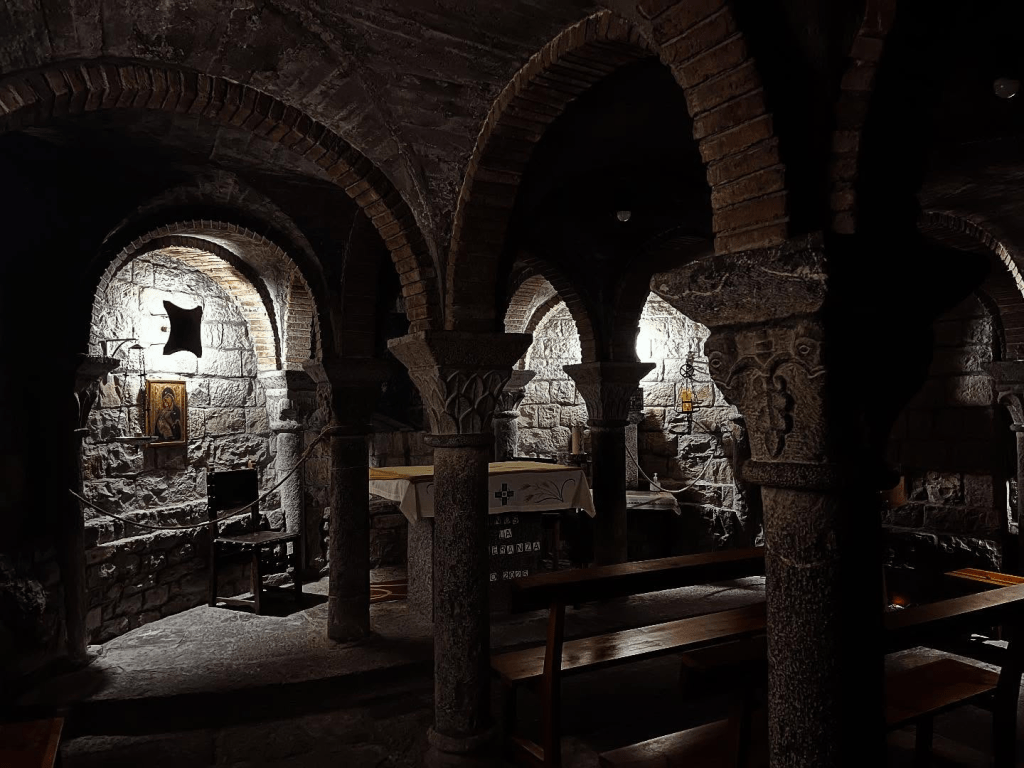
The abbey’s historical attraction for pilgrims has relied on two factors. The first is its location, being sited near the popular thoroughfares from the coast towards the Pyrenean passes which allowed access into Spain towards Santiago de Compostela. The other aspect was its collection of relics and image of the Virgin. The crypt of the abbey’s church is dedicated to its fourteenth-century Romanesque sculpture of Notre-Dame de la Crèche, while the church possesses a large rotunda of several levels dedicated to the Virgin Mary, ‘possibly in reference to the Rotunda of the Holy Sepulchre in Jerusalem’.[6] In terms of relics, prior to their transfer to other, safer locations or looting during the French revolution, the monastery held a number of valuable reliquaries and sarcophagi. These contained the partial or full relics of Saint Orseolo (the former Doge of Venice), Saint Valentine, Saint Nazaire, Saint Gaudéric and an alleged sliver of the Holy Cross. The enlargement of the church’s apses and the nave by Abbot Olba de Besalú in the eleventh century may have been influenced by an increasing circulation by pilgrims who were keen to pay devotions and make donations to these relics, displayed in side chapels, as well as the image of Notre-Dame de la Crèche in the crypt.[7]

Further down the coast towards the border with Catalonia is the coastal port of Coullioure, where the hermitage and chapel of Notre-Dame de Consolation stands on a plateau above the town, looking down onto the cove and out towards the Mediterranean Sea. The area has a multitude of springs, the most famous being the Douy spring (from which the Douy river flows down to Coullioure), and some suggest prompted sailors to erect a temple first to Neptune and then Poseidon on this site. However, archaeological evidence for this theory remains elusive as overlain by the chapel structure. The origins of the chapel are unclear, with some sources claiming it was built in the twelfth century by Dominican monks, however the first mention of a Virgin cult at this location appears in 1496 when ‘Maria de Consolacio’ is mentioned. There does not appear to be a legend attached to the discovery of the Virgin image. In 1549, the chapel is described as a capella heremitana, a ‘hermit chapel’, indicating that some observantines would have resided there from that period and acted as caretakers for the chapel. This is noteworthy as it is in the seventeenth century that hermitages become widely popular, with many chapels across the Pyrenees and Europe in general having annexes built to accommodate resident hermits, thus Notre-Dame de Consolation can be seen as an early adopter of this practise. In Roussillon, hermits were often consulted by local inhabitants on spiritual and moral problems, and the presence of a hermit at the chapel would have increased both visitations and donations to the site. As with so many other chapels and churches, the French Revolution instigated the sale of the site as State property; as to who bought the chapel, the historical record is silent. However, in 1805 the site was reopened and a new hermit took up residence. According to local legend he was a layman and so, rather than wearing a habit as had been customary for the previous generations of hermits, he dressed in traditional lay Catalan clothes, a practise which was continued by each subsequent hermit at the site until 1950 when the practise of resident hermits ended. The sanctuary was restored in 1811 and in 1975. It contains many examples of ex-votos from the seventeenth century as well as two side chapels, one dedicated to Saint Ferréol,[8] and the other to the Crucifix.[9] A pilgrimage takes place on both the 15th August and on the Nativity of the Virgin, the 8th September. The traveller Joseph-Antoine Cervini provides an extensive description of the September celebrations in the early nineteenth century.

We were going to enjoy once again the original and charming spectacle of the Catalan dance on the occasion of the feast of the Nativity of the Virgin, celebrated for two days by the inhabitants of the town and the surrounding area, but more particularly unemployed on that day, and made more pompous by the influx of foreigners. It is on the top of one of the longitudinal valleys, which the Albères form as they descend towards the Mediterranean, that the hermitage is situated. The hillside that one climbs to get there is one of the most abundant in this type of vines from which one obtains this wine so hot and so smoky which, stripped by old age, takes on the colour of a golden yellow, and which is so well known to gourmets under the name of ‘rancio du Roussillon’. While we were walking along the path, traced on the eastern slope of the mountain and in the middle of these vineyards whose color tired our eyes by its continuous uniformity, we turned around at every moment, and the vast expanse of the sea, the view of the bell tower of the church of Saint-Vincent, the glance of the houses of Collioure grouped picturesquely in the pyramidal form, and the aspect of the fort which crowns them with its old bastions, made us forget the fatigue of the road and the sad monotony of these evergreen vines. Besides, the moving and animated scenes of the various bands which preceded us, or followed us in a row, could not leave the least room for boredom. They were well-to-do farmers, or rich farmers, who, at the head of their numerous families, advanced accompanied by their servants, laden with provisions: they were fishermen who had rushed from the many bays which cut the coast from Cape Bearn to Cape Pineda in Spain, and who, alert and joyful, rushed with a rapid step, bringing in baskets the food which they were going to put in common and share among themselves: it was the mixture of people of all ages, sexes, and conditions, in a hurry to arrive, in order to secure one of the kitchens which can be hired on the spot, to prepare the meats which they had brought with them in the stew. Several Spaniards were mingled in this crowd of pilgrims and curious people; we recognized them by the large hat which covered their heads, or by the black net which wrapped their hair; They had scarlet cloth jackets lined with black velvet and decorated with the same material at the elbows, forearms, pockets and collar; the rest of their costume was similar to that of the inhabitants of the coast of the department; several of these foreigners were even only noticed by their folded coats and carelessly thrown over their shoulders. A large number of other individuals of the class of the people of the neighbouring communes, formed groups resting along the windings of the path that we followed, and on the banks of the stream maintained by the various trickles of water that flow from the surrounding heights; they were distinguished by their long scarlet caps falling on their shoulders, by the belt of the same colour, the velvet pants and jacket, and by their shoes called in the country espardenyas and which quite resemble the espadrilles of the inhabitants of the central Pyrenees.

Arriving on the terrace from which we suddenly and for the first time see the Hermitage, we find even more numerous groups, seated on the sides and under the beautiful elms which surround it. Several, others scattered above the esplanade, for want of having found space in the surrounding buildings, are busy setting up their kitchen in the open air; by means of a few stones laid in the fields, they form the hearth on which they place their pots. After visiting the church of the Hermitage, very simple in its construction, but whose high altar was quite well decorated, we followed the crowd which rushed hastily and in tumult towards the lower plateau where the juglas or jutglas, that is to say jugglers, began to make heard the sharp and nasal sound of the oboes, and to swell the bagpipe, called the bag of gemechs, that is to say the bag of moans; the piercing flageolet dominated this noisy melody whose movement was marked by the repeated blows of the tambourine. As soon as we arrived on this plateau, we saw the young people come forward and take each other by the hand, to form a sort of chain in a circle broken by the two leaders of the dance who were at the two ends. Obeying a rhythm more serious and severe than the amusement they were about to indulge in seemed to require, these young people performed a sort of monotonous swinging while taking a few steps, sometimes to the right, sometimes to the opposite side; the young girls, as if to attract their attention, came to place themselves in the centre of this circle, and from then on they were invited to the ball which followed this preparatory dance, called the contrapas, and which entirely reminded us of the Romeika of the Greeks. The ball contrasts as much as possible with the heavy and always the same pace of the contrapas; this dance is at the same time more lively, more cheerful and much more expressive; one would say the putting into action of a feeling of mutual intelligence between two hearts well in love; it is love with its phases and in its gradations; it is the painting of its whims, its fights, its deceptive traps. Here is how it is performed:

As soon as the cavalier has led his lady into the circle, he places himself opposite her at a certain distance. Immediately and forming steps and gambols, he advances on his dancer with animated gestures. The woman flees, retreats in a circle without taking a single step, and with her arms crossed on her belt, or her hands in her apron pockets and her head bent, she slides limply on tiptoe. A few sometimes stir, during the short duration of this position. In the middle of the ball some of the dancers alone and with a triple rush remove their dancers; they support them as if seated on the hand but these must second their skill by springing themselves appropriately. To this end, as soon as they have made an effort; at the same moment the dancer leaves the left hand of his dancer, makes a seat for her in the air with his right hand, supports her in front in balance with his left, pirouettes and turns on himself before afterwards they change roles, and it is then the woman who follows the dancer fleeing in turn in front of her; with a hurried step she pursues him and soon catches up with him; but often the cavalier, with a jump passes his right leg over the head of his dancer, avoids her, escapes her and then retraces his steps to begin his pursuit again. This game which lasts for a few moments is interrupted by the alternating change of dancer and dancer, a change which continues until several couples have gathered in a circle, and the ladies resting their hands on the shoulders of the cavaliers who take them under the arms, are by them lifted and supported in the air during the climax of the music which lasts a few seconds. It is a piquant and very pleasant picture that these women thus carried away at the same time, dominating the spectators to whose cheers they take it upon themselves, or else they place them on their shoulders. The young men recognized as strong enough, or rather skilful enough to succeed in this two-step, are generally the favourites and the favourites of the dancers; their left hand on the right of the rider, they stiffen their arm and leaning with the other on the shoulder of the dancer they give themselves momentum, and the latter can then raise them lightly and without putting it on the ground. As soon as the three different airs which compose each ball are played, new groups are formed, replace the first ones, and the dance thus does not suffer any interruption.

These are the principal figures of this dance, such as we have just described them; but it cannot give a just idea of ​​the numerous concourses of persons assembled in the vicinity of the chapel, nor represent the interesting variety of episodes which such a gathering offered all around. First there was the interruption of the dance occasioned by the third and last stroke of the bell which called the pilgrims to mass, then as eager to enter the church as they had been, a few moments before, to run to the ball. The mass was not yet entirely over when with the same ardour some went again towards the place of the dance, while others ran to the tables set for the meal.

What a spectacle at once picturesque and interesting was this numerous assembly in the open air, this family feast and these various scattered groups which the most perfect harmony and the same gaiety seemed to unite! the feeling of pleasure that it made us experience equalled the delight that we had felt at the sight of the dance. This picture, moreover, was entirely new to us; it seemed to us to represent a halt of a nomadic population preparing to draw, from a common meal, the strength necessary to support the fatigues of a long journey. The illusion would have been complete if the extreme difference of the costumes, and the inequality of the good cheer, had not reminded us that those who formed this gathering already knew the social distinctions, and the rank and advantages that wealth and the favours of fortune dispense with. The tables covered with numerous dishes, containing all sorts of dishes, pastries and fruits, awaited the rich farmers, who on this occasion display the greatest luxury, and seek by profusion, rather than by delicacy, to surpass one another. The simple tablecloth spread in the shade of the neighbouring elm tree was surrounded by the craftsman’s family, who were content with their modest stew and household jam. As for the fishermen and the common people accustomed to braving the heat of the southern sun, they took shelter at the first available place, and on the ground or lawn that served as a table and seat, they appeased their appetite, either with charcuterie or with sardines salted on the coast. The wine flows everywhere; a bulb with a wide belly and a narrow neck from which a thin, long and curved pipe detaches, passes and repasses ceaselessly from hand to hand; soon emptied it is soon filled again in the immense demijohn which is always nearby, but which is placed as much as possible out of the sun. It is curious to see the manner and skill with which the villagers of Roussillon, and of several other parts of the Pyrenees, use this ampoule, by making the liquor gush from afar into their half-open mouths, which falls in a thin stream, and of which they do not lose a single drop. This way of drinking at the regale is not unpleasant either for the guests or for the spectators, and in this it far surpasses the use of pewter beer pots by the English and the Dutch; drinking cups or glasses are almost unknown among the lower class and the inhabitants of the mountains. Independently of the attraction added to the Hermitage of Consolation by the prodigious crowds brought there by the feast of the Nativity of the Virgin, this place has a charm of its own, and which is guaranteed forever by the magic of its situation, the limpidity of its waters, and particularly the rustic amenity of the esplanade in the middle of which one discovers it. Whatever the time of year when the traveller finds himself in the region, like us he will applaud himself for having visited it, like us he will feel the regret of leaving it. It was only after having spent the greater part of the day there that we went down to Collioure.[10]

Further inland, close to Cuxa, the hermitage of Notre-Dame in Font-Romeu (Cerdagne) has been a popular place of pilgrimage since the twelfth century and possibly earlier. Within the chapel, a painting is dated to 1113, however there are numerous springs in the area which have a long-standing reputation for healing. A legend which is not unfamiliar surrounds the discovery of the Virgin image which stands within the chapel. A herd of oxen used to graze on the rugged mountain of Odeilló, where only barns of sheds offered any shelter, and they would often drink from the spring on which the chapel’s altar now stands. One day, the herdsman saw that his bull took more interest than usual in the spring, trampling and sniffing at the source. The herder brought the unruly bull back to the herd several times but each time the animal would return to paw the earth where the spring emerged from the ground. Eventually the impatient oxherd was about to beat the animal when he saw that, where the bull had been sniffing and pawing with its hooves, a cleft in the rock could be seen and, within that cleft, the head of a wooden statue was just visible. The oxherd dropped his stick and reproached himself for being about to inflict violence upon the innocent animal. Removing the statue, for it was a wooden image of the Virgin, he carried the Madonna to the side of the spring and rushed down to the parish of Odeilló, to spread the news. A procession was hastily organised by the village priest and all the villagers accompanied the oxherd back to the spring, where the bull was standing guard over the figurine. The villagers of Odeilló hastily built an oratory to house the image on the spot where the spring came out of the earth, located where the high altar stands today, and subsequently they raised funds for a more substantial chapel. Early on, the image was removed to the church of Saint Martin, down in Odeilló, and taken back to the chapel in a great procession on Trinity Sunday, where she remained until the Nativity of the Virgin (September 8th), before being taken back down the mountain to Odeilló. This tradition has continued to today, with the Virgin never being allowed to ‘spend winter on the mountain’ and also, more practically, coinciding with the timing of transhumance, when the livestock are brought up to the high pastures for the Summer and then brought down to the lower pastures before Autumn begins. There is a popular local legend which ties the name ‘Font Romeu’ to this event, with Font being the Catalan word for ‘fountain’ and Romeu referring to the name of the oxherd, however it is also suggested that Romeu was a term used to refer to pilgrims making their way to Rome, which then became extended to encompass any pilgrim, thus ‘Font-Romeu’ could be ‘the fountain of the pilgrims’.[11]

The twelfth-century chapel was entirely remodelled in 1686, being enlarged and extended to feature a courtyard and a larger chapel, in which a ‘camaril’houses the statue of the Virgin.[12] The statue itself is twelfth-century, made of gilded wood and represents the Virgin seated, holding a bouquet in her right hand and the infant Jesus on her knees. Her back is hollow, and it is thought that this was done to make her lighter and thus easier to carry during the processions. In the eighteenth century, a pool was built around the fountain, which funnels the spring water from its source under the high altar to the courtyard, and a great number of ex-votos can be seen in the chapel and around the fountain. After circulating the fountain and pool three times whilst reciting the rosary, pilgrims can immerse themselves in the waters, which have a reputation for general healing, and some are recorded as immersing themselves nine times in order to receive the maximum effect, as well as taking bottles of the water home with them.[13] A number of miracles have been associated with the site, including the curing of three brothers from Prades of measles in 1642, the restoration of health to a cripple in 1646 by bathing nine times in the fountain’s waters, the lifting of paralysis from a lady from Chalabre (Mirepoix) in 1740, the relief of a Dominican prior who fell from a window in 1807, the saving of Odeilló from ‘a contagious breeze’ (possibly cholera) in 1818, the saving of a woman from drowning in 1819 and the lifting of blindness from a child in 1824.[14] A Calvary was also constructed in 1852, three hundred metres from the chapel complex, with the stations placed at intervals at the edge of a grassy path which winds up the hill overlooking the chapel. Some pilgrims process up this path on their knees and at the top stands a small oratory with a statue of the Virgin behind a grill., from which a large panorama of the Cerdagne can be seen. A report by Monsieur Tolra de Bordas describes the scene of the September celebration at the chapel in 1855:

Arriving at the hermitage, the traveller does not fail to enter the chapel and to pay a short visit to the Guardian of these places. Before the morning services, which do not begin until ten o’clock, there is time to take a rest or walk around the chapel. Thus, one can, by leaving the church by the back door and turning right, walk along green platforms, where the pilgrim devoted to Mary regrets seeing frivolous amusements associated with the religious festival; one arrives there slowly by breaking through the crowd of joyful strollers who also circulate on this side, and by walking between two lines of peddlers; this time, it is no longer toys or ribbons, but edibles of all kinds, so that the traveller who goes to Font-Romeu can, without imposing on himself the hassle of transporting food, feed himself properly.

The office of the high mass, we have said, begins at ten o’clock on the day of the great feast of Our Lady of Font-Romeu. An hour in advance, the church is almost entirely filled with women of the country, most of whom keep their places by remaining seated or rather crouching on their heels. During the divine service, the observer placed outside is touched to see this immense crowd that the church cannot contain, unite in intention with those which fills the nave, and imitate, in a profound meditation, all the movements it sees being made, getting up when the inner crowd gets up, kneeling when they kneel, prostrating themselves or beating their chest, and so on. After the Gospel, the priest serving the parish of Odeilló usually goes up to the pulpit, where, after a touching instruction, he cannot neglect to stimulate the generosity of the assistants, whose ranks he does not delay in going along to collect their offerings.

[…] No one will want to leave Font-Romeu without taking with them a joyous souvenir of the church, you will find objects of piety of all kinds which the priest keeps at the disposal of pilgrims. These are blessed rosaries of Saint Bridget, medals (in copper or silver) of Our Lady of Font-Romeu, presenting on their reverse the figure of Saint John the Baptist; small crosses, images, scapulars with the image of the same Virgin; Catalan or Goig[15] hymns which are sung in Her honour;[16] a translation into French verse of the same hymn; ribbons or mides[17] of green, red or blue which can be used to pass around the neck of medals or reliquaries etc. With the high mass over, noon warns this multitude that it is time to open the baskets of provisions, and in the blink of an eye, thousands of place settings are spread out on the grass, in the shade of the mountain pines.[18]

As an aside it is also worth mentioning that just a stone’s throw from Font-Romeu lies the church of Notre-Dame de la Merci in Planès, whose foundation is attached to a very similar legend of discovery, in which a bull was seen to be scratching a patch of land in the mountainous pastures. Upon inspecting the spot which intrigued the bull, villagers discovered a statue of the Virgin Mary buried in the earth for safe-keeping. The church is dated to the eleventh century and is locally known as a Mesquita, or ‘mosque’ in Catalan, allegedly being the location of the tomb of Munuza, a Berber chief. According to an anonymous eighth-century chronicler from Cordoba, Munuza married Lampégie, the daughter of Duke Eudes of Aquitaine at the time when the Cerdagne was under Muslim control. This is almost certainly a flight of fancy on behalf of the chronicler, particularly the detail that, after being widowed, Lampégie was sent to a harem in the East. However, the story gained popularity with Romantic historians of the nineteenth-century as an explanation for the church being locally known as a ‘Mesquita’, the real reasons for which doubtless lie within the turbulent period of Muslim occupation and the Reconquista. Another curious detail is the church’s layout, which is broadly triangular, each side having a semi-circular apse, vaulted in a cul-de-four with an ovoid dome covering the church’s central space. It is thought that the triangular arrangement is a reference to the Trinity, with the circular form of the floor beneath the dome symbolising the Virgin. The statue itself is similar in style to Notre-Dame de Font-Romeu, being thirteenth-century and carved from wood. A local pilgrimage takes place on the 8th September every year.[19]

On Bell-lloc hill, overlooking the current border between the French Cerdagne and the Catalan Cerdanya, the isolated thirteenth-century church of Nostre Senyora de Bell-lloc hosts a Virgin statue which was once regarded as ‘patron and protectress of both Cerdanyas’, a title which waned as a proliferation of more localised sites emerged in the French Cerdagne.[20] The church is first mentioned in a document dating to 1260, which references the restoration of a field to the priest of ‘Santa Maria Bell-lloc’, and in 1265 the will of Bernat de Rigosa stipulates that a farm from the village of Dorres (below the Bell-lloc hill) should be donated as freehold to the church of Bell-lloc in perpetuity. There is some contention as to whether or not the church had a domus hospitalis attached to it before the sixteenth-century, with some arguing that the level and frequency of donations indicates that some manner of hospital is almost certain, making comparisons with other similar examples in the region, whilst others contend that the geographical situation of the church would make it unsuitable for such a purpose. What is certain, however, is that in 1579 a convent of Servite nuns was established next to the church, which was then destroyed during the French Revolution and whose remains can be seen today adjacent to the church.[21]

The church itself shows several phases of reform, especially in the roof of the nave, where the original Romanesque barrel vault was replaced by wooden truces and the apse covered with a quarter-sphere vault. In 1792, the wooden statue of Bell-lloc’s Virgin was transferred to the parish church of Sant Joan de Dorres in order to spare it from Revolutionary destruction. The statue is unusual in that it sits on a seat made from a sheet of wood fixed to a perpendicular panel which acts as a backrest; this arrangement has no parallel in the Cerdanya. She also wears a tunic but no mantle, and there is evidence of a canopy which once possessed an ornate border of painted stones imitating the work of a goldsmith. The Virgin’s head is covered by a veil, her face is elongated and darkened (as is that of the Infant Jesus on her lap) and her extended right hand is disproportionately large. Another remarkable detail about this carving is the tunic, which gives the impression of transparency, making it possible to guess the outline of the Virgin’s legs from the knees down. It is an exotic statue, quite unlike anything else in the region, and it leaves the viewer with a sense of strangeness. The dating on the statue is unsure, with estimates ranging from the tenth to the early twelfth century and there is no surviving legend attached to its discovery or creation. From the village of Dorres below, a street transforms into an unpaved track which leads to the sanctuary. Along this route, a pilgrimage is conducted on the 8th September each year to the hilltop and the chapel.[22]


[1] Count Guifred II of Ceragne (born 970, died 1049) was responsible for the consecration of several churches and monasteries in the region and, after retiring to Saint-Martin du Canigou in 1035 to become a monk, was buried in the Abbey upon his death. He inherited the county of Cerdagne from his father Count Oliba II in 988 after the latter took monastic vows at Monte Cassino (Lazio, Italy), as well as the county of Berga from his brother Oliva when Oliva also became a monk.

[2] See:  Banda, E., Correig, A. M., ‘The Catalan Earthquake of February 2, 1428’, Engineering Geology, No. 20, 1984, p. 89 – 97.

[3] Miltoun, Francis, Castles and Chateaux of Old Navarre and the Basque Provinces Including Also Foix, Roussillon and Béarn (Boston: L. C. Page & Company, 1907), pp. 134 – 135.

[4] Romuald (born c. 951, died c. 1025), was the founder of the Camaldolese order and an important figure in the eleventh-century movement of ‘Eremitical Asceticism’. Born in Ravenna, he entered the monastery of Sant Apollinare in Classe after being the second to his father during a duel, however he found the monastic life there to be too lax. He then went to Venice where he studied under the hermit Marinus. It was Romuald who persuaded the Doge of Venice to leave for Cuxa, as the former was suffering remorse for murdering his predecessor. Marinus and Romuald left with him, founding a small hermitage next to the abbey where Romuald lived for a decade, making use of Cuxa’s library. He then spent thirty years wandering Italy, reforming monasteries and hermitages, taking and then giving up the position of Abbot back at Sant Apollinare and eventually founding five hermit cells at Camaldoli. This ssy became the monastery of Fontebuono, the mother-house of the Camaldolese Order. Romuald’s feast day was added to the Tridentine calendar in 1594 on the 19th June, but then changed the following year to the 7th February, the date on which his relics were transferred to Fariano in 1481. In 1969, his feast day was moved back to the day of his death, the 19th June. See: Butler, Alban, The Lives of the Saints: Volume II February (Dublin: James Duffy, 1866).

[5] Kibler, William & Zinn, Grover, (Eds.), Routledge Revivals: Medieval France (1965): An Encyclopedia (London: Taylor & Francis, 2017), p. 844.

[6] Santoro, 2011, p. 202.

[7] Mallet, Géraldine, Églises Romanes Oubliées du Roussillon (Barcelona: Les Presses du Languedoc, 2003) p. 193 – 202.

[8] Saint Ferréol (birth date unknown, died c.303) is a martyr saint, killed by Roman soldiers in the early fourth century. His hagiography alleges that Vienne (as he was originally known) was forcibly enlisted into the Roman army and tried to protect Saint Julien de Brioude, another soldier who converted to Christianity and was killed in 304. For this Vienne was imprisoned and, after successfully escaping and being pursued across the Rhone, he was slaughtered on the banks of the Gier river. Dedications to Saint Ferréol take place across France, with a particular concentration around the Rhone and the South-West of the country. See: Dory, Franck, ‘Saint Ferréol Martyr, de Vienne au Pays Catalan’, Archéo66, Bulletin de l’AAPO, Perpignan, Vol. 27, 2012, p. 81 – 84.

[9] Zantedeschi, Francesca, The Antiquarians of the Nation: Monuments and Language in Nineteenth-Century Roussillon (Leiden: Brill, 2019), pp. 96 – 109.

[10] Cervini, Joseph-Antoine, Voyage Pittoresque dans les Pyrénées Françaises et les Départements Adjacents (Paris: Truettel et Wurtz, 1830), pp. 158 – 160. Translated by the author.

[11] Tolra de Bordas, M., Pèlerinage a Notre-Dame de Font-Romeu (Perpignan: J. B. Alzine, 1855), pp. 36 – 46.

[12] A camaril or a cambril is the Catalan term for a small elevated chamber behind an altar, where an image of special veneration is housed. In the Cerdagne, a great many Catalan terms are still used and the language is frequently still spoken, despite being technically a French territory. Tolra de Bordas’ describes the camaril as being ’16 metres square’ and ‘a magnificent oratory where one feels instinctively drawn to prayer and meditation. There, the Christian, prostrate before the Cross, illuminated only by the glow of a crystal lamp suspended from the vault, and also weakly by the daylight that penetrates through the niche of the Virgin’. Ibid., p 54. Translated by the author.

[13] Ibid., p. 59.

[14] Ibid., pp. 64 – 67.

[15] Goig is a Catalan term for verses made in praise of the Virgin Mary or a saint after the Latin Gaudete meaning ‘joy’.

[16] The goig is provided at the end of Tolra de Borda’s book.

O patrona y advocada                  (O patron and advocate

De tot lo poble de Deu!                Of all the people of God!

Ohiunos, Verge sagrada,              Ohiunos, sacred Virgin,

Maria de Font-Romeu.                 Mary of Font-Romeu.

En una freda montanya                In a cold mountain

Del terme de Odeilló,                   The region of Odeilló,

En la terra de Cerdanya,              In the land of Cerdanya,

Als confins de Rosselló                 The confines of Rosselló

Vos de tots sou venerada              You are revered by all

Com digna Mare de Deu;              Worthy Mother of God.

Ohiunos, Verge sagrada,              Ohiunos, sacred Virgin

Maria de Font-Romeu.                 Mary of Font-Romeu.)

Ibid., pp. 84. Translated from Catalan by the author. I am unable to find a translation for ‘Ohiunos’ however it occurs in multiple goigs from the Cerdagne/Cerdanya devoted to the Virgin Mary and may therefore be a localised honorific title, glorification, or contraction.

[17] Mides is the plural of mida, a Catalan term for a measure or measurement.

[18]Ibid., pp. 30 – 32. Translated from French by the author.

[19] Langlet, Léon, L’Église Ésotérique de Planès (Pyrénées-Orientales) (Perpignan: Imp. du Midi, 1966).

[20] Sahlins, Peter, Boundaries: The Making of France and Spain in the Pyrenees (Berkley, CA: University of California Press, 2023), p. 260.

[21] The Servite Order, otherwise known as the Order of Servants of Mary (Ordo Servorum Beatae Mariae Virginis) was created in Florence in 1233 as one of the original five mendicant orders of the Roman Catholic Church, later comprising of several branches of friars, nuns, religious sisters and lay groups. Its devotion to the Virgin Mary led the Order to focus on the values of hospitality and compassion, leading it to be in charge of countless hospitals during the Medieval period. In the wake of the Protestant Reformation, many houses were destroyed in Germany but the Order found a great reception in southern France.

[22] Mallet, Géraldine & Roura, André, Eglises Romanes Oubliées du Roussillon (Montpellier: Presses du Languedoc, 2003), p. 245.

Extract from Chapter Two of ‘Highly Holy’

Carnival is here and the various villages, towns and cities across the Pyrenees are gearing up for some wild celebrations. However, rather than delve into these at this time, the following ‘Highly Holy’ extract explores a rather different theme, that of the thirteenth-century heresy of Catharism in Languedoc (with some bleed over into Catalonia). It is taken from Chapter Two, which charts the major themes and events of Christianity in the Pyrenees from the twelfth to the twentieth century and, combined with Chapter One, provides a broad historical overview of the subject before analysing more specific themes such as pilgrimage, saint cults, Virgin apparitions, seasonal traditions and more. I hope everyone has a lovely celebration and we can all look forward (hopefully!) to the arrival of Spring.

Extract from Chapter Two, ‘Cathars, Crises and the Catholic Resurgence’.

By the twelfth century the Church could well be said to have taken on the role of a temporal lord, firmly enmeshed in all the political and economic spheres which come with high levels of power in society. This was a far cry from the earliest visions of the Christian Church and communities yet it was inevitable in the face of its implementation and comparatively swift merging with royal lineages and municipal hierarchies across Christendom. Correspondingly, several strains of thought emerged at the dawn of the Medieval period which protested this evolution, with some groups contesting that such a move had driven the Church away from its primary function and its original spirit. Many of these movements were combatted by the Church and deemed as heretical, either due to their doctrines, their potential to pose a threat to the supremacy of the Church’s power structure, or a combination of the two. Two such groups which can be said to be antecedents of the Cathar heresy, at least in terms of thought, were the Manichaeans (or rather, their legacy) and the Bogomils. Manichaeism emerged in the third century as a dualist religion within Sasanian Empire and served as a rival to early Christianity within the Aramaic-speaking regions before being suppressed as a movement by the Roman Empire in 382, who viewed it as a threat to their authority, as well as by the Christian Church. Manichaeism then began to spread further eastwards, reaching as far as China and Tibet, where it enjoyed some success in peasant movements, and it enjoyed a brief popularity in the early days of Islam however here too it was quickly suppressed. Manichaeism derived from the Iranian prophet Mani, who effectively aimed to synchronise and expand beyond the teachings of Zoroaster, Jesus and Buddha, as well as certain Gnostic strains of thought from the time. It has been suggested by some scholars that Augustine of Hippo, after converting from Manichaeism to Christianity, carried forth some of the former’s ideas into mainstream Christian thought, such as the nature of Good and Evil, the concept of Hell and his own dualistic theology.[1] However, Mani’s view of Jesus failed to find favour within the Church, not least because of their contradiction of the Nicene view. For Manichaeans, Jesus was ‘Luminous’ (a revelation and guide for the spirit trapped within its material cage, i.e. the body), ‘Messiah’ (wholly divine and not human born, thereby denying the concept of the ‘Virgin birth’) and ‘Suffering’ (representative of the suffering soul captive in the body).[2] Several of these ideas continued to find popularity in later centuries and the word ‘Manichaean’ became used by the Church as an umbrella term in application to doctrines which held broadly similar viewpoints, with many of those who wrote dissident treatise which they felt reflected the urge to lead a ‘true Christian life’ being labelled by the Church as ‘Manichaean heretics’. One example is provided by Adhemar of Chabannes in 1017 who wrote of ‘Manichaeans who are seducing the people’ in Aquitaine […] denying baptisms, the cross and the entire holy doctrine.’[3] This is but one example of a growing trend at the time of individuals and communities who were rejecting the hierarchal and intercessional nature of the Church in pursuit of other visions of leading a ‘Christian life’, who in turn were labelled as ‘Manichaean’ in synonymy with heresy.

The Bogomils hold a more concrete link to the Cathar story in terms of contemporary chronology and theology. Bogomilism emerged in the First Bulgarian Empire during the tenth century, founded by the priest Bogomil, whose name has been loosely translated to mean ‘dear to God’. Its tenets likely grew from an earlier fifth-century Armenian movement, Marcianism, and was potentially also influenced by the Armenien Paulicians who emerged in the seventh century,[4] however the degree to which the Paulicians were dualistic is highly debated. The Bogomils followed a form of Gnostic doctrine which was highly dualistic, in which (simply put) God ruled the spiritual realm and Satan ruled the earthly realm, existing as eternal opponents. They were also opposed to ecclesiastical hierarchy, which added to the danger the Church felt that they posed to the status quo. The peasantry were likely the first social group to come into contact with Bogomilism, and the movement was quickly driven out from what is now Macedonia into Serbia and Bosnia, and from there their influence extended into the Italian Piedmont region, where they also faced persecution. By the fifteenth century they had been eradicated, however many scholars believe that their combination of Gnostic dualism and antipathy towards ecclesiastical authority achieved a far-reaching influence well before their persecution was ultimately successful.[5] For instance, the Bogomil text ‘The Book of the Secret Supper’, in which John the Evangelist poses a series of questions to Jesus during a supper in Heaven, is said to have been adopted by the Cathars as one of the key texts in their theology, having been taken from Italy to Provence in the twelfth century by the Cathar ‘bishop’ Nazario, a fact written on a copy of the book in Carcassonne by Inquisitors during their stay there during the Albigensian Crusade.[6]

During the eleventh century, we find the first mentions of ‘Cathari’ in the historical record, primarily in Rhineland cities (especially Cologne), Northern France and Lombardy, as well as in Languedoc, and a ‘council’ of Cathar leaders was held in 1167 in Saint-Félix-Lauragais (Haute-Garonne), by the end of which council ‘bishops’ had been established for ‘dioceses’ in Toulouse, Carcassonne, Albi, Agen and Lombardy. Thus, it was in Northern Italy and Languedoc that the Cathars seem to have established the most embedded presence within the socio-cultural landscape.[7] In terms of Cathar writings, little survives and the few which too tend to have originated from Italy, where literacy levels where higher than in the Languedoc and its geographical proximity to the Balkans meant that books arriving from Bogomil sources would generally appear there first, including the ‘Book of the Secret Supper’ and ‘The Vision of Isaiah’, however both works were known in the West by the end of the twelfth century:

‘The Secret Supper’ elucidates the Bogomil/Cathar creation myth in which Satan is cast out of heaven for wishing to be greater than God. Satan pretended to repent, at which God forgave him and let him do what he wanted. With his new-found freedom, Satan created the world of matter, and formed human beings from the primordial clay. Each soul was a trapped angel from heaven. Satan then convinced humanity that he was the one true god, an action which caused the real god to send Christ – a spirit who entered Mary through her ear[8]  –  in order to alert humanity to the ways of the devil and to announce the existence of the true god. ‘The Vision of Isiah’ was accepted by both the moderate and absolute schools,[9] as it showed a material world and a firmament riven by the battle between Satanic and Godly forces.[10]

However, the most important surviving text from the Cathars comes from after the Albigensian Crusade and is also likely Italian in origin. ‘The Book of Two Principles’[11] is thought to have been written (or compiled) by John of Lugio near Lake Garda in the 1240s and indicates that the Cathars had placed their own unique interpretation on the nature of Dualism rather than being content to merely recycle Bogomil concepts verbatim. In ‘The Book of Two Principles’ we find a sustained polemic against those moderate schools whom the author asserts are no better than Catholics, a group which also receives a great deal of the author’s ire:

The work makes a case for there being two coeternal principles of good and evil, each of which created their own spheres – heaven and the material world respectively. The true god cannot be the author of evil. The verse in the Gospel of John which states ‘All things were made by it [the Word of God], and without it, ‘nothing’ – i.e. the material world – was made by Satan. The true world was the domain of the real creator god, which was not a world of matter, but a higher world that obeyed its own laws.[12]

These concepts demonstrate a distinctive evolution of the Bogomil heresy and around them a loose association of preachers would coalesce, primarily targeting the peasantry in Italy and southern France in which the Cathars’ antipathy toward the Church’s power and practise found a ready audience. The primary reason for this was in the socio-cultural attitudes towards the Church in both regions, with southern France (i.e. Occitania) having a complex system of lordly fiefdoms which viewed the King of France (and by extension the Church which supported him) with suspicion due to the persistent attempts by the latter to curtail their ancestral rights of power in their lands. ‘Occitan susceptibility to Catharism is perennially explained by the so-called fractured character of Occitan society: the relative absence of vassalic ties in favour of the non-hierarchical conventientiae, the resulting independence of the nobles reinforced by the topography of political forces and especially the weakness of the counts of Toulouse.’[13] In Italy a similar attitude derived from the primacy of the city states and the tension between them and the Church in terms of power and control over their subjects. To focus on Occitania, specifically Languedoc, it is also important to consider that a degree of religious ‘freedom’ was enjoyed, with Jews suffering less than in other regions of Europe, which grew from a general culture of artistic and philosophical inquiry that had emerged from the various occupants of these lands prior to the twelfth century i.e. ‘Celtic’, Roman, Visigothic, Frankish and Islamic. Occitania also enjoyed great wealth, at least in terms of resources and the aristocracy, which the French King and the Church found enviable after their coffers were depleted by the Crusades.[14] Perhaps one of the most celebrated examples of Occitan artistry which demonstrates this culture of inquiry and a tolerance for anti-clerical attitudes is found in that of the ‘Troubadours’, a term applied to a group of composers and performers of Occitan poetry found on both sides of the Pyrenees from the twelfth to the mid-fourteenth century and who often relied upon aristocratic sponsorship, financial support and hospitality. Their themes revolved mainly around chivalric and courtly love, however many examples of their poems contain social and satirical critiques of public figures, ranging from other famous troubadours to certain lords and clerics. Cathar ‘priests’ or preachers, known colloquially as ‘bonnes hommes’ who travelled the countryside holding outdoor services and preaching their dualist doctrines to the laity, were known to also enjoy aristocratic hospitality and it is popularly assumed from certain poetic lines in the works of individual Troubadours that both Cathars and Troubadours were known to each other, likely from sharing the same lordly halls.[15]

In terms of the organisation of the Cathars, at their head were the ‘Bishops’ who were elected for each Cathar community, ‘together with an ‘elder son’ and a ‘younger son’ who would succeed to the bishop’s office in the event of his death or deposition.’[16] The majority of Cathars were the credentes or believers, a version of the Catholic laity. They were not obliged to live the life of the Perfecti (‘Perfects’), the active representatives of Cathar dogma in the world who ‘eschewed all physical contact between men and women, and ate no product of sexual generation such as meat, milk, eggs and cheese […] Perfects fasted on certain days of the week and for three forty-day periods during the year […] Before the times of persecution they wore a characteristic black robe, which was afterwards replaced by a black thread worn next to the skin.’[17] The credentes supported the Perfecti with gifts of food and lodging, guided them from place to place during the time of persecution, listened to their preaching and attended their ceremonies. Deacons were also appointed to look after certain hospices, institutions which looked after the Perfecti and where they could find shelter, as well as providing training for credentes looking to become Perfecti.[18] The deacons also provided a level of pastoral care for their town or region and operated a monthly confessional service.[19] As can be seen, prior to the Albigensian Crusade the Cathars possessed a well-organised and relatively evangelical movement, one which held a large degree of support and tolerance from across the social classes in Languedoc and which quickly became a target for the Church.

Despite the more profane reasons given above, there can be no doubt that the Church objected to Catharism on purely doctrinal grounds and the first efforts to stamp it out occurred in 1147 when Pope Eugene III issued an order for the arrest of Cathars.[20] Under the watch of subsequent popes there was the mission of Cardinal Peter of Saint Chrysogonus in Toulouse in 1178 and the decision of the Council of the Lateran in 1179 to suppress Catharism, all to very little effect. It was Pope Innocent III[21] who applied a more robust approach to the Cathar problem, first attempting a peaceful solution by sending legates to talk not only with the Cathar bishops but also the nobles who protected them, as well as with Catholic bishops, several of whom he replaced with more zealous candidates to combat the heresy’s presence. In 1206 Diego of Osma (later Saint Dominic) embarked on a mission to Languedoc, holding several public debates with Cathar leaders, yet concluded that what was lacking in local Catholic preachers was humility, sanctity and asceticism; the mission was a failure. A papal legate was sent to Toulouse in 1208 to meet with Raymond VI, Count of Toulouse,[22] after which the Count was excommunicated for aiding the Cathars which led to a fierce argument. During his return to Rome, the legate was murdered, allegedly by one of Raymond VI’s knights. This became the spark for a violent recourse by the Church, one which would become known as the Albigensian Crusade.

As with most military endeavours the details of the Albigensian Crusade are many and varied, comprising of sieges, sorties, battles, betrayals and butchery and it is not the intention of this chapter to provide a comprehensive narrative of this episode. To briefly summarise the events which led to the successful repression of Catharism in Languedoc and the Pyrenees, in 1209 the Pope declared a crusade against the Cathars and appealed to the King Phillip II of France for help. While the king declined to participate personally he did dispatch several of his barons to aid in the campaign, including Simon de Montfort. This effectively pitted nobles of France against the nobles of Languedoc and the call to arms was made popular by a Papal decree allowing for the confiscation of lands owned by Cathars and their supporters, causing something of a free for all among the French nobility eager to acquire new fiefdoms in the South. The first target were the lands of the Trencavels, a prominent and powerful Languedoc family, with Béziers, Albi, Carcassone and the Razes all falling to the crusading forces with a great deal of slaughter. Béziers was the scene of particularly indiscriminate violence and Carcassonne (the capital of the Trancavel lands) fell victim to a siege, which ended in the death of Raymond Roger Trencavel, Viscount of Carcassonne. Following the siege Simon de Montfort was designated as the leader of the Crusader army until he was killed nine years later in 1218 at the siege of Toulouse. The Treaty of Paris in 1229 brought about an official end to the crusade, in which the House of Toulouse and the House of Trencavel effectively lost either the majority or the whole of their fiefs to the king of France, marking an end to the relative independence of Languedoc nobility.[23]

However, at this point Catharism had not been fully extinguished and the Inquisition was established in 1233 to root out all remaining Cathars in the region, operating out of bases in Toulouse, Albi, Carcassonne and other towns up until the mid-fourteenth century. The siege of the fortress of Montségur (where many Cathars had fled to in search of shelter) from May 1243 to March 1244 is seen as a symbolic end to the Albigensian Crusade due to the burning of over two hundred Cathars in the ‘Prat dels Cremats’(‘field of the burned’) at the foot of the castle, yet the final fortress to suffer was that of Quéribus in 1255, also a shelter for Cathars, sat atop a rocky outcrop in the Corbières.[24] With no further walls to hide behind, fugitive Cathars continued to meet secretly amid the forests, caves and mountains of the Ariégoise Pyrenees and many made their escape from Languedoc into Catalonia via mountain passes[25] and through southern France to Cathar communities in northern Italy well into the fourteenth century. In 1310, the leader of a Cathar revivalist movement which had begun to flourish in the Pyrenean foothills of Languedoc, Peire Autier,[26] was burnt in Toulouse and the last recorded execution of Cathar Perfecti in the region took place in 1321 at Pamiers, his name was Guilhèm Belibasta.[27]


[1] Van Oort, H., ‘Augustine and Manichaeism: New Discoveries, New Perspectives’, Verbum et Ecclesia, Vol. 27, No. 2., 2006. Available here: https://www.researchgate.net/publication/272649477_Augustine_and_manichaeism_new_discoveries_new_perspectives

[2] For a comprehensive examination of Manichaeism and its theology, see: Tardieu, Michel, Manichaeism (Champaign, IL: University of Illinois Press, 2008).

[3] Roux, Julie (Ed.), The Cathars (Vic-en-Bigorre: MSM, 2006), p. 27.

[4] For a fulsome analysis of the Paulicians and their beliefs, see: Garsoïan, Nina, The Paulician Heresy: A Study of the Origin and Development of Paulicianism in Armenia and the Eastern Provinces of the Byzantine Empire (Berlin: De Gruyter, 1967).

[5] Runciman, Steven, The Medieval Manichee: A Study of the Christian Dualist Heresy (Cambridge: Cambridge University Press, 1982), pp. 63 – 93. See also: Obolensky, Dmitri, A Study in Balkan Neo-Manichaeism (Cambridge: Cambridge University Press, 1948).

[6] For a complete online version of this text, see: http://gnosis.org/library/Interrogatio_Johannis.html

[7] Lansing, Carol, Power & Purity: Cathar Heresy in Medieval Italy (Oxford: Oxford University Press, 1998).

[8] It is worth considering that the use of the ear as an entry point for Christ into Mary may reflect the concept of ‘In the beginning was the word’, i.e. the prominence of logos in Gnostic thought which likely influenced Bogomil, Cathar and other dualistic heresies.

[9] This pertains to the variation in dualist heresies in terms of how staunchly dualist their doctrines were.

[10] Martin, Sean, The Cathars: The Most Successful Heresy of the Middle Ages (Harpenden: Pocket Essentials, 2005), p. 142.

[11] Available to read in full here: http://gnosis.org/library/cathar-two-principles.htm

[12] Ibid., p. 143.

[13] Paterson, Linda, The World of the Troubadours: Medieval Occitan Society, c. 1100 – c. 1300 (Cambridge: Cambridge University Press, 1993), p. 338.

[14] This is, of course, a highly simplified and potted explanation of a complex cultural context.

[15] Linda Paterson’s book referenced above is highly recommended as a study of the Troubadour phenomenon and also of its potential connection with the Cathar presence in Occitania.

[16] Ibid., p. 336.

[17] Ibid., pp. 335 – 336.

[18] This would begin with a period of instruction and doctrinal tests, accompanied by bouts of asceticism, before being presented to the Perfecti and given the right to recite the Pater Noster with proper understanding of its meaning from the Cathar standpoint. Finally, the baptismal rite was administered, known as the consolamentum. This ritual broke the cycle of reincarnation which saw their angelic souls being recycled through various bodies after having been imprisoned in the material realm by Satan. However, by taking the consolamentum their souls would then be free to finally re-enter Heaven and return to the spiritual realm of the true god. It should be noted that a man could be ‘reincarnated’ as a woman and vice versa, which led to a level of opportunity for women in the Cathar movement which was unusual at the time; women could be Perfecti and it was not unusual for Perfecti of both sexes to travel together, preaching and ministering to the credentes. However, in the Languedoc it was believed that one’s final form prior to breaking the cycle had to be that of a man. See: O’Shea, Stephen, The Perfect Heresy: The Revolutionary Life and Death of the Medieval Cathars (New York, NY: Walker & Company, 2000).

[19] Ibid., p. 336.

[20] Pope Eugene III (born 1080, died 1153) was Pope from 1145 until his death. In response to the capture of Edessa by Muslim forces in 144 he proclaimed the second Crusade, which lasted from 1147 to 1150. He was the first Cistercian monk to be elected as Pope and was generally considered to have been meek and spiritual in his approach to Papal matters.

[21] Pope Innocent III (born 1161, died 1216) was the most influential and powerful of the Medieval popes, greatly expanding the scope of the crusades in the Holy Land (namely by organizing the Fourth Crusade from 1202 to 1204) and against Muslim forces in Iberia, as well as instigating the Albigensian Crusade.

[22] Raymond VI (born 1156, died 1222) succeeded as Count of Toulouse in 1194, whereupon he re-established peace with Alfonso II of Aragon and the Trencavel family, an important noble house in Languedoc. He is said to have been the first target of the Albigensian Crusade and held a vast amount of territories, over which his control was complicated and tenuous due to a series of allegiances and vassalhoods. He died excommunicated.

[23] Martin, 2005, pp. 71 – 121.

[24] It is worth noting that almost all of the castles which were besieged during the Albigensian Crusade and subsequently claimed by the French crown were remodelled and used as bulwarks against the threat of incursions into Languedoc territory by Aragonese forces. Thus the castles presented today as ‘Cathar castles’ no longer hold their original form at the time of the crusade and bear many late-thirteenth and fourteenth century alterations, despite their now romantic presentation.

[25] Catharism appears to have been first introduced into the Catalan Counties during the early thirteenth century, and by 1226 the Cathar bishop of Toulouse had assumed charge of these nascent Cathar communities.  The lands surrounding Castelbò in the Alt Urgel, near La Seu d’Urgell, seem to have developed a particular sympathy for Catharism. For an examination of the Cathars in Catalonia, see: Adroer i Tasis, Anne & Català i Roca, Pere, Càtars i Catamisme a Catalunya (Barcelona: Rafael Dalmau, 2005). For a brief discussion of the possible presence of Cathars in Andorra, see: Gascón Chopo, Carles, ‘El Catarisme a les Valls d’Andorra’, Els Correus a Andorra, una Història Inacabada (Andorra: Societat Andorrana de Ciències, 2009), pp. 128 – 135.

[26] In the testimony of Stéphanie de Châteauverdun, a noble and Cathar Perfecti from the Sabartès, he states that the few high-ranking Cathars who survived during this time were living in the mountains. Peire Autier was first introduced to Cathar theology by his younger brother Guilhèm via a book, possibly the ‘Gospel of St John’, which prompted both men to travel to Lombardy and receive the consolamentum in 1296. During their time in Lombardy a wide network of safe houses was established in their homeland to prepare for their return, with the aim of spreading the Cathar doctrine once again throughout Languedoc. Peire returned to Toulouse in 1299 and Guilhèm appeared in Tarascon shortly afterwards, the men then stayed with Peter Raymond of Saint-Papoul (Aude), a fellow Perfecti, in a dovecot throughout the Winter and Spring of 1300. For the decade that followed they recruited a handful of credentes to their cause and operated clandestinely, largely administering the consolamentum to the dying which was sometimes followed by the endura, a rare Cathar rite which involved a terminal form of fasting designed to act as a manner of suicide and allowed these secretly-baptised Cathars to ‘remain true to their faith before death’. Martin, 2005, 124 – 131. A Cathar text known as the ‘Lyon Codex’ or the ‘Lyon Ritual’ transcribes several prayers and rites of the Cathars in Occitan and is said to date to the early fourteenth century. Some have argued that it was written by Peire Autier, see: Brenon, Anne, ‘Le Codex Cathare Occitan de Lyon: Un Livre de Peire Autier?’, Archives Ariégoises, Vol. 8, No. 1, 2016, pp. 9 – 37. A transcription of the Lyon Codex can be found here: http://gnosis.org/library/Cathar_Ritual-full_text.html

[27] For a microstudy of an Ariégoise village during this period which faced persecution for supporting Cathar beliefs, see: Le Roy Ladurie, Emmanuel, Montaillou: Cathars and Catholics in a French Village 1294 – 1324 (London: Penguin Books, 2013). The book derives a great deal of information from a series of Inquisitional records known as the ‘Fournier Register’ and one can find the name Guilhèm Belibasta mentioned several times in interrogations of suspected heretics from Montaillou.

Extract from Chapter One of ‘Highly Holy’.

‘Highly Holy’ is currently undergoing the proofreading process, which is slow but steady – with such an enormous topic it pays to be diligent! All things going well it should be published during the Summer/Autumn, and from now until then I will publish monthly excerpts from each of its seven chapters. We begin with Chapter One ‘From the Romans to the Romanesque’, which along with Chapter Two provides a broad historical overview of Christianity’s major territorial, theological and architectural trends from the Roman period to the twentieth century in the Pyrenees. Presented below is an excerpt which describes the role and importance of the Visigoths within Christianity’s Pyrenean story, tracing their movements, the role (and discarding) of Arianism in Visigothic beliefs, and their decline in the face of Frankish advances.

Extract from Chapter One ‘From the Romans to the Romanesque’.

The Rise and Fall of the Visigoths

At the beginning of the fifth century the Roman Empire’s control of its territories was in the process of fracturing, a process which one Germanic group in particular took full advantage of. This group was the Goths, first referred to as ‘Visigoths’ by Roman statesman Cassiodorus after their loss against Clovis I in 507. Whilst the emphasis of this section will be on their ecclesiastical influence on the Pyrenees, a brief contextualisation of their rise to power, conquest of Roman provinces such as Novempopulania, Narbonensis I and Hispania Citerior Tarraconensis and the creation of their empire will be of use.

The Goths were a people whose origins lay in Scandinavia but through a combination of overpopulation and conflicts with neighbours become a relatively settled and successful military power around the Black Sea. Inevitably, their success began to impinge on the presence of Roman territories in the area, with the Goths crossing the Danube in 238 to raid the province of Moesia,[1] taking several hostages and pillaging towns. Conversely, they acted as swords-for-hire in the Roman army, appearing in the legions assembled by Gordinian III during the war with the Persians in that same year, however when their subsidies were halted the Goths lost no time in turning against their employers and in 250 they joined the large-scale invasion of Roman territories, led by their king Cniva.[2] [3] Throughout much of the third century and well into the fourth century the Goths continued their policy of raiding Roman provinces throughout the Balkans, Greece and Anatolia with varying success until a peace treaty was signed in 332. This peace would last for less than fifty years as, after resettling on the banks of the Danube with the permission of Emperor Valens in an effort to escape pressures exerted by the Huns, the Goths were not provided with the lands promised nor were they helped by the Romans when they endured starvation, who encouraged them to trade their children in exchange for food. The Goths rebelled again against the Romans and started a six-year period of revolt and plundering throughout the Balkans which, whilst providing many victories for the Goths such as the Battle Adrianople in 378 (when Emperor Valens was killed), ultimately ended in their defeat and the necessity of another treaty in 382. In this treaty they became semi-autonomous, free from Roman legal structures and the owners of vast tracts of arable land in exchange for vows of loyalty to the Romans and, more concretely, the provision of troops for the Roman army from their ranks.[4]

Emperor Theodosius I presided over a decade of peace with the Goths,[5] however upon his death in 395 Alaric I made a successful bid for the Gothic throne and for the next fifteen years indulged in sporadic conflicts with the Romans, which came to a head in 408.[6] Following several struggles between Roman generals who wished to hold power in the newly divided Eastern and Western Roman Empires, the families of several thousand Germanic soldiers in the Roman army were slaughtered and Alaric I declared his intention to march on Rome. After a two-year campaign, Alaric’s forces entered Rome via the Salarian Gate on the 24th August, 410, sacking the city and beginning what is classically regarded as the ‘beginning of the end’ for the rule of the Romans across Europe.

In 418 the Visigoths[7] were given land in Aquitania by the Western Emperor Honorius in reward for their help in repelling the invasion of Roman Hispania in 409 by their fellow Germanic tribes the Vandals, Alans and the Suebi.[8] This would form the nucleus of their later kingdom, with the primary capital being established in Toulouse. After a series of battles fought in support of the Romans against their Germanic rivals such as the Vandals and the Suebi, as well as expansion into Hispania and Gaul in defiance of the Romans, in 475 King Euric unified the various Visigothic factions and signed a peace treaty with Emperor Julius Nepos which effectively gave the Visigothic territory the powers of an independent kingdom in all but name.[9] By this point the Visigoths had captured vast swathes of southern Gaul and were swiftly becoming the dominant power in the Iberian Peninsula, forcing the Vandals into northern Africa and crushing the Alans. King Euric was also responsible for adopting many elements of Roman bureaucracy and taxation; under his reign the Visigoths emerged as independent from their nominal Roman masters and usurped Roman control of much of Gaul and Iberia. The first incarnation of the Visigothic kingdom was now fully established and in a prime position to expand its influence on both sides of the Pyrenees.[10]

The Visigoths were converted to Christianity around the period of 376 to 390, coinciding with events which preceded the beginning of the fall of the Western Roman Empire. Two factors which had been suggested for this swift transition are the assimilation of Christian captives into Gothic society and the equation of Christianity with participation in Romanised society, a process which the Visigoths were keen to engage with at this time.[11] However, rather than the Trinitarianism practised by most Romans, the Visigoths adhered to Arianism, which would lead to great religio-political conflicts with the Church once the Visigothic Kingdom was established. These conflicts would last until King Reccared I renounced the doctrine in favour of the Nicene Creed in 589 at the Council of Toledo, largely in an effort to pacify the situation and unify his kingdom under one single faith. With Arianism being a hallmark of what is referred to as ‘Gothic Christianity’ in the fifth and sixth centuries it is worth brief explorations as an interesting theological diversion which enjoyed two centuries of prevalence among the Visigoths throughout areas of the Pyrenees.

The original doctrine of Arianism was conceived by Arius, a presbyter from modern-day Libya who preached and studied in Alexandria during the third and fourth centuries. He held that Christ was begotten by the Father before the beginning of time and thus was not co-eternal with the Father yet did exist with him ‘outside of time’, as time applies only to the creations of God. This distinction was amplified and expanded by his disciple Eunomius during the fourth century, who founded the Anomoean school of Arian thought which taught that God the Father was ‘unbegotten’ and God the Son was the ‘only-begotten’. This heresy was condemned during the Council of Constantinople in 381 and whilst the term ‘Arianism’ became synonymous with a variety of nontrinitarian doctrines at this time, it was the Anomoean interpretation which gained most traction and stood in stark contrast to the orthodox Trinitarian view, which placed the Father and the Son as being one and the same in essence and was supported by the First Council of Nicaea in 325.[12] The key issue for theologians was one of salvation. If Christ was subordinate to the Father, essentially ‘less than God’, how then could the Son guarantee Mankind’s redemption through his death? Arianism gained traction in Constantinople, with several bishops adopting its perspective including the Gothic convert Ulfilas, who belonged to the ‘Homoian’ strand of Arianism, one which was less extreme than the Anomoean school but nevertheless claimed that the Father and Son were ‘similar but not identical in terms of substance.[13] Ulfilas was sent as a missionary to the Gothic tribes around the Danube and was extremely successful in converting them to Arian Christianity; thus when the Goths began settling in the provinces of the Western Roman Empire and eventually establishing a kingdom there, most of them belonged to this ‘heretical’ branch of Christianity.[14] The renunciation of Arianism among the Germanic tribes began in 496 with the Franks’ King Clovis I, then in 587 with the Visigothic King Reccared I and the Lombards’ King Aripert I in 653, after which the orthodox view of the Father and Son being ‘unbegotten’ and one held sway among the overwhelming majority of Christendom, with any divergent views being cast as heretical and subject to punishment.[15] However the ecclesiology of the Kingdom of the Visigoths began within this Arian doctrinal framework and was at odds with the orthodox creed held by many Christians within these territories, whose families had been converted prior to their arrival and formed part of the pre-existing Christian communities.[16]

To return to more earthly matters, by the beginning of the sixth century the Visigothic Kingdom encompassed the formerly Roman diocese of Septem Provinciarum and the majority of Hispania, excepting the regions now known as Galicia, Cantabria and the Basque Country. Since 420 Toulouse had acted the primary Visigothic stronghold in Aquitania and then the capital of their kingdom, although thanks to the efforts of the Franks in northern Gaul this would only be the case for another seven short years. The Frankish king Clovis I instigated a brief war with the Visigoths out of which the latter only just emerged victorious, however in 507 the Franks united with the Burgundians to attack the Visigoths again and this time the Visigoths were overwhelmed at the Battle of Vouillé near Poitiers. Toulouse was sacked and the Visigothic presence in Gaul was decimated, their only territorial holding being part of the original Roman province of Narbonensis I which had been ceded to them by in 462 under King Theodoric II. With their king Alaric II killed in the battle of Poitiers and their capital sacked, the Visigoths retreated over the Pyrenees into Iberia to consolidate their powerbase at Toledo, however this kingdom would be marred by a seemingly endless series of civil conflicts and vies for power by competing aristocratic factions, which may explain King Reccared I’s adoption of Nicene Christianity in the latter part of the sixth century in the vain hope that a unification of faith might soothe these eternally troubled waters.

Before addressing the second phase of the Visigothic Kingdom up to the invasion of the Iberian Peninsula by Islamic forces in the eighth century, it is time to address its built and ecclesiastical legacy in the ‘Kingdom of Toulouse’. Toulouse was a vital site for the Visigoths, so much so that it quickly became their capital before being sacked and thus it is logical to assume that this city and others like it across southern France would bear distinctive traces of a near-century of Visigothic occupation. However, the reality is quite the opposite, as summed up by Herwig Wolfram:

The Gothic ‘guests’ left barely any traces in the language and place-names and virtually none in the archaeological finds of Aquitaine. But modern scholars even quarrel over the meagre remains. The modern significance of the problem is slight. There never was in France a large-scale settlement of Goths comparable to that of the Franks.[17]

In fact, the Visigothic legacy in France seems to consist less of bricks, mortar and faith but rather in given names, some place-names which emerge after the Frankish conquest (referring to former inhabitants) and legal structures.[18] Across the former Kingdom of Toulouse, one could still ‘profess the Gothic law’ until the twelfth-century and in 964 there is a record of a mother in ‘the Gothic South’ naming all eight of her children in the Visigothic fashion. Several villages and landmarks adopted names following the collapse of the Kingdom of Toulouse which have been translated as ‘the village of the Goths’ or ‘the mountain of the Goths’, which may possibly relate to the positive relationship enjoyed between the Visigoths and their Gallo-Roman subjects.[19] Toulouse enjoyed continued prosperity during this period, unlike many other cities in Western Europe given the political instability of Rome’s fracturing and collapse, and the local population found great security in the protection offered by the Visigoths, who preserved Roman law and created ‘The Breviary of Alaric’ in 506. This was a codified collection of Roman legal frameworks issued by Roman jurists which applied both to the Visigoths and their Gallo-Roman subjects, which enhanced the feeling of stability and continuity. In the North, the Franks had broken this tradition and instigated their own laws which existed outside of the Roman system.

It is worth noting that during this time there existed a ‘parallel universe of Arian and Catholic churchmen’ and whilst great friction existed between them no attempt was made by the Visigoths to suppress the pre-existing Church organisation. There was also the latter’s continuing campaign of suppressing paganism and the reorganisation of the archdiocese of Narbonne (in which the bishoprics of Nîmes, Uzès, Lodève and Béziers were revived, and those of Elne and Carcassonne created) has been cited as illustrative of their success in this area within the Pyrenees.[20]

Another ephemeral legacy of the Visigoths in the French Pyrenees is possibly that of the Cagots, although the etymology of the term is vigorously debated. The Cagotsare a mysterious yet socially distinct group which are traditionally found in the Pyrenees from Gascony to the Basque Country, as well as in Aragon, the northern Navarre and Asturias. As far back as the fifteenth century laws were in effect which relegated to them to live outside of town or city walls, restricted the professions they could practise and were excluded from social and political rights, including the right to marry non-Cagots.[21] [22] Among the many interpretations of this historically persecuted minority’s etymological origins are a controversial suggestion that it arises from a blend of canis (dog) and the Old Occitan term for Goth, Gòt, in reference to their being the descendants of those Visigoths defeated by the Frankish king Clovis I.[23] The nineteenth-century French historian and pastor Antoine Court de Gébelin presented a similar interpretation, asserting that Cagotderived from the Latin caco-deus, loosely translating to ‘false god’ and linking this to the possibility that the Cagotsdescended from practitioners of the Arian heresy beyond the Visigothic renunciation. Thus de Gébelin posited that the shunning of the Cagotsderived ancestrally from a continuing belief in the nontrinitarian doctrine under the Franks, who were Catholic in their creed since the days of Clovis I.[24] These interpretations and many others have been the subject of small but fierce debates in the past two centuries, often amid the continuing persecution of the Cagots and with no common accord being reached. [25] However, it is an intriguing thought that the most enduring legacy of the Visigoths and their period of Arianism in the Kingdom of Toulouse may be that of the Cagots who, like their potential Gothic ancestors, traditionally lived apart from the local population, albeit with a much diminished reputation for protection and stability.

The eighty years in Iberia preceding King Reccared I’s official rejection of Arianism could be loosely be termed the ‘Arian Kingdom of Hispania’ for the Visigoths and was a tangled web of regicide, competing Visigothic and Ostrogothic factions and tensions between the Arian Visigoths and the Hispano-Roman population.[26] Further complications were added by the fact that the Visigoths did not control the entirety of the Iberian Peninsula, with the Suebi Kingdom existing in Galicia, the Basques and Cantabrians holding independent territories in the North and the Byzantine Empire[27] taking advantage of Visigothic civil wars to carve out a territory in the South. It was only around the seventh century when the Peninsula would be fully in control of the Visigothic dynasty, with Toledo acting as the capital and the host of the infamous ‘Councils of Toledo’ between the fifth and seventh centuries.[28] These eighteen synods would decide various doctrinal issues with regard to the application of orthodox Christianity (an evolving concept) across the Iberian Peninsula and further afield. With regard to the Pyrenees, the territory of Tarraconensis was carried over from the Roman era as a defined province, and in terms of closer examination it is this region which concerns us in terms of ecclesiastical culture and diocese organisation under the Visigoths during the sixth and seventh centuries; the ‘pre-’ and ‘post-Arianism’ timeframe prior to the Umayyad conquest.

 Much like their ecclesiastical legacy in southern France, the survival of Visigothic churches in Spain is meagre, with a handful of examples present largely across the North and West of the Peninsula. This is largely due to their destruction during the Umayyad conquest and, in those which escaped, extensive renovations in the following centuries which largely obliterated the original Visigothic architecture. However, some churches from these two centuries survive and reveal a very defined style.

[Visigothic architecture is characterised by] the horseshoe arch and the employment of large blocks of superbly crafted ashlar, fitted together without the use of mortar… While familiar with the basilican models, the Visigoths tended to prefer the Greek-cross plan, with the side compartments taking on the appearance of mini-transepts… Historians have for long been intrigued by the way in which Visigothic buildings foreshadow the emergence of Romanesque architecture four centuries later, for the decorative carving, the use of barrel vaults, and the presence of the ‘regular crossing’ all seem to point toward the future. How Visigothic architecture might have developed we shall never know, for in 711 the Iberian Peninsula was overrun by Moslems [sic] from North Africa. Christian building came to an abrupt halt.[29]

Of the few Visigothic churches in Spain which still survive, either in full or in part, examples include the church of San Juan Bautista (Palencia, Castile and Léon), the church of Santa Comba (Ourense, Galicia), the church of Santa María de Melque (Toledo, Castile-La Mancha), Suso Monastary (San Millán de la Cogolla, La Rioja), the Hermitage of Santa María (Burgos, Castile and Léon) and the crypt of the Monastery of San Salvador de Leyre (northern Navarre). The latter is the only example which falls within the broad area of the Pyrenees however its classification as a ‘Visigothic monument’ is unclear, for while traces of a pre-Romanesque (likely Carolingian) church was discovered beneath its nave, Saint Eulogius of Cordoba was recorded as visiting the monastery in 848 and a flourishing monastic community is attested to have existed here prior to the founding of the complex, it would appear that the Visigothic elements within the crypt may be a matter of style rather than chronology with there being no documented evidence of the structure having been built prior to the eighth or ninth centuries. It is also worth noting that many of the examples given above are present along the route of the Camino de Santiago de Compostela, a pilgrimage route which would begin to be promoted in the tenth century but find its full expression as a pilgrim destination in the later Middle Ages as a rival to Jerusalem and Canterbury.

The paucity of surviving Visigothic churches and cathedrals does not necessarily indicate that few were built between the sixth and eighth centuries; the creation of new dioceses and the expansion of existing ones, combined with the appointment of new bishops, would often be accompanied by renovation or new constructions. One such example can be found with the documented existence of the Bishop of Urgell in 527, when a ‘Bishop Just’ is recorded as attending the second Council of Toledo, and it seems that his successors also took part in later synods. [30] According to Isidore of Seville, Justus had three brothers: Nebreidius of Egara, Elpidius of Huesca and Justinian of Valencia, all of whom were also bishops and from an aristocratic family based in Tarraconensis. Since the Late Antique period, La Seu d’Urgell had played a notable role as a crossroads on the roads from the plains of Lleida to Cerdanya and Roussillon, as well as through the valleys of what would later be known as Andorra into Gaul, thus it had already enjoyed a degree of small but dense occupation by the formation of the Diocese of Urgell in the sixth century. This was a time when the Visigoths were involved in the reorganisation of ancient Roman territorial divisions in the Pyrenees, albeit without abandoning them, in an effort to strengthen their defences against their new neighbours across the mountains, the Franks. The appropriation of pre-existing fortifications and construction of new sites for this purpose also took place, as exemplified in the parochial Andorra context of Sant Vincenç d’Enclar. This was originally a hilltop fortification on El Roc d’Enclar which controlled an important pass from North to South. Whilst the church’s origins are dated to the end of the eighth century, the founding of the fortification has been dated to the second half of the fourth century and early fifth century and it remained within use during the Visigothic era ‘as proven by the discovery of metal items, primarily bronze, used for personal ornamentation as part of the military uniforms […] The importance of the pass through the valleys of Andorra most likely determined its control from the city of Urgell, from which the military offensive against the Franks could be coordinated.’[31]

With the sixth-century formation of both the diocese and the bishopric of Urgell, it has been suggested through the use of comparative examples from elsewhere both in the Iberian Peninsula and in France, that the construction of a cathedral at this time was very likely. Construction of the present cathedral of La Seu d’Urgell was begun in 1116, making it very firmly Romanesque, however the scholarly consensus is that an earlier cathedral would have existed in a central location within the settlement, possibly near the location of the later cathedral. No archaeological evidence has surfaced regarding this potential building, however it has been suggested that it was destroyed in 793, along with the old town of La Seu, by the troops of Abd al-Malik during their return from raiding Narbonne. In the first half of the ninth century the town was re-sited to its present, lower location adjacent to the river, with the remains of the old fortified town became the headquarters of local counts; today this area is known as ‘Castellciutat’, the ‘castle town’. This may explain the need for the construction of a new cathedral in the twelfth century and the lack of material evidence for an earlier cathedral, a building which would logically be required in the town since it became the centre of the diocese. The importance of La Seu during the Visigothic period, at this point, is attributable to the Pyrenees being home to a significant population thanks to shifting centres of centralised power, the legacy of long-range trade which crossed the valleys and mountains and the agro-pastoral potential offered by the lower and upper pastures. With the replacement of the Romans it fell to the Visigoths to organise, structure and maintain the political and religious hierarchies which ensured the security and profitability of these mountains. A key aspect of this was in the continuity of old dioceses and the founding of new ones such as with Urgell and La Seu d’Urgell became the centre of a large Pyrenean bishopric, playing a major role in the process of maintaining both doctrinal and political order in the Visigothic borderlands, as illustrated by the control and use of Roc d’Enclar.[32]


[1] Moesia Superior and Moesia Inferior roughly equate to the eastern regions of modern-day Serbia and Albania, as well as northern Bulgaria and small parts of southern Ukraine.

[2] Marcus Antonius Gordianus (born 224, died 244) was the second youngest sole emperor of the Roman Empire. He was killed at twenty years old during the Battle of Misiche near Fallujah, Iraq.

[3] Cniva (birth date unknown, death date likely that of one ‘King Cannabaudes’, defeated in battle by Emperor Aurelian in 271) was a Gothic king who ran various invasions of the Roman Empire, successfully capturing Philippopolis in 250 (Plovdiv, Bulgaria) and killing both Emperor Decius and his son in 251 at the Battle of Arbitus.

[4] Todd, Malcom, The Early Germans (Oxford: Blackwell, 2000), pp. 149 – 155.

[5] Theodosius the Great (born 347, died 395) ruled the Roman Empire from 379 to 395 and was the last Emperor to preside over the entire empire before its split into East and West. He was also responsible for establishing the Nicene Creed as the official orthodox doctrine for Christianity.

[6] Alaric I (born c. 370, died 411) was a Gothic king who helped Emperor Theodosius defeat the Franks during his time in the Roman army prior to gaining the throne. After his de facto assumption of leadership for the Goths he led several operations against the Western Roman Empire, culminating in the sacking of Rome 410. When he died from fever in Italy, he was buried under a streambed (the stream having been temporarily diverted for the purpose) and those who interred him were killed so that his grave would remain a secret.

[7] From this point on we shall refer to them under this moniker.

[8] This is a vast simplification but for the purposes of this book it will suffice. For a more in-depth discussion of these events, see: Heather, Peter, The Restoration of Rome: Barbarian Popes and Imperial Pretenders (Oxford: Oxford University Press, 2013).

[9] King Euric (born c. 420, died 484) was the son of Theodoric I and was the first Visigothic king to declare complete independence from Roman emperors, his predecessors being content to be legates and puppets for the dwindling Western Roman Empire.

[10] Katz, Soloman, The Decline of Rome and the Rise of Medieval Europe (Ithaca, NY: Cornell University Press, 1955).

[11] Heather, Peter & Matthews, John, The Goths in the Fourth Century (Liverpool: Liverpool University Press, 1991).

[12] This was later applied to the concept of the Holy Spirit, forming the Trinity of Father, Son and Holy Spirit which was viewed in the Nicene Creed as being of the same essence.

[13] Ulfilias (born c. 311, died 383) was a Goth of Greek descent, his parents having being captured by the Goths. He was raised as a Goth in Transdanubia (now part of Wallachia in Romania) and became proficient in both Greek and Latin. He is credited with developing the Gothic alphabet and translating the bible into the Gothic language.

[14] However, it has been suggested that they were tolerant of believers in the orthodox Nicene creed and also Jews within their kingdom, see: Singer, Isidore & Adler, Cyrus (Eds.), ‘Arianism’ in The Jewish Encyclopaedia, Vol. I (New York, NY: Funk & Wagnalls, 1912).

[15] It is an interesting side note that these anti-trinitarian views resurfaced during the Protestant Reformation, leading to several persecutions by the Church and the recanting of these positions by several Protestant leaders such as John Assheton and Michael Sevetus, the latter being burned alive under the orders of John Calvin in 1553. See: Bainton, Roland, Hunter Heretic: The Life and Death of Michael Servetus, 1511 – 1553 (Boston, MA: The Beacon Press, 1953).

[16] For an authoritative history and explanation of Arianism, see: Wiles, Maurice, Archetypal Heresy: Arianism Throughout the Centuries (Oxford: Oxford University Press, 1996).

[17] Wolfram, Herwig, History of the Goths (Berkley, CA: University of California Press, 1988), p. 226.

[18] This is not to suggest that there is no archaeological legacy at all relating to the Visigoths in the territories comprising the Kingdom of Toulouse, merely that these remains are not substantial enough in relating to the theme of this chapter, i.e., a summary of the development and spread of Christianity in the Pyrenees.

[19] Ibid, p. 230.

[20] Rush, Simon, The First Romanesque Architecture of Conflent, Pyrénées-Orientales, France (66). Tradition, System and Style. PhD Thesis. Birkbeck College, University of London, 2022. Unpublished, p. 58. Available here: https://eprints.bbk.ac.uk/id/eprint/49950/

It would also appear that paganism was endemic in the Iberian Visigothic kingdom well into the seventh century, see: McKenna, Stephen, Paganism and Pagan Survivals in Spain up to the Fall of the Visigothic Kingdom. A Doctoral Dissertation (Washington D.C.: The Catholic University of America, 1938). Available here: https://libro.uca.edu/mckenna/paganism.htm

[21] Jolly, Geneviève, ‘Les Cagots des Pyrérnées: Une Ségrégation Attestée, une Mobilité Mal Connue’, Le Mond Alpin et Rhodanien. Revue Régionale d’Ethnologie, Nos. 1 – 3, 2000, pp. 197 – 222. Available here: https://www.persee.fr/doc/mar_0758-4431_2000_num_28_1_1716

[22] For a brief synopsis of the Cagots’presence in carpentry, see: Locker, Martin, Bountiful Borderlands (Andorra: Mons Culturae Press, 2021), pp. 137 – 138

[23] Delacampagne, Christian, L’Invention du Racisme: Antiquité et Moyen-Âge (Paris: Fayard, 1983), pp. 125 – 127.

[24] de Gébelin, Antoine Court, Dictionnaire Étymologique, Historique et Anecdotique des Proverbes et des Locutions Proverbiales de la Langue Française (Paris: P. Bertrand, 1842), pp. 1182 – 1183.

[25] For an antiquated but interesting exploration of the Cagots’ origins, see: Tuke, D., ‘The Cagots’, The Journal of the Anthropological Institute of Great Britain and Ireland, Vol. 9, 1880, pp. 376 – 385. Available here: https://zenodo.org/records/2119746

[26] The Ostrogoths were a branch of the Goths who held sway in Italy. For a comprehensive history, see: Burns, Thomas, A History of the Ostrogoths (Bloomington, IN: Indiana University Press, 1984).

[27] This was otherwise known as the Eastern Roman Empire.

[28] Collins, Roger, Visigothic Spain: 409 – 711 (London: Blackwell Publishing, 2004).

[29] Stalley, Roger, Early Medieval Architecture (Oxford: Oxford University Press, 1999), pp. 32 – 34.

[30] Justus of Urgell, or ‘Sant Just’ in Catalan (birth date unknown, died c. 527) was the first recorded Bishop of Urgell and is recorded in the Roman martyrology as having his feast day on the 28th May. The details surrounding his life are largely unknown, however the archbishop of Seville and Hispano-Roman scholar Isidore of Seville (born c. 560, died 4th April 636) described Justus as one of the ‘illustrious men’ of whose lives he wrote about. See: Torres i Amat, Fèlix, Memorias para Ayudar a Formar un Diccionario Crítico de los Escritores Catalanes y dar Alguna Idea de la Antigua y Moderna Literatura de Cataluña (Barcelona: Imprenta de J. Verdaguer, 1836), pp. 340 – 342.

[31] Godoy Fernández, Cristina, ‘Archaeology in the Eastern Part of the Tarraconensis Province in the Times of the Visigothic Kings’, Catalan Historical Review, Vol. 13, Nos. 9 – 25, 2020, p. 18.  Available here: https://www.raco.cat/index.php/CatalanHistoricalReview/article/download/376409/469674

[32] Smith, Damian, ‘The Resignations of the Bishop Bernat de Castelló (1195 – 8) and the Problems of La Seu d’Urgell’ in Pope, Church and City: Essays in Honour of Brenda M. Bolton, Brenda Bolton (Ed.) (London: Brill, 2004),pp. 115 – 128.

A Trip to Aínsa

Recently I undertook a brief trip to the village of Aínsa in Huesca (Aragon); this lovely village with its Medieval arcades, square and fortified walls is well-known in Spain and France for its picturesque situation however its history is also extremely interesting. Legend places its founding in 724 by King Garci Ximénez (about whom many legends exist, including his spontaneous election as king by a gathering of monks who had not conferred about their choice beforehand), following his alleged reconquest of the Cinca Valley from Islamic occupation. It is from this (debated) event that the County of Sobrarbe comes, the name deriving from a red cross appearing to the king above the branches of a holm oak before battle; ‘sobre arbre’, ‘above the tree’. The oak with a fiery cross above it became Aínsa’s coat of arms, and in the seventeenth century a covered cross was built just outside the town’s walls on the alleged site of the oaken vision.

Aínsa (stock photo, as the village was so busy on our visit I could not get a decent picture of the overall square!)

Aínsa is situated on a promontory above the confluence of the Cinca and Ara rivers, making it an ideal location for keeping watch of who is traversing the Cinca valley. Whilst no specific finds have been located on the site of the town, the valley and its surroundings possess a rich archaeological heritage stretching back to the Palaeolithic, particularly in the Vero Cultural Park, where rock art has been dated to 30,000 years BC. There are also a number of megalithic monuments in the broader area and Aínsa’s position is ideal for defence, making it extremely likely that it was settled in some capacity prior to King Garci Ximénez’s military endeavours. The Medieval village (which sits above several modern streets about the rivers’ banks) consists primarily of two parallel streets leading to the main square and the church, all of which are surrounded by eleventh-century walls. The square is arcaded on its northern and southern sides and, following a steep decline into poverty in the twentieth century from emigration, the loss of agricultural lands thanks to reservoirs and dams, the village has enjoyed a renaissance since the 1960s, when cultural and natural tourism begun to flourish in the region. This is also thanks to the creation of several national parks in the broader area, such as that of Ordesa and Monte Perdido, less than an hour’s drive away from Aínsa. Speaking of driving, the journey to and from Andorra was very beautiful, leading over the mountain port from La Seu d’Urgell to Sort, then via Tremp over a winding pass into Huesca, where Puente de Montañana, Benabarre and Abizanda led us through some stunning Autumnal scenery in the mountains, with churches and castles perched on almost every crag.

In Aínsa our first stop was a surprising one, at the Eco Museum. This museum is deeply tied into preservation efforts for the Quebrantohuesos (‘bone-breaker’ or the bearded vulture), and has dedicated many years to reintroducing these birds into various spots in the Iberian Peninsula via a novel system of hand-rearing chicks and using a vulture marionette, then releasing them into the wild at different points to reduce the risk of co-sanguinatity between birds. There were several lovely dioramas of Pyrenean fauna and one could even (quietly) visit an enclosure in which pairs of eagles, owls and vultures were kept whom had been injured, paralysed or in some way would not survive anymore in the wild.

An example of the diorama.

The collegiate church of Santa Maria possesses a very fine bell tower (with the most cramped stairs I have ever encountered, almost a crawl space in some parts), crypt and minute cloister. The church was completed in the mid twelfth century and consecrated in 1181, built in the Romanesque style, whereas the cloister was built in the fourteenth century, with enlargements made to the church in the sixteenth century with various chapels. It is an austere space with a thirteenth-century polychrome Virgin mounted in the apse and the crypt has many carvings on the capitals of its squat, smooth pillars. These are mainly reproductions of the originals, as the crypt was destroyed during the Spanish Civil War, a sad and regrettably not unusual phenomenon. The cloister was damaged at the same time but thankfully much of its original fabric survives and there are several small chapels within its space with central basins collecting water from the roofs, with which the various plants there are watered.

The church crypt with its numerous carved capitals.

The Museum of Traditional Arts and Crafts has an extensive collection of ceramics, ironwork, wooden furniture and rush-woven baskets relating to local crafts and production; perhaps most impressive was the enormous collection of decorated locks and door-knockers, many of which bore decorative styles which have comparisons in Catalonia and Andorra. There were also a great many examples of furniture decorations in the form of symbols which can be found across the Pyrenees, such as the six-pointed Hexafoil, which featured on everything from cheese-presses to door panels and banisters. Finally, we visited the castle walls, the outer part of which can be walked along in the south and north-facing enclosure entrance to the village. The fortifications were first built in the eleventh century and then renovated and expanded in the seventeenth century, prior to the Treaty of the Pyrenees, at a time when the border between Aragon and France was a highly contested and flexible affair.

An array of traditional ‘jacket strippers’, used to prevent people gaining entry to a house through the smaller windows.

On the return to Andorra we stopped at the Sanctuary of Torreciudad, a massive complex of monumental brickwork constructed in the 1970s next to the original Medieval hermitage. The name ‘Torreciudad’ derives from an old watchtower built during the Islamic occupation of the region, located a few metres away from the old hermitage, which was constructed in Romanesque period. The Virgin of Torreciudad dates from the period and is now housed in the modern sanctuary; it is one of the ‘Black Virgins’ of the Pyrenees and depicts the Madonna seated with Child, having been venerated by locals for the better part of a millennia. The founder of the Opus Dei, Josemaria Escriva de Balaguer, was taken as an infant to the original hermitage by his mother to cure him from a serious illness; this seems to have worked and he was taken back to his home in Barbastro, where he made a full recovery. In the 1960s Josemaria decided to build a new sanctuary to the Virgin of Torreciudad in gratitude, with construction taking three months, from January to April in 1970. Exposed brick is omnipresent and, to my mind, has a peculiar yet beautiful mix of almost Soviet monumentalism, neo-Byzantine curves and a sort of ‘Church Militant’ effect, like an updated version of those churches and cathedrals built following the Albigensian Crusade, designed to impress strength and order over heresy. The original hermitage is a small, quiet affair on a nearby promontory overlooking the azure waters of a reservoir, with scarred pews and the Moorish watchtower overlooking its vault and bell tower. In the distance, Mont Perdido and other peaks can be seen (with dustings of snow). It is an exceptionally beautiful situation and much recommended for a visit.

The new sanctuary of Torreciudad.

The original sanctuary of Torreciudad and the tower.