Christmas update and Extract (from ‘Highly Holy’)

With Christmas fast approaching it is time to offer another update and another extract from ‘Highly Holy’, which is very nearly complete; just the conclusion and index remain, then proofing etc. I have brought together a large number of images to illustrate various themes and sites discussed in the text and, hopefully, the whole thing should be ready to purchase by Summer. The novel ‘The Heights of Perfection’ is now in layout and cover design phase, and should be ready to buy in the Spring. And then of course the layout needs to begin on ‘Last Feet in the Lane’! I hope you all have a lovely Christmas and a relaxing break over this Midwinter, and see you all in the new year.

Extract from Chapter Six – The Festive Cycle

Christmas Eve holds a variety of customs throughout the Pyrenees,[1] all of which lead up to the liturgical event commonly held by all parishes in every valley, that of Midnight Mass, known in French as ‘La Messe de Minuit’, in Spanish as ‘La Misa de Gallo’ and Catalan as ‘Missa del Gall’, the latter two meaning ‘Mass of the Rooster’ due to its lateness.[2] Up to the early twentieth century, three Masses were celebrated in Catalonia on Christmas Eve. The first was known as the ‘Missa del Gall’ (also known as the ‘Missa de l’Aurora’ or ‘Missa del Sol’), the second was called the ‘Missa dels Pastors’ and the third the ‘Missa de la Gent’. They were given these names due to the sequence of the ‘Adoration of Jesus’; the first being the that of the birds, the second of the shepherds and the third of the people of Bethlehem.[3] In many places it is traditional to drink thick, hot chocolate before leaving for the Midnight Mass, followed by a few sips of wine or spirits. Prior to Midnight Mass, a number of regional events take place across the Pyrenees. In Catalonia and, thanks to the predominant Catalan influence, the Pyrénées-Orientales, the presence of Pastorets and Pessebres are extremely common. Pastorets are theatrical productions which follow the story of the Nativity, often mixing humour and musical performances into the narrative.[4] The comedic tone of these performances is often in contrast with the religious celebration and are now performed in theatres, however previously it was common for them to take place in episodes throughout the service itself. These Pastorets have evolved from simple retellings of the birth of Jesus into lavish farces, frequently concentrating more on the antics of the shepherds (the protagonists of the story) and with a variable core of parallel stories such as the sale of a soul to the Devil, impossible love between a shepherd and shepherdess etc. The sources for many of these tales are found in the Golden Legend, apocryphal Gospels and also the Medieval mystery plays of the Christmas cycle (Officium Pastorum, Ordo Prophetarum, Ordo Stellae and Ordo Raphaelis). Many of these representations were enriched and embroidered over time, having maintained a fairly traditional structure up to the sixteenth century but becoming more elaborate between that point and the present day. The current Pastorets have all but relegated the mystery of Jesus’ birth to the background in favour of the antics and adventures of the two protagonist shepherds, each representing the universal duality of intelligence and reason on the one hand, and simplicity and narrow-mindedness on the other. Some of the grotesque and comical elements which accompany the shepherds as they make their way to the stable to venerate Jesus have disappeared over time, subject to various bans by the Church, such as the ‘doubting of Saint Joseph’, yet other aspects such as the ridicule of the Devil and some very tame blasphemies have survived.[5]

A Pessebre is a nativity scene made from small clay figures set against landscapes made from cork, moss, bark and other natural materials, similar to other nativity scenes created across the Christian world since the third century. The Catalan word ‘pessebre’ originally refers to the stable manger and there are records of nativity scenes in Catalonia from the thirteenth century. These were first present in convents and parish churches, however they gradually made their way into first aristocratic homes and then the homes of the middle and working classes. It is a testament to the popularity of these scenes in a domestic setting that, by the eighteenth century, the Fira de Santa Llúcia (Market of Saint Lucia) was founded in Barcelona, where one could purchase all the necessary figurines and backdrops needed to create a Pessebre in one’s home. A key feature of the Catalan nativity scene is the ‘caganer’, a character who is depicted defecating in the open air while wearing typical Catalan peasant costume with a white shirt, dark trousers, a red sash, a hat and smoking a pipe. He is crouched down, his buttocks exposed and often hidden under a bridge, behind a haystack or a rock, sometimes accompanied by a piglet which sniffs him out of curiosity, but always out of sight of the nativity stable itself and those figurines who have come to venerate the infant Jesus. It is customary to ask children to locate the caganer, giving a small reward to the one who finds him in the scene. During the seventeenth and eighteenth centuries, the caganer was not restricted to nativity scenes but also popular as a motif on tiles made by guilds, as well as in nineteenth-century romances. It has been suggested that his introduction into nativity scenes took place in the seventeenth and eighteenth centuries as part of the Baroque period’s focus on realism in art, particularly relating to village life, when working conditions, domestic and outdoor scenes were used as artistic themes. Catalan folklorist Joan Amades has suggested that his meaning lies in fertilising the earth and ensuring the nativity scene for the following year, as a symbol of luck and joy. Others have proposed other interpretations, such as a relation to the excesses of old pre-Christian feasts, an organic representation of the awe experienced by the shepherds when confronted by the angel, the cosmic indifference that contrasts with the spiritual motivation awakened by the greatest mystery of humanity, the birth of the Redeemer, the link between transcendence and contingency and, perhaps most reductively, the ‘other’ in an idyllic landscape, the Catalan character, since, despite the momentous events that occur at that moment, the character does not waste time and must save on fertilizer.[6]

The tradition of bringing in Christmas logs on Christmas Eve is an ancient one which like bears some crossover from pre-Christian festivities during this period. In the Basque Country both Christmas Eve and the log which burns in the hearth over this period is called ‘Olentzero’, which is also the name of a traditional Basque Christmas figure, said to descend from a race of giants[7] In some Basque villages, several logs are put on the fire on Christmas eve; one for God, one for the Virgin, one for All Saint’s Day, another for the owner of the house and one for each member of the family. All are lit at supper time and burnt until consumed, except for the one dedicated to God. This is removed before it is reduced to ashes and then kept until New Year’s Day, when it will be placed in the street, front of the main door, and then all who live in the house (including animals) will walk over it saying ‘Sarna fuera!’ (‘Mange out!’). This ritual is also practised in some of the more rural mountain villages of Navarre but on Christmas Eve itself, calling the log ‘Gabonzuzi’. It is also customary for the father of the house to bless the bread eaten on Christmas eve. In Burguete (Navarre) the two largest logs from the firewood store (often held in the courtyard of the house) are thrown on the fire. In Espinal (Navarre) they light four or five logs at dusk on Christmas Eve, calling them ‘Baztarrekos’, whereas in Isaba (Navarre) a log which was cut at the start of the year it burnt. In Ansó (Huesca) a log is loaded on to the hearth and kept burning all through the night, so as to keep the infant Jesus warm, and in Baraguás (Huesca) the largest log in the store is used, little by little, throwing ashes on top to make it last, to light each new hearth from Christmas Eve until Candlemas. When lighting this long-suffering log, the owner of the house would make the sign of the cross over it and then pour a stream of wine over it in the form of the cross with a ladle. In Gistaín (Huesca), the Christmas log was so enormous that two pairs of oxen would be employed to drag it from the forest, due to it having to last an entire year until the following Christmas Day. Before lighting this log (presumably the first section or chunk, as no hearth could accommodate an entire trunk), the owner of the house would have to say a short sermon, ending with the formula ‘Tizón de Navidad, tú eres el tronco de la casa!’ (‘Christmas log, you are the log of the house!’).[8] In El Pimendón (Huesca) there was a solemn ritual associated with lighting the log or ‘cabirón’; the head of the family would first bless the log and sprinkle it with turrón (almond) leaves which would produce a flash as soon as they caught fire, accompanied by the words ‘cabirón, cabirón, caga turrón!’. These customs are not dissimilar to those found in Provence, as described in Mistral’s famous poem ‘Mireia’, in which the owner of a farmhouse sprinkles his Christmas log with wine three times, then carry it around the house three times accompanied by his entire family carrying three candles, after which he gives a solemn sermon and requests the log grant good weather and bless both man and beast in the house. In Catalonia (and the French Cerdagne) this ritualised behaviour relating to Christmas logs has taken on an elaborate performance which relates particularly to children. The aforementioned Tío de Nadalis ‘fed’ and kept warm, typically with a blanket, which has the added benefit of hiding the small holes made by parents into which sweets are placed out of sight. Either on Christmas Eve or Christmas Day (the timing varies from household to household), the log is then beaten with sticks and commanded to defecate, the sweets then falling out of the holes to be collected by the children, who are sent to pray between beatings so that the log can be refilled without them seeing. In the Val d’Aran, the largest log from the woodshed is thrown on to the fire until midnight when, half-charred, it is recovered by the children of the house and covered with a cloth. The children then adjourn to a nearby room to pray, after which they would beat the log with sticks and hearth tongs. The sweets which had been secreted on the log by the parents during the children’s prayers then fall out. In La Seu d’Urgell, the Tío de Nadal would also yield bottles of liquor for the adults. In some villages in Conca del Tremp it was customary to keep the last remains of the burned Christmas log as an amulet against fire and disease.[9]

In Andorra, it was customary when leaving for Midnight Mass to make sure the fire was burning and that a chair was placed nearby in case the Virgin Mary might visit and wish to warm herself.[10] Much like the practises surrounding All Hallows Eve and All Saints’ Day,[11] there is a belief in some Pyrenean villages that the spirits of the dead make an appearance during Christmas Eve. In Larrabezua (Basque Country), ancestors are said to leave footprints in the ashes of the hearth, and in the Ariège one must provide for the spirits of the dead on Christmas Eve, traditionally leaving out a loaf with a knife driven into it while at Midnight Mass, in order that they might eat and not bother the household upon everyone’s return.[12] For example, in La Bastide-de-Sérou, the knife is stuck in the bread and then wrapped in a napkin, whereas in Gabre, the lady of the house sets aside a little of everything (bread, wine, beans etc.) so that the Infant Jesus will find something to eat when he comes into the world. In Montesquieu-Avantès the same is done but in order to placate angels, who if they find nothing become enraged and no longer protect the house. This is very similar to the Gascon customs of fairy meals left out over New Year’s Eve.[13] The Mass itself is often very crowded with the laity bringing instruments and singing carols. In many mountain villages from Aragon to Catalonia it was customary for shepherds to bring their sheep to the service, with the Huescan shepherds often covering their lambs in children’s clothing to keep them warm.[14]  The church of Alquézar the service was accompanied by an organ, tambourines, ‘pulgaretas’ (tiny castanets moved with the thumb) and other instruments. In Pont de Suert (Catalonia), two children dressed as angels would keep the infant Jesus company at the altar and in western Pallars village of Bellanos (Catalonia) people would bring roosters which crowed along with the choir. In the neighbouring town of Benés (Catalonia) it was customary for shepherds to bring their lambs but only if they were black, and the richest households would bring cakes to be blessed and distributed among the congregation. At the stroke of midnight in Sarroca de Bellera (Catalonia), young men would be sent up to the bell tower to ring the bells until dawn, fuelled by brandy, wine and pastries, while neighbouring villages would arrive at the church holding lanterns to attend the Mass. During this village’s service children would play reed instruments to imitate the song of a nightingale, some members of the choir would rock a stone as if it were a new-born child and others would sing the carol ‘Noi de la Mare’. Similarly, in Montrós in the Flamisol valley (Catalonia) it was customary for young men to carry small birds to the Mass which they would release at the moment of worship, while shepherds brought sparrows which they offered on trays, who then flew away within the church during the service. In other areas of the Catalan Pyrenees the shepherds would bring a ram or lamb dressed up with ribbons and flowers, sometimes wearing a long cow bell and a candle on each horn, whilst ladies of wealthy households brought ring-shaped cakes called ‘redorts’ to be left on a pew in the presbytery, where it was blessed. In Arudy (Pyrénées-Atlantiques) shepherds would place their flock around the various churches, before entering and offering a lamb tied with ribbons to the priest, much like their earlier autumnal ‘Procession of the Sheep’.[15]

After Mass, many worshippers would stand around the church and drink hot chocolate or hot wine supplied by the parish, and in the Navarrese valley of Roncal young villagers used to go out into the street to play music, dance, stage mock battles and ring bells:

After the ‘Cock’s Mass’ at midnight, the men of Roncal make Rough Music in the streets – we remember that Carnival is thus ushered in in the once-Basque Val d’Aran – lighting great fires on the snow to the clashing of bells and saucepans. At home they burn the log, cut early in the year to be kept for this dawn, and go a-wassailing, half in Spanish, half in Basque […] Old Christmas night is given over to fights between villages, parties announcing their attack by ringing bells and threatening with sticks.[16]

In early twentieth-century Huesca it was common to see street revels after Midnight Mass, with groups of young people playing guitars and bandurrias.[17] In Somanés the entire town gathers to drink wine and sing carols around the streets and in both Pozán de Vero and Abiego a live nativity scene is staged, after which the donkey is ridden to each house in which someone is sick in order to with them well. In the aforementioned Bellanos, young men lit large bonfires in the square and jumped over them, similar to the tradition of Saint John’s Eve, and in Rialp (Catalonia) the villagers would grill meat or sausages over the fire. In La Junquera, San Lorenzo de la Muga and Agullano (Catalonia) it was customary for one to throw trees, carts, ploughs and anything else made from wood into the fire without being chastised for it. Other traditions included the singing of folk songs before saying the rosary, the observance of a day-long fast before Midnight Mass and blessing the Christmas log before eating empainazos following Mass. In the mountainous village Badaguás these were served spinach, pumpkin pastries, sweet acorns, roasted pears, dried figs, raisins, walnuts and dried apricots. This feasting was common throughout the region following the day and evening’s fast, with women kneading dough three of four days before Christmas Eve so that there might be bread, pastries, cakes and empanadas in the post-Mass meal.[18]


[1] Noche Buena (Spanish), Nit de Nadal (Catalan), Réveillon de Noël (French).

[2] It is worth noting that, for the Basques, Christmas celebrations begin on the 21st of December with the Feast of Saint Thomas (Santo Tomas), during which people take to the streets to dance, eat a corn flour flatbread known as Talo with Txistorra (a form of cured sausage similar to chorizo) and perform dances in traditional costumes. These clothes are known as caseras and are worn in honour of the mountain villagers who used to come to town on Saint Thomas’ day to sell their goods and pay their rents to local landlords.

[3] Dunkley, Peter, ‘What Andorrans do at Christmas’, in Andorra: Festivals, Traditions and Folklore. (Escaldes: Andorra Writers Circle, 1998), p. 126.

[4] In Provence, these are known as Pastorale and accompany the Mass itself.

[5] Martorell Coca, Josep, ‘Approche du Comique Carnavalesque dans le Théâtre Populaire Catalan de Source Médiéval’, in Carnival and the Carnivalesque,Konrad Eisenbichler & Wim Hüsken (Eds.) (Leiden: Brill Publishing, 2024), pp. 253 – 254.

[6] Arruga, Jordi & Mañà, Josep, El Caganer (Barcelona: Editorial Alta Fulla, 1992).

[7] The figure of Olentzero is posited as having pre-Christian origins within the Basque Country. He is commonly said to descend from a race of Basque giants, the jentillak, with some legends claiming that the giants, after throwing an old man from a cliff who did not wish to live through the Christian conversion, tripped and fell off the cliff themselves except for Olentzero, and other purporting that the other giants simply left and Olentzero was the only one who stayed and embraced Christianity. On Christmas Eve, Basque boys would typically fashion a guy-like figure to represent Olentzero, placing him in the chimney corner, a scythe in one hand and his head a created from a cauldron. His current role is to declare Christmas throughout the Basque country (despite being ‘banned’ by the Franco regime as a symbol of regional separatism), and leave presents next to each family’s shoes, the latter being neatly arranged in the centre of the room on Christmas eve. He is also said to descend from the mountains on a divine horse, presumably to make it around to each house in time during this single night. His post-Franco incarnation is a rather more sanitised and family-friendly version. Prior to his repression, Olentzero was in various Basque regions said to have either three eyes or blazing red eyes, and to cut the throats of children who did not go to bed or those who broke the tradition pre-Christmas fast with his sickle. See: Locker, Martin, The Tears of Pyrene (Andorra: Mons Culturae Press, 2019), p. 236.

[8] In Huesca, the Christmas log is also known as La Choca and its ash is traditionally kept to be spread on fields as fertiliser or on cloths as a lice preventative.

[9] Violant i Simorra, El Pirineo Español (Barcelona: Editorial Alta Fulla, 2003), pp. 558 – 560.

[10] Dunkley 1998, p. 126.

[11] These are explored later in this chapter.

[12] Gallop, Rodney, A Book of the Basques (London: Macmillan & Company, 1930), p. 254; Alford, 1937, p. 74.

[13] Vézian, Joseph, Carnets Ariégeois (Bordeaux: Éditions Sud Ouest, 2000), p. 76.

[14] This also happened in the Pallars, where lambing would take place between the Conception (8th December) and Christmas Eve, then again in the Spring. See: Violant i Simorra, Ramon, La Vida Pastoral al Pallars (Tremp: Garsineu Edicions, 2001), pp. 278 – 279.

[15] Violant i Simorra, El Pirineo Español (Barcelona: Editorial Alta Fulla, 2003), pp. 561 – 562.

[16] Alford, 1937, p. 137.

[17] The bandurria is a twelve-stringed member of the lute family, typically used in Spanish folk pieces known as ‘rondallas’.

[18] Violant i Simorra, 2003, p. 563.

A Short Update and Advent-related Extract from ‘Highly Holy’ (forthcoming).

With December’s beginning being just around the corner it is time for another update and to share a small extract from the forthcoming ‘Highly Holy’ book regarding the beginning of Advent in the Pyrenees. The final chapter (Chapter Seven) is on the verge of being finished, just leaving work on the Introduction, Concluding Remarks, Bibliography, image sourcing, proofreading, layout etce. This will end up being a fairly long book, given the subject matter, and I hope to have it published by the end of next year.

My next novel to be published under the Mons Culturae Press banner will be ‘The Heights of Perfection’, which is in the cover design and layout stage; this should be ready to purchase in Spring next year. Following this, ‘Last Feet in the Lane’ (the follow-up to ‘Boughs and Byways of Ytene’) will be published.

Musically, PYRE:NUMEN will see ‘A Winter’s Heart’ released in the next Winter batch by Under the Dark Soil, a cassette version of Ambient Crenellations’ ‘Formless Churches’ will kick off a six-part ambient series based on Christian mysticism on Hidden Crypt Records, and some other releases/ surprises are also (theoretically) in store for the Winter season.

Another update/seasonal best wishes missive will be provided prior to Christmas, and then a series of extracts from ‘Highly Holy’ will be provided on a monthly basis to give a flavour for the book as a whole prior to its publication.

Extract from ‘Chapter Six: The Festive Cycle

Advent can be thought of as a period rather than a single celebration, it taking place over four weeks rather than on a specific day. It is generally a rather austere period in terms of weather, as by late November Winter has largely closed its grip around the Pyrenees with the first flurries of snow, freezing nights and cold winds. The livestock are grazing on the lower, frosty pastures or stabled in barns and in Catalonia there are a number of homely proverbs which relate to the weather and agriculture in Advent:

Per l’advent, posa’t al sol I guarda’t del vent.

(For Advent, lay in the sun and protect yourself from the wind.)

Cada cosa a son temps, naps I cols a l’advent.

(Everything in its season, turnips and cabbages in Advent.)

La neu a advent gela molt fàcilment.

(The snow of Advent freezes very easily.)

Per l’advent, naps i cols a trencadent.

(For Advent, turnips and cabbages in tooth-breakers.)[1]

La neu del mes d’advent glaça les dents.

(The snow in the month of Advent freezes your teeth.)

Si vols all coent, planta’l per l’advent; si el vols bo i fi, sembra’l per sant Martí. Però si el vols vertader, fes-ho pel gener.

(If you want cooking garlic, plant it in Advent; if you want it good and fine, sow it on Saint Martin’s day. But if you want it to be true, do it in January.)[2]

Malalt de l’advent, que es guardi del vent.

(For sickness in Advent, beware of the wind.)

Les coses al seu senyor i els naps a l’advent.

(The things to their lord and the turnips to Advent.)[3]

In terms of liturgy, Sunday Mass will involve the lighting of a new Advent candle on the altar, sermons relating to the coming birth of Christ and the use of purple in clerical vestments. Within the period of Advent are the feasts of the Immaculate Conception (December 8th) and of Saint Lucia (13th December).[4] Puríssima (as the Immaculate Conception is colloquially know in Catalan) has now become the traditional day for opening ski slopes in the Pyrenees and often forms part of a bank holiday weekend, during which Christmas markets begin to open and other, commercial ventures relating to the Christmas season begin to open their doors. Frequently these markets are also seen as an opportunity to celebrate regional foods, which may originate both from the desire maintain local culinary identity and also to inject a little cheer into the onset of Winter. There may also be a link to the post-Martinmas season of ‘winter revels’. For example, in Gorliz (Biscay), there is an annual contest of snails ‘a la Vizcaína’, a sauce traditionally prepared by grandmothers for special celebrations.  More ecclesiastically, the Feast of the Immaculate Conception is marked by a special Mass in churches across the Pyrenees and processions, often bearing a Marian image throughout the town of village.

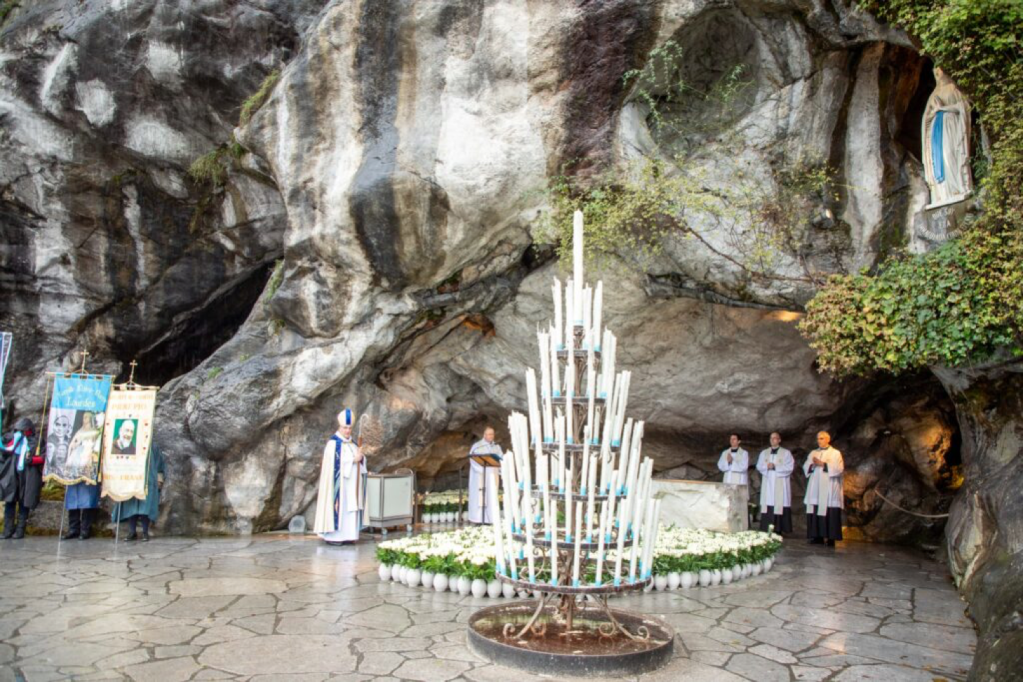
Outdoor Mass at the Lourdes’ Grotte de Massabielle on the 8th of December.

Photo source: https://www.lourdes-france.com

This is perhaps most fulsomely expressed at Lourdes, whose basilica is dedicated to this particular liturgical event. It was at Lourdes that the apparition of the Virgin Mary said to Bernadette ‘I am the Immaculate Conception’, and thus the feast has a special significance for this great sanctuary. The evening prior, a torch lit procession takes place follows Vespers and, on the day itself, white roses are placed within the grotto where the visions took place, followed by an Angelus, a Rosary service in the grotto, Vespers at the basilica and another torch lit procession around the sanctuary.[5] Although not strictly speaking in the Pyrenees, the Catalan capital of Barcelona traditionally has a wide array of shopfronts decorated with flowers and vegetation during Puríssima, and in the villages of Arenys de Mar and Arenys de Munt, children would smoke pipes with particular smoking mixtures made from local herbs, leading to the day being known as the ‘Mare de Déu Fumadora’.[6]

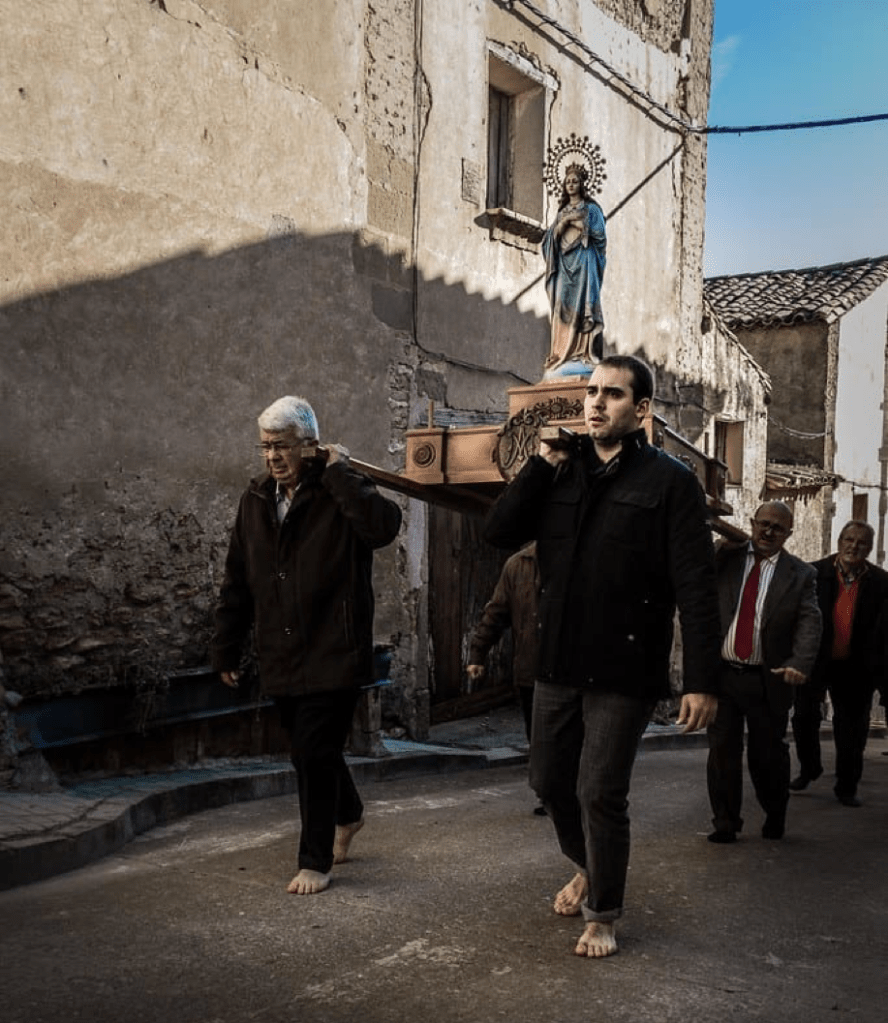
Procesión de los Descalzon in Lascellas.

Photo source: https://ganasdevivir.es

 In Lascellas (Huesca) this day is marked by a barefoot procession (Procesión de los Descalzon) in honour of a promise made by the village to the Virgin Mary during a time of plague in exchange for being spared. They carry an image of the Virgin of the Immaculate Conception, as well as images of Saint Anthony and the Virgin of the Rosary, and the barefoot receive a ‘panetic’ (a bread sprinkled with aniseed seeds) which is donated by various households in the village and blessed during Mass. It is during this time that the Tío de Nadal log in Huesca and the Catalan Pyrenees or the Nadau Tidunin the Pays du Luchon (Hautes-Pyrénées and the Haute-Garonne) and in the Val d’Aran, is brought inside, covered with a blanket and ‘fed’ until Christmas Day.


[1] This likely refers to the bitter snow in Advent, referred to in the following proverb.

[2] Saint Martin’s Day celebrates Saint Martin of Tours and falls on the 11th of November. It is also known as Martinmas and, in northern Europe, traditionally marked the end of Harvest season and the beginning of Winter.

[3] Capmany, Aureli, Calendari de Llegendes, Costumes i Festes Tradicionals Catalanes: De Juliol a Desembre (La Bisbal d’Empordà: Edicions Sidillà, 2019), p. 245. Translated by author.

[4] Saint Lucia or Saint Lucy (born c. 283, died c. 304) is a martyr and the patron saint of the blind, as well as seamstresses, tailors and dressmakers. According to the early Julian calendar, her feast fell on the longest night of the year. This timing may have relevance to pre-existing celebrations and also to the symbolism of candles and lamps attached to Saint Lucia, not only in terms of her association with sight but also in dispelling darkness, as well as the root of her name luc– sharing that of the Latin for light, lux. ‘We must remember that I the Julian calendar, which preceded the Gregorian (introduced by Pope Gregory XIII in 1585), the solstice occurred on December 13, with the result that Lucy was linked to all the traditions involving the solstice. Thus it was said of Lucy that “she shed the light of her eyes on the long night of the solstice”.’ Lanzi, Fernando & Lanzi, Gioia, Saints and Their Symbols (Collegeville, MN: Liturgical Press, 2004), p. 90

[5] Dompnier, Bernard, Les Cérémonies Extraordinaires du Catholicisme Baroque (Clermont-Ferrand: Presses Universitaires Blaise-Pascal, 2009).

[6] Amades, Joan, Guia de Festes Tradicionals de Catalunya (Barcelona: Editorial Aedos, 1958), p. 145.

A Trip to Aínsa

Recently I undertook a brief trip to the village of Aínsa in Huesca (Aragon); this lovely village with its Medieval arcades, square and fortified walls is well-known in Spain and France for its picturesque situation however its history is also extremely interesting. Legend places its founding in 724 by King Garci Ximénez (about whom many legends exist, including his spontaneous election as king by a gathering of monks who had not conferred about their choice beforehand), following his alleged reconquest of the Cinca Valley from Islamic occupation. It is from this (debated) event that the County of Sobrarbe comes, the name deriving from a red cross appearing to the king above the branches of a holm oak before battle; ‘sobre arbre’, ‘above the tree’. The oak with a fiery cross above it became Aínsa’s coat of arms, and in the seventeenth century a covered cross was built just outside the town’s walls on the alleged site of the oaken vision.

Aínsa (stock photo, as the village was so busy on our visit I could not get a decent picture of the overall square!)

Aínsa is situated on a promontory above the confluence of the Cinca and Ara rivers, making it an ideal location for keeping watch of who is traversing the Cinca valley. Whilst no specific finds have been located on the site of the town, the valley and its surroundings possess a rich archaeological heritage stretching back to the Palaeolithic, particularly in the Vero Cultural Park, where rock art has been dated to 30,000 years BC. There are also a number of megalithic monuments in the broader area and Aínsa’s position is ideal for defence, making it extremely likely that it was settled in some capacity prior to King Garci Ximénez’s military endeavours. The Medieval village (which sits above several modern streets about the rivers’ banks) consists primarily of two parallel streets leading to the main square and the church, all of which are surrounded by eleventh-century walls. The square is arcaded on its northern and southern sides and, following a steep decline into poverty in the twentieth century from emigration, the loss of agricultural lands thanks to reservoirs and dams, the village has enjoyed a renaissance since the 1960s, when cultural and natural tourism begun to flourish in the region. This is also thanks to the creation of several national parks in the broader area, such as that of Ordesa and Monte Perdido, less than an hour’s drive away from Aínsa. Speaking of driving, the journey to and from Andorra was very beautiful, leading over the mountain port from La Seu d’Urgell to Sort, then via Tremp over a winding pass into Huesca, where Puente de Montañana, Benabarre and Abizanda led us through some stunning Autumnal scenery in the mountains, with churches and castles perched on almost every crag.

In Aínsa our first stop was a surprising one, at the Eco Museum. This museum is deeply tied into preservation efforts for the Quebrantohuesos (‘bone-breaker’ or the bearded vulture), and has dedicated many years to reintroducing these birds into various spots in the Iberian Peninsula via a novel system of hand-rearing chicks and using a vulture marionette, then releasing them into the wild at different points to reduce the risk of co-sanguinatity between birds. There were several lovely dioramas of Pyrenean fauna and one could even (quietly) visit an enclosure in which pairs of eagles, owls and vultures were kept whom had been injured, paralysed or in some way would not survive anymore in the wild.

An example of the diorama.

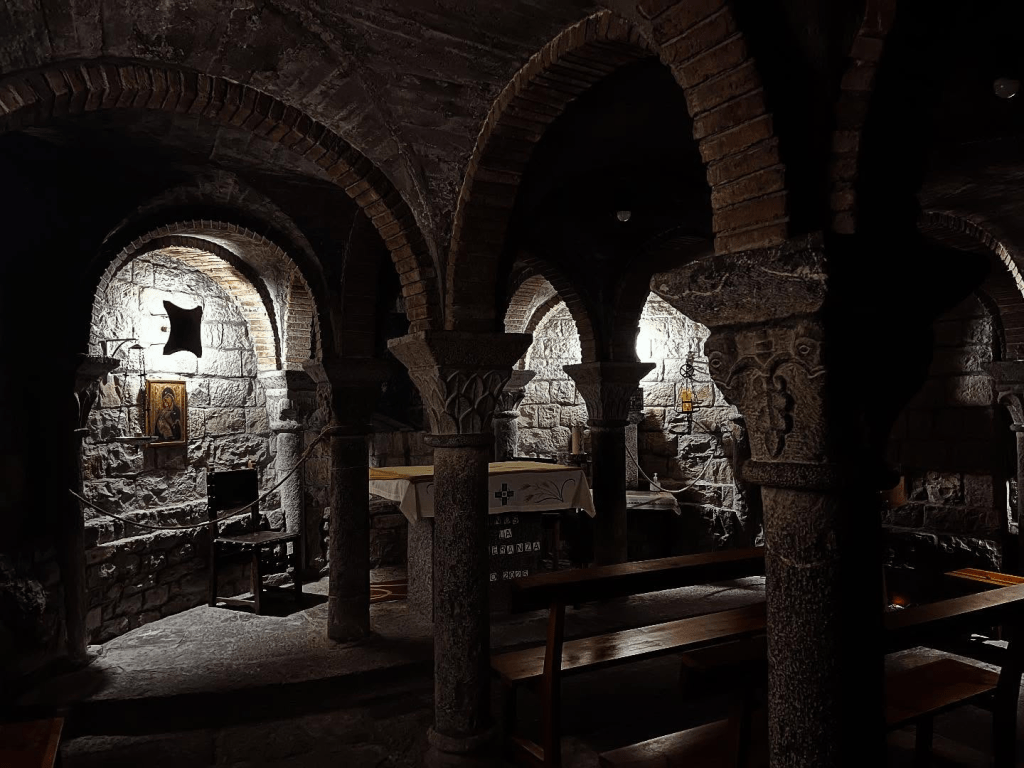
The collegiate church of Santa Maria possesses a very fine bell tower (with the most cramped stairs I have ever encountered, almost a crawl space in some parts), crypt and minute cloister. The church was completed in the mid twelfth century and consecrated in 1181, built in the Romanesque style, whereas the cloister was built in the fourteenth century, with enlargements made to the church in the sixteenth century with various chapels. It is an austere space with a thirteenth-century polychrome Virgin mounted in the apse and the crypt has many carvings on the capitals of its squat, smooth pillars. These are mainly reproductions of the originals, as the crypt was destroyed during the Spanish Civil War, a sad and regrettably not unusual phenomenon. The cloister was damaged at the same time but thankfully much of its original fabric survives and there are several small chapels within its space with central basins collecting water from the roofs, with which the various plants there are watered.

The church crypt with its numerous carved capitals.

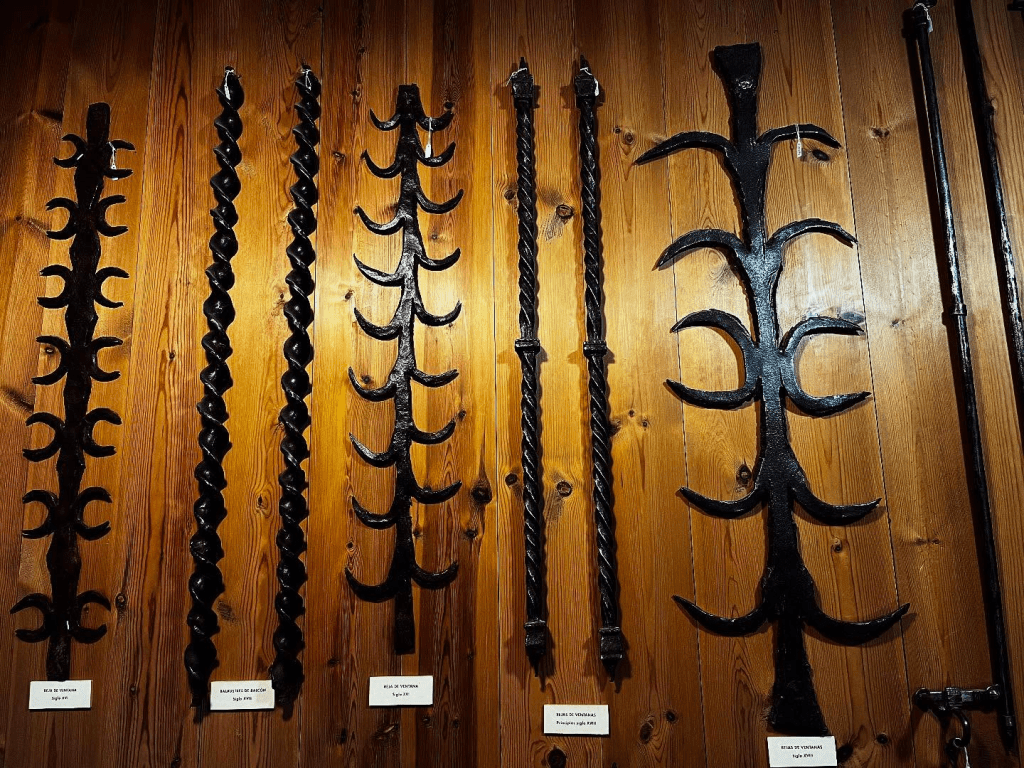
The Museum of Traditional Arts and Crafts has an extensive collection of ceramics, ironwork, wooden furniture and rush-woven baskets relating to local crafts and production; perhaps most impressive was the enormous collection of decorated locks and door-knockers, many of which bore decorative styles which have comparisons in Catalonia and Andorra. There were also a great many examples of furniture decorations in the form of symbols which can be found across the Pyrenees, such as the six-pointed Hexafoil, which featured on everything from cheese-presses to door panels and banisters. Finally, we visited the castle walls, the outer part of which can be walked along in the south and north-facing enclosure entrance to the village. The fortifications were first built in the eleventh century and then renovated and expanded in the seventeenth century, prior to the Treaty of the Pyrenees, at a time when the border between Aragon and France was a highly contested and flexible affair.

An array of traditional ‘jacket strippers’, used to prevent people gaining entry to a house through the smaller windows.

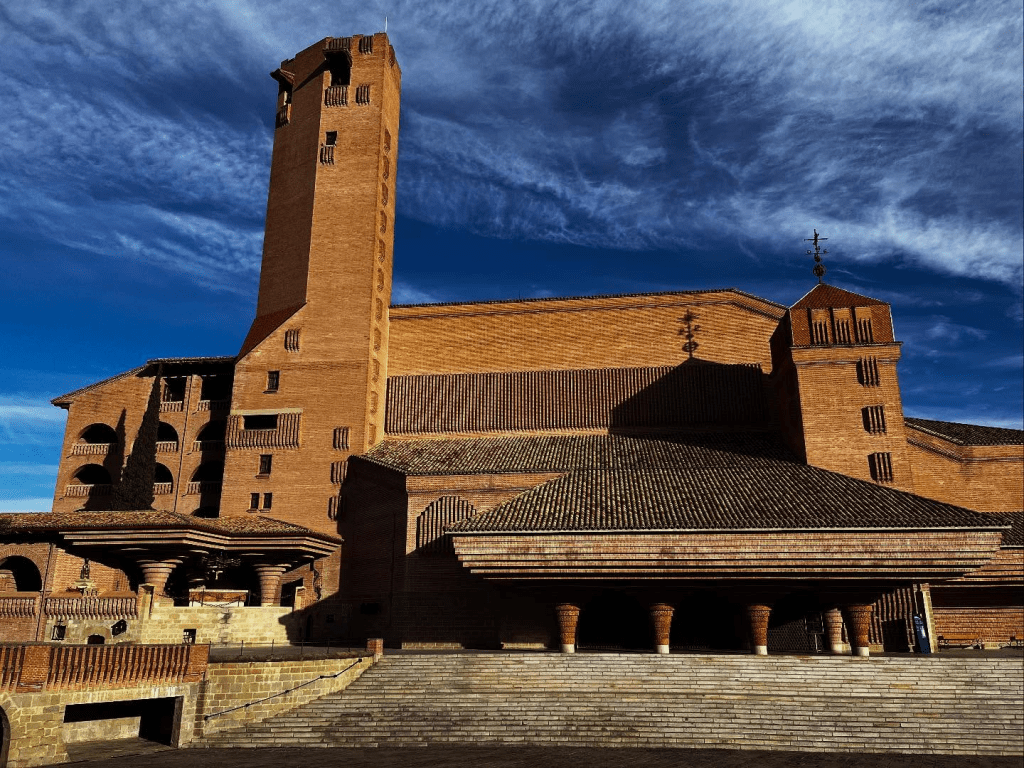
On the return to Andorra we stopped at the Sanctuary of Torreciudad, a massive complex of monumental brickwork constructed in the 1970s next to the original Medieval hermitage. The name ‘Torreciudad’ derives from an old watchtower built during the Islamic occupation of the region, located a few metres away from the old hermitage, which was constructed in Romanesque period. The Virgin of Torreciudad dates from the period and is now housed in the modern sanctuary; it is one of the ‘Black Virgins’ of the Pyrenees and depicts the Madonna seated with Child, having been venerated by locals for the better part of a millennia. The founder of the Opus Dei, Josemaria Escriva de Balaguer, was taken as an infant to the original hermitage by his mother to cure him from a serious illness; this seems to have worked and he was taken back to his home in Barbastro, where he made a full recovery. In the 1960s Josemaria decided to build a new sanctuary to the Virgin of Torreciudad in gratitude, with construction taking three months, from January to April in 1970. Exposed brick is omnipresent and, to my mind, has a peculiar yet beautiful mix of almost Soviet monumentalism, neo-Byzantine curves and a sort of ‘Church Militant’ effect, like an updated version of those churches and cathedrals built following the Albigensian Crusade, designed to impress strength and order over heresy. The original hermitage is a small, quiet affair on a nearby promontory overlooking the azure waters of a reservoir, with scarred pews and the Moorish watchtower overlooking its vault and bell tower. In the distance, Mont Perdido and other peaks can be seen (with dustings of snow). It is an exceptionally beautiful situation and much recommended for a visit.

The new sanctuary of Torreciudad.

The original sanctuary of Torreciudad and the tower.

A long overdue update.

Greetings everyone. As has been obvious, this blog or newsletter has been silent for quite some time whilst I have been writing different books. I should like to reinvigorate things slightly with an update as to progress on various fronts. So far, all of my fiction work which was published in hardback form with Mount Abraxas Press has been republished by my own Mons Culturae Press in unlimited paperback format. Going forward, all my fiction will be available this way. Two novels have been completed and are awaiting the layout/editing process:

The Heights of Perfection‘ – the story of an invalid in 1930s Mayfair who dreams of travelling the Alps and uses his extensive library of Alpine literature to do so, driving him to the edge of insanity and over into a sublime realm.

Last Feet in the Lane‘ – a follow-up of sorts to ‘The Boughs and Byways of Ytene’, featuring an anthropologist in late 1990s England who wishes to delve deeper in Aubrey Winslade’s manuscript, the past and present of the Vagabond Trust, and the Matter of Albion.

Both will be published in early and late 2026 respectively. I will announce their publication here.

Also, the research book ‘Highly Holy‘ (dealing with the histories, cultures and traditions of Christianity in the Pyrenees) is on its penultimate chapter. I should have the writing finished by Spring 2026, looking to publish later that year.

Finally, I have set up a Goodreads profile for those who are kind enough to leave reviews/feedback on my work. It can be found here: https://www.goodreads.com/martinlocker

All of this is done in a DIY fashion (without, I hope sacrificing quality of research or story-telling), and so I have come to the realisation that I need to up my game in terms of self promotion; something I am not fond of but must be done. So if anyone has any suggestions as to reliable blogs, podcasts etc. (or individuals) who would be reliable reviewers for work both present and future, do let me know in the comments section below!

More to come, and apologies for the silence.

Over and out.

Martin.

Blog Update

As some may have realised, the blog has not been updated for quite some time. This is due to the focus of the project having shifted to books and (more recently) monographs rather than short articles. This is the approach which will be continued into 2023, however some bite-sized posts will also emerge on highly specific subjects related to the Pyrenees. It will also continue to be used to present short extracts from up-coming publications.

‘Bountiful Borderlands’ Extract #2: Chapter Two ‘Bane of the Izard – The Hunter’

Turning to wolves and bears first, these beasts were perennially seen as threats to livestock and people, and thus ruthlessly hunted with traps, rifles and spear-like contraptions. An excellent account of a village wolf-hunt in Landes (Pyrénées-Atlantiques) in the early 19th century provides details as to how such an event was organised. In this area, stilts (known as sangues) were used by some to cover the sandy ground and obtain good visuals of the prey or flock, and an accomplished user could move as fast as a trotting horse. In this case, the party set off at day-break, some on their sangues and all carrying rifles:

Every one being mounted on sangues, the appearance of the parties as they came in sight was extremely singular. Those at a distance seemed moving along high above the surface of the ground, and without any visible support; while others, surmounting a sandy knoll, continued to ascend long after the whole of their person had appeared above it. Some wore the sombre-coloured cloak and narrow-crowned hood, out of which it was almost ludicrous to behold a young face peeping; others wore their sheep-skin jackets with the wool outside, some black, some white, and all of the strangest cut imaginable.[1]

They arrive at the extreme end of a forest, in which the wolves are said to live, and they begin beating and guarding in order to flush out the animals:

Single files, from fifty to a hundred paces distant from each other, according to the inequality of the ground, but always within shot of any animal which might attempt to escape by breaking though the lines, were extended down each side of the forest, the side next the river requiring a less number to guard it that the other, as the wolf will not, unless hard pressed, take to the water. Along the upper end of the forest, that to which the wolves were to be driven, the files were placed closer, and the best shots of the district invariably occupy this, the post of honour. The sides and upper end of the forest being thus as it were secured, a line of beaters was drawn across the lower part of the wood. This party, always on foot, is generally composed of the youngsters of the canton, whose business it is to make more use of their lungs than of the old horse-pistols and carbines, with which a few of them are armed. Dogs, although sometimes useful in following a wounded animal, are seldom permitted to accompany the beaters, as they are never sufficiently well-trained to range close, but wandering ahead destroy the regularity of the battue. As the beaters advance, the files who have been guarding the sides of the wood fall into a line with them, so that, increasing in numbers as they go through the wood, they soon become so near to each other that not a single thicket or dingle, however small, escapes their search.[2]

After several hours, the beaters are visible as they make their way through the forest, and guns are checked and preparations are made for the breaking of the wolves from their sylvan cover. The first wolf to emerge escapes to the next woodland, avoiding the excited shots of the hunters, however the three others that are flushed out by the beaters are shot. Amusingly, during the shooting the Maire (mayor) tumbles to the ground screaming and then falls silent; much is made of this and everyone fears he is dead from a stray shot. It is revealed however that a bullet merely severed one of his stilts, and the fall to earth knocked him unconscious. This has been fortunate for the other wolves that broke cover, as during this confusion they manage to escape unharmed. Other animals are also killed by the beaters and guards during the hunt, and the author recounts of foxes, wild boar and roe deer as being among the prizes. After this everyone settles down to drinking brandy, eating and dancing, as well as a race to determine who is fastest on his sangues. The results are predictably chaotic, as one would imagine when combining brandy and stilt-racing, and are described in this charming passage:

I have already said that the sangues were from four to five feet in length; it may therefore be supposed that mounting upon such articles is no easy matter, without having a wall or bench from which to start. The usual mode of managing the affair by the Landais is to sit on the ledge of a window of the second story of their cottage, and there fastening on the stilts, walk away from the place; or a ladder is generally leaning against the walls of the cottage, up which they mount until sufficiently high to effect their object. Here, however, there were none of the usual facilities afforded for mounting; and every one was put to his wits to discover some method or other to get on his horse. The most active of the party having selected a pine which had a drooping branch, climbed on to it, and managed without much difficulty to effect their object. Several of the elderly ones, and some of the juniors, whose libations had placed their capacity on a level with that of their seniors, were not so successful. One heavy fellow, who had raised himself on the branch of a pine close to where we were sitting, had just succeeded in buckling on one of his stilts, when the branch on which he sat gave way. The leg with the stilt on was mechanically thrust out to break the fall, but the result was much the contrary. With only one support, a single stride was all that could be made, but that stride was an important one; for, unable to deviate from the direction in which the branch broke away, the heavy carcase of the fellow landed in the centre of a group whose advanced state of jollification altogether precluded their joining in the race. […] Another fellow had, in the hurry of the moment, carried off one of his neighbour’s sangues instead of his own, and did not discover the mistake until he had buckled them on, and thinking that all was right, started from his place of mounting. Then he found to his surprise that one stilt was half a foot shorter than the other, and that, accordingly, to balance himself was quite impossible. So away he went staggering and limping, endeavouring to describe a circle, so as to get back to the tree from which he had sprung. But the odds were against his succeeding. The shorter stilt having sunk in the hollow of a decayed tree root, the discrepancy of length became still greater; to recover his equilibrium was impossible, and he measured his length on the ground.[3]

After a few fights break out, one of which is settled with staffs, the race takes place across a river and a plain, and the winner is greeted with thunderous applause. This is also the only mention that I have found in any English account of the practise of sangues racing, hence its inclusion here. Murray also recounts the method used by a professional wolf and fox hunter using hounds, around Pau:

The wolves are frequently driven down from the mountains by the snow, and take refuge in the woods of the low country; and the peasants, when they see then, inform M. Dupont of their presence. The wolf is a more difficult customer to deal with than the fox. He is hardly ever killed by being fairly run down by dogs. Very few instances of wolves being so killed are known; although runs of this kind have been known to last a day and a night – the dogs following the same wolf for that length of time. On this account, the hunters always endeavour to wound or cripple him, so as to put him upon a more equal footing with the dogs; and, accordingly, every one, upon such occasions, is armed.[4]

Whilst Murray is not present for a wolf-hunt but rather a fox-chase, he does describe the pomp and ceremony with which this hunter dresses and enters through villages, announcing his arrival with a horn so that the locals might come and admire him in all his splendour, and it is likely that the same happened when Monsieur Dupont went chasing wolves. This is a very different affair to the Landais wolf hunt recounted above; here we can see overt displays of social status, potentially even paying clients, in a manner more akin to the aristocratic hunts of Fébus:

Afraid that we should not get out of bed early enough, M. Dupont had ordered his piqueur to come to our hotel about four in the morning and ‘blow us up’ with his great horn.[5] About five, the master and his hounds, and a party of French gentlemen arrived, and we, being all ready, joined them. […] Our master of the hounds, a most enormous man, could not, with jack-boots, great coat, blunderbuss, holsters and all, ride under one and twenty stone. He was mounted upon a small chestnut mare, with legs like those of an elephant, and it was amazing to see how she moved under the prodigious weight she carried. […] There are, – as I observed before, – generally, two of these abominable French horns in a hunting party, the one carried by the piqueur, the other by the master, or a friend. M. Dupont’s nephew was the bearer of this – to the ears of a sportsman – most disagreeable instrument; and he rode at the head of the party: while the piqueur, with the dogs and the other horn, brought up the rear. In this manner, we rode into the town of Tarbes, our leader halting at each turn or winding of the streets, and sounding his ‘Tantara’ for a few seconds; after he had been answered by the piqueur, with the other horn, from the rear, he moved on again, thus giving warning of our approach, and affording all the inhabitants plenty of time to come to their windows, and admire us. Glad were we, when the neighbourhood of our hotel permitted us to escape.[6]

Again, whilst this relates specifically to a fox hunt, it is more than likely that for this gentleman, such grandeur would accompany a wolf hunt, also potentially with a team of helpers and participants which he would lead through villages and out to the forests.

Violant i Simorra describes two methods of wolf hunting in the Pyrenees. One involved a group of men running around a series of mountains shouting a whistling to drive the wolves towards a party of armed hunters. These men would be waiting at the other end of the route ready to shoot the creatures on sight. Another method involved driving the wolves towards either a gorge or an enclosed field. The latter was known as a lobera and would narrow to a trap concealed with branches where, occasionally, a lamb would be tethered as bait. Boar hunts would sometimes follow a similar course in the Pallars (Catalonia); hunters armed with axes and shotguns would be posted throughout the mountains, waiting and watching while their dogs would root the boars out from their shelters. Once the boars had been driven out they would be chased into a ravine or a cave where the axes and shotguns would be employed. In the Valle de Hecho (Huesca), two scouting groups would run along the flanks of the mountains tracking the boars while a reseguero (aided by dogs) would ensure that no boar could turn back and escape, using screams and whistles.[7]

In the Ariège there used to exist a formula for increasing the potency of a hunter’s hounds. In Loubens, the several hunters would turn up a sleeve of their jackets or coats, cross themselves and repeat:

Cassaïre de lardos                      Chasseur de chair                       Hunter of flesh

Autant de lebres tuaras,               Autant de lièvres tu tueras,           As many hares that you kill,

Coumo m’en daras.                     Autant tu m’en donneras.              As many you will give me.

At the end of the hunt, usually in the evening, the hunters would wash the dogs’ muzzles in a stream, to rid them of the magic.[8] Traditionally the most common hunting dog in the French Pyrenees is the Braques Français, the original breed of which dates back to the 15th century. Typically a pointer, it is also employed in flushing, retrieving and even trailing game, and over time has evolved into two distinct regional varieties: the type Gascogne and the type Pyrénées. The former is larger and slower, the latter is smaller and swifter. It is possible that the breed is descended from the Spanish Pachon Navarro. Whilst the French Mastiff was favoured during aristocratic hunts of boar, deer, wolves and bears, the Braques Français is a versatile breed that can cover many roles and also would have been more readily available to the peasant hunter.[9]

A more formidable but no less enthusiastically pursued ‘threat’ was the Brown Bear; so much so, in fact, that by the mid 20th century it was practically extinct in the Pyrenees and is only recently making a return via controversial conservation schemes. As Hemingway noted, ‘Every year hunters kill dozens of bears in the Pyrenees mountain fastness’.[10] Mention has already been made earlier in this chapter of the rewards offered by monastic institutions for the slaughter of bears (and wolves), and of the Medieval views towards bears. Interestingly, this is belied by the focus on the bear in various traditional festivals throughout the Pyrenees, in which it is a major character and indicates a profound presence in the Pyrenean psyche, myth and folklore.[11] This, however, did not stop hunters from pursuing the bear, killing the adult and in many cases taking the cubs to sell to bear trainers in the Ariège; the hamlet of Ercé, for instance, was famous for its bear school during the 19th century, and the Haute-Couserans was home to many of the best bear trainers:

Visitors to the remote region of the Couserans region were often alarmed to see children playing with bear cubs. The cubs were always orphans. The hunter would wrap himself in a triple layer of sheepskins and arm himself with a long knife. When the bear reared up and hugged the woolly human, the hunter pushed its jaw aside with one hand and stabbed it in the kidneys with the other, remaining locked in the embrace until the bear collapsed. The cubs were taken to the village where they grew up with the children and the livestock until they were old enough to be trained.[12]

The Ariège was quite unique in this respect, as it produced the best orsalhèrs, and by 1800 up to two hundred of these bear-trainers/handlers existed in just two valleys, those of Alet and Garbet. One noble from the Comminges (Haute-Garonne) remarked in the late 19th century that each time a bear cub was captured, it would go to the Ariège. The cubs would be raised in the house like a dog, and the mistress of the house would feed them with bottles, and in one case from Ustou, even breast-feed them.[13]

Despite this apparent affection, one could almost call bear hunting an obsession in some areas of the Pyrenees. To give an example of the extent to which bears were hunted, we can turn to Andorra, which traditionally has been one of the richest areas for bears. Records indicate that between 1520 and 1854, five hundred and thirty-seven payments were made to bear hunters upon the presentation of their kill; this figure was actually exceeded by the Béarnaise hunters of the Ossau valley (Pyrénées-Atlantiques) during the same period. The records for the parish of Andorra la Vella over twenty years at the start of the 19th century give an idea of the frequency in which bears in this valley were killed; three in 1800, six in 1802, three in 1803, three in 1805, four in 1806 and 1808, ten in 1812, three in 1816 and 1818, seven in 1819 and three in 1820. Even if these figures represent a particularly populous region for bears, if one extrapolates this over the centuries, and indeed over the various valleys of the Pyrenees, it is unsurprising that the population was decimated by the 1950s.[14]


[1] Murray, Hon. James Erskine, ‘The Pyrenean Hunter: Wolf-hunting in the Landes’ in Bentley’s Miscellany, Volume 4, J. M. Lewer (ed.) (New York, NY: Jemima M. Mason, 1839), p. 499.

[2] Ibid, p. 500.

[3] Ibid., pp. 504 – 505.

[4] Murray, James Erskine, Summer in the Pyrenees, Vol. II (London: John Macrone, 1837b), p. 156.

[5] A piqueur is an attendant that directs the hounds in a hunt.

[6] Murray, 1837b, pp. 157 – 160.

[7] Violant i Simorra, Ramon, El Pirineo Español (Barcelona: Editorial Alta Fulla, 1986), pp. 360 – 362.

[8] Vézian, Joseph, Carnets Ariégeois (Présentés par Olivier de Marliave) (Bourdeaux: Éditions Sud Ouest, 2000), p. 104.

[9] Clark, Anne Rogers & Brace, Andrew, The International Encyclopedia of Dogs (Hoboken, NJ: Howell Book House, 1995), pp. 146–147

[10] Hemingway, Ernest, Hemingway on Hunting (New York, NY: Scribner Classics, 2001), p. 160.

[11] For a detailed study of the bear in the Pyrenees, see Chapter Three of Locker, Martin, The Tears of Pyrene (Andorra: Mons Culturae Press, 2019).

[12] Robb, Graham, The Discovery of France (London: Picador, 2007), p. 169.

[13] Casanova, Eugeni, L’Ós del Pirineu: Crònica d’un Extermini (Lleida: Pagès Editors, 2005), p.197. This book contains a wealth of statistics and interviews with hunters, and is recommended for an in-depth analysis of bear-hunting in the Pyrenees.

[14] Casanova, 2005, p.197.

Audio of ‘Tears of Pyrene’ Talk 21/01/2020

I just finished giving a talk on the recent ‘Tears of Pyrene’ book at the Andorran International Club. It’s quite broad brush, but goes into three key themes. The talk was filmed however the video is being awkward so audio is all that can be salvaged right now (the end is cut off but that’s basically the end anyway), and can be downloaded here <<< Tears of Pyrene Talk 21:01:2020.mp3>>>


Fairy-Lore of the Pyrenees Part II

Carrying on from the previous article, below we will delve deeper into the existing fairy-lore of the Pyrenees, which is under-explored in the ethnographic record in the 20th century. We will read sweeping examinations by no less than Charles Dickens (!), local enthusiasts and French local anthologies from 1909…


Firstly, it is interesting to note that in the French Pyrenees, Les Blanquettes (as examined in the previous article) were also locally known in the Béarn as Hados, and the name of the village of Belhades (Petite Leyre) may derive etymologically from belle hados (beautiful fairy).


Also, coincidentally, from an anthology dating back to 1870 we can find the illustrious Charles Dickens summarising Pyrenean fairy-lore thus, which must be admitted is not in a uniformly complimentary fashion:

‘As to the fairies, they are still visible to the unsophisticated Pyreneans, and they sit at the entrance of their grottos, combing their golden hair, much as they used to in our old nursery days. He who tries to reach them, perishes; should he find favour in their eyes, he disappears for ever from this world. If, however, a mortal releases a fairy from a spell, she sometimes lends him her magic wand, with which he can obtain whatever he desires. In the Barège valley the fairies inhabit the interior of the Pic de Bergons, and flax placed at the foot of their abode is instantly spun into the finest thread. In the valley of Barousse they go from house to house on New Year’s night, carrying happiness in their right hands, and sorrow in their left, under the form of two children, the one crowned with flowers, the other weeping. To propitiate them a repast is spread in a room with open doors and windows, and on the morrow the master of the house distributes the food among his family and servants, with good wishes for the New Year. Occasionally, however, tricks may be played upon female fairies with impunity, as when one was caught in a pair of trousers left in a garden for this purpose’.[1]

Also discovered from much rootling around is a list of several different types of fairy attested as living around French Pyrenees. It should be mentioned that no sources can be found for this list, attributed as it is to a local within the Hautes-Pyrénées, however oral history is a vital part of ethnographic research and as such it deserves to be included:

Balandrou (Hautes-Pyrénées) – This creature allegedly cultivated an apple tree whose golden fruit would bestow immortality.

Dames Blanches (Aude & Hautes-Pyrénées) – These live within the castles of Puivert and Mauvezin.

Encantadas (Vaucluse) – These fairies dwell around Rousillon near caves, rivers and waterfalls, and also deep within the woods, and they dream of being human.

Fada (Ariège) – Similarly these fairies wish to be human, and protect hordes of gold.

Goga (Catalonia) – This fairy lives in Gariotxes beside a river, where she washes her clothes. Anyone who manages to steal these clothes by moonlight is said to become prosperous in the future.

Hada (Gascony) – These creatures have webbed feet and live near water or in caves. They have been known to help farmers, and also in the Ariège they are said to advise on crops.

Nore (Aude) – This fairy was said to live atop the peak of Bugarach.

Outasuna-Maithagarria (Basque) – Linked to hunting, she appears riding a deer and resembles the goddess Diana.

Sarrasine (Ariège) – Dwelling in the rivers of the Salat valley, they have webbed feet.

Parques de la Lune (Ariège) – These nocturnal fairies dwell at crossroads in the Arize Massif, and are said to hold the destiny of both the living and the dead.

Romula (Ariège) – This fairy is said to live in the Grotte du Camaillot near St-Jean-de-Verges, and she charms both humans and animals with her singing. She crosses the river of the dead and was the deity of that river (more about this creature below).

Roneca (Aude) – A terror of children, she is said to haunt various valleys in the Aude with a candle and a large sack on her back to collect infants who are bad.

Saurimonda (Aude) – Dwelling in the valleys of this area and also around the Montagne Noire, she is said to be beautiful with blonde hair and is popularly linked to both gold and the sun. Nuggets of gold in rivers are attributed to her dropping her comb in the waters.[2]


The legend of Romula is tied to a large stone head near the Roc d’Huile, seen when crossing the river at Saint-Jean-de-Verges (whether it is still there I cannot verify). The head is so large that it would take a dozen wine barrels to fill it where it hollow. In order to find out the name of this alleged ‘giant’, one has to ask Romula, who lives in the Grotte du Camaillot. She is in charge of checking the ‘passports’ of those who cross the river in Death’s boat, and has long golden hair and silver eyes. The head is said to date from the Roman era, and the legend linking Romula to this monument runs this:

At a time when the Romans had pitched their tents at the Massif du Plantaurel, Romula (whose name is eerily similar to Romulus, one of the twin founders of Rome) was awaiting Death’s boat on the landing stage at the Roc d’Huile. Within the boat were two people, Fortunatus and Infortunatus. Fortunatus had all his papers in good order and was allowed to pass, however Inforunatus was not so lucky, as his passport lacked the appropriate signature. Additionally, he was an infamous bandit and had been a cruel man during his lifetime, making the lives of local people wretched. Romula reproached him, showing him all that he had done badly in life, his robberies, bluster and injustices and condemned him to remain standing where he was. The water around him turned to oil, which became alight, the flames melting the rock around the man. By the time that the water had put the flames out, the man had become stone, and his enlarged form that had fused with the rock stood stolidly in the earth, his legs sunken into the soil, and only his head remained above ground… [3]


There are more fairy stories to follow in Part III, which will arrive in good time.


References

[1] Dickens, Charles, ‘Superstitions of the Pyrenees’ in All the Year Round, Vo. 3, No. 23, January Ist, 1870, p. 113.

[2] Translated from the French from this source: https://aubedesfees.forumactif.fr/t480-les-fees-des-pyrenees

[3] Anon, Almanac Patoues of the Ariejo (Fouix: Imprimario de Gadrat Ainat), 1909.


Fairy-Lore of the Pyrenees: Part I.

Fairy-lore, at least as understood within the 18th/19th century romantic context as so popularised by works such as those of the Grimm brothers within ethnographic literature, is curiously rare within the Pyrenees, at least within the character seen within mainland France and as recorded by Thomas Keightley.[1] Some examples do however exist, hidden away within caves, forests and mountain peaks, and there are presented below (Part I) three of these scarce examples, as recorded within travelogues and legendariums from this period. In Part II, further examples will be presented and dissected in relation to broader European fairy-lore.

It may be worth briefly qualifying what constitutes a ‘fairy’ or ‘sprite’ within ‘traditional’ European folklore. Generally (and this term is used advisably), this refers to some manner of natural spirit (usually small in stature) that personifies some manner of genius loci, and can be said to reach back to a reflection of pre-Christian belief in a spirit of place, minor ‘Pagan’ deity, or associated household spirit that could be both puckish, malign or benign, as so-whether it willed. Typically, they are etymologically linked to the concept of ‘small-folk’ in various ethnographic contexts, they inhabited the margins of human/natural interaction, both aiding, abetting and harming, in the manner of the ‘elves’ of folk belief, and within the 19th century they became transformed into the winged creatures so beloved of folklorists today. It is of course, within the space of a short article, impossible to trace back into the dim past the origins (in a Pyrenean context at least, although this may be the subject of a future volume) of the various and curiously scarce ‘fairy’ motifs within the Pyrenees, but it is worth recording some of the most interesting examples below. It is also worth noting that, within the French context at least, these beliefs have all but been eradicated.

Beginning within the French cultural regions of the Pyrenees, Les Blanquettes is a local term in the Haute Pyrenees for fairies, who are attributed with the power to raise storms, bring luck or misfortune to people, and are said to live in the interior of the Pic de Bergons, where they spin flax into fine thread.

The peasantry have been careful to prepare in a clean and empty chamber, the repast which they wish to offer to their guests. A white cloth covers the table upon which is placed a loaf, a knife, a jug of water, or of wine, with a cup and a candle in the midst. They believe that those who offer the best food, may hope to have their herds increased, their harvests abundant, and that marriage will crown their dearest hopes; but those who fail in these attentions to the fairies, and who neglect to make preparations worthy of the spirits who come to visit them, may expect the greatest misfortunes; fire will consume their dwellings, wild animals devour their flocks, hail will destroy their harvests, or their infants die in the cradle. Upon the first day of the year, the father, the eldest person, or the master of each house, takes the bread which has been offered to the fairies, breaks it, and after having dipped it in the water or the wine, contained in the jug, distributes it among the family, and also among the servants; after this they wish each other a good year, and breakfast upon the bread.[2]

Additionally, in the Bearn valleys, Les Blanquettes are also said to dwell in cavern mouths, mountain peaks, dress in white and often appear in a circular formation. Sadly, when asked at the time that this was reported, the local consulted said that he believed that these were only shadows, and thus that fairy-lore in that area was almost dead.[3]

There also exists a very specific legend from this region, pertaining to the Abadies family of Adast in Cauterets (Hautes-Pyrenees) with a domestic fairy, the fairy Abacia:

In the days when the fairy Urganda (one day old, another young) had her favourite among certain knights-errant whom she especially protected; when the fairy Monto, foundress of the city of Mantua [Lombardy, Italy], changed herself into an adder once a week, and Melusina, from the highest tower of the ancient castle of the Lusignans, announced with mournful and piercing shrieks their destruction and the ruin of the royal house; beneatha  hillock to the south of Adast, in the valley of Lavedan, the fairy Abacia remained enchanted in a fountain, which is no longer on, being at this day dry.

Tradition has not told us whether she was of the first, the second, or the third order of fairies; but Desinty, more powerful than the all, had carefully assigned to each the part she had to perform on earth, and it was written in her immutable decrees, that the fairy Abacia could only be disenchanted by a man not married, who was fasting, and yet had eaten. How many years elapsed before any one thus qualified appeared to release the imprisoned fairy, tradition has also forgotten to inform us.

However, it so happened that, towards reaping tie the youngest heir of the house of Abadie of Adast went abroad into his harvest fields, having for his companion the heir of Vignaux and Natala; and going in to the one where the fountain was with the fairy Abacia hidden under its waters, took an ear of corn, and breaking a grain between his teeth, cast it away without swallowing it.

At the same instant a young and beautiful woman stood before him, who, fixing on him the look which especially belongs to fairies, said in the sweetest of voices, “You have disenchanted me, and ought now to take me as your wife. Do you consent?” The young man, enamoured of her beauty, readily agreed. “My fate (she added) still depends on another engagement. Promise that you will never call me ‘lady’, or ‘lady of the water.’” He promised.

Two children, beautiful as angels, were the fruits of this union; every thing prospered in their happy home; but at an epoch, of whose date there exists no trace, it happened that the husband went up to see his hay cut on the summit of the mountain neighbouring to Cauteretz. As he returned in the evening with his servants, he saw with astonishment and anger, that the unripe grain of his fields had been cut down and piled in shocks; and his wrath redoubled  on arriving at his house he learned that it had been done by his wife’s command. He refused to listen to the gentle explanations which she would have given him; and at once to humiliate and punish her, cried out, “Lady – lady of the water!” The fairy instantly disappeared.

Then did he weep, groan, and utter bitter cries; but he was destined never to behold her more. Sometimes, when he was absent, she would come and embrace her children, combing their hair, and always with a golden comb.

One evening when she was alone with then, she said, and her tears fell as she spoke, “It is owing to your father’s perjury that I have not done for you all that my power as a fairy might have enabled me to undertake, and now my destiny calls me into another region; but from thence I shall watch over you. Love virtue, walk in the paths of honour, and learn what I am permitted to disclose to you of the secrets of futurity. Know, that one of your descendants will have much renown, and that a war-like and illustrious nation of the north will call him to reign over their nation”.

Having thus spoken, the fairy Abacia disappeared – and for ever![4]

Within this we can identify a few key themes that emerge in various ‘fairy’ tales across Western Europe, namely the disenchanting of a fairy via a man, the marriage that ensues, the bearing of children from the union, the ‘profane name(s)’ that must not be uttered, the subsequent uttering and the disappearance thereupon by the fairy wife. An additional note of interest is the mention of a golden comb – again, a typical feature of fairy-lore.

Moving across the granite Pyrenean spine, into the Basque Country, we find several examples of ‘Fairy’-lore, as recorded in the excellent Rev. Wentworth Webster’s ‘Basque Legends’.[5] Particularly of note is the legend of ‘The Lady Pigeon and Her Comb’, accompanied as it is with an interpretation:[6]

A mother and her son scratch a meagre existence, so much so that the son decides to venture off to make a living, and comes across a forest that lies a considerable distance away. Within the forest he finds a castle and, knocking upon the door, he is answered by a Tartaro.[7] Upon revealing the nature of his wretched state, the boy is spared by the giant, and given a very specific task, whose nature is strangely charitable. He is to leave the area in a few days and lie in wait for three young ladies who bathe in the giant’s garden. The boy is charged with stealing the middle of the three ‘pigeon cloaks’ that are discarded by the ladies whilst they bathe, upon which the lady whose cloak is stolen will be forced to remain in the water and promise to help the boy always. The boy thus does as he is told to, and the outcome is that the boy ventures, with an assurance of employment, to the father of the lady’s house the next day.

The father informs him that there is much work to do, much of it manual, and indeed much of it overwhelming: to pull up oaks by their roots, cut them into lengths, sort branches from trunks and roots. After he must plough, harrow and sow the land with wheat, finally creating a small cake of the self-same wheat by midday, lest he be killed.

The boy agrees, yet goes back to the forest to muse, pensively, upon which the fairy lady appears to him assuring him of her help. In order to do so she throws her comb into the air, utter various incantations which will mimic the workload of the boy, including the creation of the cake. By noon the cake is ready, which he races to take to the father. The father however is suspicious, and says to the mother ‘Be careful he is not in league with your daughter!’. I now defer to the legend itself:

His wife says to him, “Take care that he is not in league with your daughter.”

The husband says to her, “What do you mean? They have never seen each other.”

This husband was a devil. The young lady told our lad that her father is going to send him to fetch a ring in a river far away. “He will tell you to choose a sword from the midst of ever so many others, but you will take an old sabre and leave the others.”

The next day his wife told him that he ought to send him to fetch a ring which he had lost in the bed of a river. He sends him then, and tells him that he must choose a sword; that he will have quantities of evil fish to conquer. The lad says to him that he will not have those fine swords, that he has enough with this old sabre, which was used to scrape off the dirt.

When he arrived at the bank of the river he sat there weeping, not knowing what to do. The young lady comes to him, and says:

“What! You are weeping! Did not I tell you that I would always help you?”

It was eleven o’clock. The young lady says to him

“You must cut me in pieces with this sabre, and throw all the pieces into the water.”

The lad will not do it by any means. He says to her:

“I prefer to die here on the spot than to make you suffer.”

The lady says to him, “It is nothing at all what I shall suffer, and you must do it directly–the favourable moment is passing by like this, like this.”

The lad, trembling all over, begins with his sabre. He throws all the pieces into the river; but, lo I a part of the lady’s little finger sticks to a nail in his shoe. The young lady comes out of the water and says to him:

“You have not thrown everything into the water. My little finger is wanting.” 1

After having looked for it, he sees that he has it under his foot, hooked on to a nail. The young lady gives him the ring. She tells him to go without losing a moment, for he must give it to the king at noon. He arrives happily (in time). The young lady, as she goes into the house, bangs the door with all her might and begins to cry out:

“Ay! ay! ay! I have crushed my little finger.”

And she makes believe that she has done it there. The king was pleased. He tells him that on the morrow he must tame a horse and three young fillies. 2 The lad says to him:

“I will try.”

The master gives him a terrible club. The young lady says to him in the evening:

“The horse which my father has spoken to you about will be himself. You will strike him with all your might with your terrible club on the nose, and he will yield and be conquered. The first filly will be my eldest sister. You will strike her on the chest with all your force, and she also will yield and will be conquered. I shall come the last. You will make a show of beating me too, and you will hit the ground with your stick, and I too will yield, and I shall be conquered.”

The next day the lad does as the young lady has told him. The horse comes. He was very high-spirited, but our lad strikes him on the nose, he yields, and is conquered. He does the same thing with the fillies. He beats them with his terrible club, they yield, and are conquered; and when the third comes he makes a show of hitting her, and strikes the earth. She yields, and all go off..

The next day he sees the master with his lips swollen, and with all his face as black as soot. The young ladies had also pain in the chest. The youngest also gets up very late indeed in order to do as the others.

The master says to him that he sees he is a valuable servant, and very clever, and that he will give him one of his daughters for wife, but that he must choose her with his eyes shut. And the young lady says to him:

“You will choose the one that will give you her hand twice, and in any way you will recognise me, because you will find that my little finger is wanting. I will always put that in front.”

The next day the master said to him:

“We are here now; you shall now choose the one you wish for, always keeping your eyes shut.”

He shuts them then; and the eldest daughter approaches, and gives him her hand. He says to the king:

“It is very heavy, (this hand); too heavy for me. I will not have this one.”

The second one approaches, she gives him her hand, and he immediately recognises that the little finger is wanting. He says to the king:

“This is the one I must have.”

They are married immediately. They pass some days like that. His wife says to him;

“It is better for us to be off from here, and to flee, otherwise my father will kill us.”

They set off, then, that evening at ten o’clock, and the young lady spits before the door of her room, saying:

“Spittle, with thy power, you shall speak in my place.” 2 And they go off a long way. At midnight, the father goes to the door of the lad and his wife, and knocks at the door.; they do not answer. He knocks harder, and then the spittle says to him:

“Just now nobody can come into this room.”

The father says, “It is I. I must come in.”

“It is impossible,” says the spittle again.

The father grows more and more angry; the spittle makes him stop an hour like that at the door. At last, not being able to do anything else, he smashes the door, and goes inside. What is his terrible rage when he sees the room empty. He goes off to his wife, and says to her:

“You were not mistaken; they were well acquainted, and they were really in league with one another, and they have both escaped together; but I will not leave them like that. I will go off after them, and I shall find them sooner or later.”

He starts off. Our gentleman and lady had gone very far, but the young lady was still afraid. She said to her husband:

“He might overtake us even now. I–I cannot turn my head; but (look) if you can see something.”

The husband says to her: “Yes, something terrible is coming after us; I have never seen a monster like this.”

The young lady throws up a comb, and says:

“Comb, with thy power, let there be formed before my father hedges and thorns, and before me a good road.”

It is done as she wished. They go a good way, and she says again:

“Look, I beg you, if you see anything again.”

The husband looks back, and sees nothing; but in the clouds he sees something terrible, and tells so to his wife. And his wife says, taking her comb:

“Comb, with thy power, let there be formed where he is a fog, and hail, and a terrific storm.”

It happens as they wish. They go a little way farther, and his wife says to him:

“Look behind you, then, if you see anything.”

The husband says to her: “Now it is all over with us. We have him here after us; he is on us. Use all your power.”

She throws again a comb immediately, and says:

“Comb, with thy power, form between my father and me a terrible river, and let him be drowned there for ever.”

As soon as she has said that, they see a mighty water, and there their father and enemy drowns himself.

The young lady says, “Now we have no more fear of him, we shall live in peace.”

They go a good distance, and arrive at a country into which the young lady could not enter. She says to her husband:

“I can go no farther. It is the land of the Christians there; I cannot enter into it. You must go there the first. You must fetch a priest. He must baptize me, and afterwards I will come with you; but you must take great care that nobody kisses you. If so, you will forget me altogether. Mind and pay great attention to it; and you, too, do not you kiss anyone.”

He promises his wife that he will not. He goes, then, on, and on, and on. He arrives in his own country, and as he is entering it an old aunt recognises him, and comes behind him, and gives him two kisses. 2 It is all over with him. He forgets his wife, as if he had never seen her, and he stays there amusing himself, and taking his pleasure.

The young lady, seeing that her husband never returned, that something had happened to him, and that she could no longer count upon him, she takes a little stick, and striking the earth, she says:

“I will that here, in this very spot, is built a beautiful hotel, with all that is necessary, servants, and all the rest.”

There was a beautiful garden, too, in front, and she had put over the door:

“Here they give to eat without payment.”

One day the young man goes out hunting with two comrades, and while they were in the forest they said one to the other:

“We never knew of this hotel here before. We must go there too. One can eat without payment.”

They go off then. The young lady recognises her husband very well, but he does not recognise her at all. She receives them very well. These gentlemen are so pleased with her, that one of them asks her if she will not let him pass the night with her. 1 The young lady says to him, “Yes.” The other asks also, “I, too, was wishing it.” The young lady says to him:

“To-morrow then, you, if you wish it, certainly.”

And her husband says to her: “And I after to-morrow then.”

The young lady says to him, “Yes.” One of the young men remains then. He passes the evening in great delight, and when the hour comes for going to bed, the young lady says to him:

“When you were small you were a choir-boy, and they used to powder you; this smell displeases me in bed. Before coming there you must comb yourself. Here is a comb, and when you have got all the powder out, you may come to bed.”

Our lad begins then to comb his hair, but never could he get all the powder out, such quantities came out, and were still coming out of his head; and he was still at it when the young lady rose. The lad said to her:

“What! you are getting up before I come.”

“And do you not see that it is day? I cannot stop there any longer. People will come.”

Our young man goes off home without saying a word more. He meets his comrade who was to pass the night with this young lady. He says to him:

“You are satisfied? You amused yourself well?”

“Yes, certainly, very well. If the time flies as fast with you as it did with me you will amuse yourself well.”

He goes off then to this house. The young lady says to him, after he had had a good supper:

“Before going to bed you must wash your feet. The water will be here in this big copper; when you have them quite clean you may come to bed.”

Accordingly he washes one, and when he has finished washing the other, the first washed is still black and dirty. He washes it again, and finds the foot that he has just well washed very dirty again. He kept doing like that for such a long time. When the young lady gets up, the gentleman says to her:

“What! You are getting up already, without me coming?”

“Why did you not then come before day? I cannot stay any longer in bed. It is daylight, and the people will begin (to come).”

Our young man withdraws as the other had done. Now it is the turn of her husband. She serves him still better than the others; nothing was wanting at his supper. When the hour for going to bed arrives, they go to the young lady’s room; when they are ready to get into bed, the young lady says to him:

“Put out the light.”

He puts it out, and it lights again directly. He puts it out again, and it lights again as soon as it is put out. He passes all the night like that in his shirt, never being able to put out that light. When daylight is come, the young lady says to him:

“You do not know me then? You do not remember how you left your wife to go and fetch a priest?”

As soon as she had said that he strikes his head, and says to her:

“Only now I remember all that–up to this moment I was as if I had never had a wife at all–how sorry I am; but indeed it is not my fault, not at all. I never wished it like that, and it is my old aunt who kissed me twice without my knowing it.”

“It is all the same now. You are here now. You have done penance enough; your friends have done it too. One passed the whole night getting powder out of his head, and the other in washing his feet, and they have not slept with me any more than you have. At present you must go into your country, and you must get a priest. He shall baptize me, and then we will go into your country.”

The husband goes off and returns with the priest, and she is baptized, and they set out for his country. When they have arrived there, she touched the earth with her stick, and says to it:

“Let there be a beautiful palace, with everything that is needed inside it, and a beautiful garden before the house.”

As soon as it is said, it is done. They lived there very rich and very happy with the old mother of the lad, and as they lived well they died well too.

It has been suggested that this myth relates to the age-old cycle of weather and fertility. Webster (1879) writes that the opening of the story represents man in misery, without the knowledge or aid of cultivation and agriculture. The old king is Winter personified, and his daughter is Spring, her golden comb being the sun. The young man ‘who, without her aid, can effect nothing, is man in relation to the frozen ground, which needs her aid to quicken it into fertility. It is the old Sun-god, the Cyclops, who tells him where to find, and how to woo, his fairy bride.’[8] However, in order to be married, he must acquire the skills of managing the forest, sowing and reaping corn, and creating the cake, all of which are only learned with the help of the lady: ‘The taming of the horses shows the need and help of domestic animals in agriculture. These things are necessary to be known ere spring can free herself from winter’s dominion and marry her chosen lover.’[9] Ultimately after the escape from her father (Winter) and the conjuring of vegetation, it is the swollen river and rains of Spring that sweep Winter away, however she is unable to enter the Christian land. This has been interpreted by Webster as the need of the natural powers for the civilizing effect of agriculture for their potential to be reached, and the man, scared by the prospect of such work, it lured back to nomadic, hunter-gatherer ways. He forgets his bride in the pleasure of the chase and spends the rest of the Winter hunting. However, the lure of the Spring, with her food in abundance draws man back into the world of agriculture, and he submits to her, the wedding of earth and husbandry ensues, and the warm glow of Summer can be looked forward to.

In Part II we will explore more fairy tales from the Pyrenees and delve deeper into their interpretations…


References:

[1] Keightley, Thomas, The Fairy Mythology : Illustrative of the Romance and Superstition of Various Countries (London: H.G. Bon, 1870).

[2] Murray, James, A Summer in the Pyrenees Vol. II (London: John Macrone, 1837), p. 173.

[3] Costello, Louisa Stuart, Béarn and the Pyrenees, Volume 2 (London: Richard Bentley, 1844), p. 335.

[4] Chatterton, Lady Georgina, The Pyrenees: With Excursions into Spain, Volume 2 (London: Saunders & Otley, 1843), pp. 208 – 211.

[5] Webster, Wentworth, Basque Legends (London: Walbrook & Co., 1879).

[6] Webster, 1879, pp. 120 – 132.

[7] This is a cyclopean giant frequently found within Basque mythology.

[8] Webster, 1879, p. 131.

[9] Ibid.

Book Extract #6

Here is the final extract from the forthcoming book ‘Tears of Pyrene’. In this we examine some of the Medieval and Early Modern events that shaped the cultures and peoples of the Pyrenees:


Pilgrims and Bandits

During the Middle Ages, the Kingdom of Navarre straddled the Pyrenees, and passed between several dynasties, all of which left their influence on the territory.[1] Originating as one of the ‘buffer states’ formed by Charlemagne, mentioned above, to protect the Pyrenees from Moorish attacks, the Navarre as a kingdom and a region has centred around Pamplona since its inception. Its borders ebbed and flowed from the 10th to the 20th centuries, being controlled by Basques, the Crown of Aragon, the Counts of Champagne, the dynasties of Foix and Albret variously, until the Treaty of the Pyrenees in 1659, which at least placed it beyond the reach of French claims.[2] [3] Despite changing rulers and territorial shifts, one aspect remained constant for much of the Medieval period in the Navarrese Pyrenees, and that was the flow of pilgrims following the ‘French Route’ towards Santiago de Compostela, and the relics of St James.

By the 12th century, the cult of St James at Santiago de Compostela was drawing between half a million and two million people each year.[4] Roughly five primary routes had come into favour during the Middle Ages, at least three of which converged at Roncesvalles before plunging down into the Pyrenean foothills towards Pamplona, generating a steady stream of human traffic over the Pyrenean pass between St-Jean-Pied-de-Port (Pyrénées-Atlantiques) and Roncesvalles (Navarre). So popular was the route, that one of the first examples of a tourist guidebook originates from the 12th century and addresses the best routes to take when travelling to Santiago de Compostela. The Liber Sancti Jacobi [5] was likely written between 1140 and 1150, and is filled with advice on the routes, landscapes, hostelries and peoples encountered along the Camino de Santiago de Compostela. One lengthy extract in particular is worth quoting, due to its description of the landscapes and dangers awaiting pilgrims in the Pyrenees from unscrupulous toll-collectors in the various passes that brought people to Roncesvalles:

Then, round the pass of Cize, is the Basque country, with the town of Bayonne on the coast to the north. Here a barbarous tongue is spoken; the country is wooded and hilly, short of bread, wine and all other foodstuffs, except only apples, cider and milk. In this country there are wicked toll-collectors – near the pass of Cize and at Ostabat and Saint-Jean and Saint-Michael-Pied-de-Port – may they be accursed! They come out to meet pilgrims with two or three cudgels to exact tribute by improper use of force; and if any traveller refuses to give the money they demand they strike him with their cudgels and take his money, abusing him and rummaging in his very breeches. They are ruthless people, and their country is no less hostile, with its forests and wildness; the ferocity of their aspect and the barbarousness of their language strike terror into the hearts of those who encounter them. Although they should levy tribute only on merchants they exact it unjustly from pilgrims and all travellers […] Still in the Basque country, the road to St James goes over a most lofty mountain known as Portus Cisere [Pass of Cize], so called either because it is the gateway of Spain or because necessary goods are transported over the pass from one country to another […] From the summit can be seen the Sea of Brittany and the Western Sea, and the bounds of the three countries of Castile, Aragon and France […] On this mountain, before Christianity was fully established in Spain, the impious Navarrese and the Basques were accustomed not only to rob pilgrims going to St James but to ride them like asses and kill them. [6]

Summer was an especially popular time for people to travel, due to the weather which would have been a major concern for those crossing the Pyrenees, and also due to the July vigil held in honour of St James in Santiago de Compostela. At this time, many pilgrims would have been walking among the high pastures containing livestock, watched over by shepherds and cowherds, in the tradition of transhumance.[7] [8] An indication of the level of traffic that flowed largely over the Pyrenees to Santiago de Compostela was the reconsecration of the cathedral in 1207, as the fabric of the building had been destroyed by the crush of people around the altar, which had also led to bloodshed.[9] With both France and Spain remaining Catholic throughout the ensuing centuries, particularly from the 13th to late-18th centuries,[10] this steady stream of pilgrims crossing the Pyrenees, staying in local inns or purpose built pilgrim hospices, the area of Roncesvalles Pass has become synonymous with the tradition of pilgrimage, not least due to the impressive hospice, ossuary,[11] and collegiate church established there.[12] [13]

In the mid-14th century, the Black Death devastated Europe. The regions that surround and encompass the Pyrenees however were strongly affected; the Basque Country and Aragon lost up to two thirds of their populations, the Navarre lost roughly half, and Catalonia lost over a third. Huesca (Aragon) was particularly affected, as was the Bigorre region, and Urgell (Catalonia), where the Bishop of Seu d’Urgell died from the pandemic on 1st May, 1348. Several areas of the Pyrenees appear to have been spared however, likely due to their sparse populations and distance between settlements, which prevented the plague from spreading as effectively as in urban environments.[14]

Moving forward to the early-17th century, one figure emerges across the mountains in the Labourd (Pyrénées-Atlantiques) who would have a significant cultural and demographic impact in the Pyrenees, Pierre de Rosteguy de Lancre.[15] King Henry IV of France sent Pierre de Lancre, of the Parliament of Bordeaux, to pursue and eradicate witchcraft in the region, leading to dramatic hysteria and persecutions in Gascony. This had to dual effect of sending many local innocents to the stake, and also driving a wave of refugees from de Lancre’s witch hunts over into the Basque Country, many of which brought their own tales of Sabbaths and Inquisition ‘witch-lore’, that would have a lasting effect on how witchcraft was perceived in the region.[16] A further aspect of this was that the new arrivals, combined with existing fears and the European climate of malefic hysteria, formed the basis of what are now popularly known as the Basque Witch Trials, during which some seven thousand cases were investigated.[17]

Borders & Battles

The other event which shaped the Pyrenees in the 17th century was the Treaty of the Pyrenees, a document which in 1659 ended the war between France and Spain that had run from 1635.[18] The majority of the document was concerned with non-territorial matters, such as ‘princely alliances, commercial agreements, and the cession of jurisdictions along the French frontier of the Spanish Netherlands[19] and the Franche-Compté,[20] where the major battles in the Bourbon-Habsburg phase of the Thirty Years War had been fought.’[21] However it also finally demarcated the French and Spanish territories along the Pyrenean border, as the medieval states that preceded the Treaty rarely saw the Pyrenees as a boundary, often spanning the range and encompassing parts of what would become both France and Spain. Certain areas were contentious, such as the plains between Cerdanya and Roussillon and the area of Conflent, however the agreement was reached that these should be termed as French territories. However, it should be noted that the formally Catalan territories that extended into what are now the Ariège, Aude and the Pyrénées-Orientales (such as northern Cerdanya) are also frequently referred to as ‘Northern Catalonia’,[22] proving that the Pyrenean cultural memory is long indeed, and there are many examples of toponyms that hold Catalan signifiers. The final act to define several aspects of the Pyrenean Franco-Spanish border (particularly villages and townships on the border itself) would be signed in the Bayonne Treaties between 1856 and 1868. Thus, for the first time in its history, the Pyrenees found itself enshrined in law as a geographical territorial border between two nation states.[23]

The French Revolution in the late-18th century is well known for the violent social, political and economic upheavals that it wrought on the French population and the country’s institutions.[24] It is beyond the scope of this chapter (and indeed this book) to address this era in the detail it deserves, however there are elements that relate specifically to the Pyrenean populations that are of interest, crucially those relating to territory and autonomy. Broadly speaking, the system of provinces that existed under the ancien regime in which districts such as Languedoc, Béarn, Foix and Rousillon[25] enjoyed their own traditions, courts, taxation rights and a level of autonomy, thus making central French governance nearly impossible, was extinguished during the early years of the French Revolution.[26] Instead, the system of départements was introduced, forming along the Pyrenees the Pyrénées-Orientales, the Ariège, the Aude, the Haute-Garonne, the Hautes-Pyrénées and the Pyrénées-Atlantiques. The latter had a particular impact on the French Basque population, who had practised a system of foruak/fueros or ‘home rule’ in Labourd region for centuries,[27] and the new Jacobin state refused to recognise these liberties, suppressing the native government and declaring a new département, the Basse-Pyrénées (now the Pyrénées-Atlantiques) in 1790. The Lower Navarre also became amalgamated into this new territory, and the National Assembly decreed that French law superseded any prior autonomy in the area, despite Basque being the most commonly spoken language there.[28] This forced restructuring of Pyrenean territories, politics and national identities was followed in 1793 by the War of the Pyrenees, which saw the French First Republic fighting against the kingdom of Spain, itself allied with Portugal, in both the western and eastern Pyrenees until 1795. Already at war with Austria, Prussia and Sardinia-Piedmont, France occupied the Netherlands and declared its annexation, forcing a diplomatic break with Great Britain and, subsequently declaring war on Britain and the Dutch Republic, and then Spain; the battleground was to be the length and breadth of the Pyrenees. The French army was comprised of veterans, national guardsmen, and those conscripts that had been gained from the levée en masse which demanded all able-bodied men between eighteen and twenty-five to report for duty.[29] In Spain, the Army of Catalonia was deployed to the eastern Pyrenees, and on 17th April, 1793 it crossed the border[30] and captured St. Laurent-de-Cerdens (Pyrénées-Orientales). The Spanish forces advanced further over the next few months, winning the majority of their engagements, until they were defeated in the Battle of Peyrestortes (Pyrénées-Orientales) on the 17th September, which marked the Spanish army’s furthest incursion into French territory along the eastern Pyrenees. Various skirmishes, battles and repulsions followed in the Tech Valley, Villelongue-dels-Monts and Collioure, largely in Spain’s favour until the death of the commander of the Army of Catalonia, General Ricardos, on 13th March, 1974. After this, under the command of General Duggomier, the Spanish forces’ luck began to turn, culminating in the four-day Battle of the Black Mountain (Camany, Catalonia), 17th – 20th November, in which both the French and Spanish commanders were killed, followed by the French winning the Siege of Roses (Girona, Catalonia) in February 1975. After peace was signed, but before the frontline had heard the news, the Spanish recaptured Puigcerdà and Bellver. This would be the last act of the campaign in the eastern Pyrenees.[31]

Simultaneously to this campaign, battles between French and Spanish forces were also taking place in the western Pyrenees between 1793 and 1796. Following a small series of skirmishes by both forces in 1793, French forces seized both the Izpegi Pass and the Izpegi Bridge (Basque Country) on 3rd June 1794, with minimal losses. July saw the Armée des Pyrénées Occidentales[32]under Generals Moncey, Delaborde and Frégaville, attack and capture several positions in the northern Basque Country, culminating in San Sebastien on 30th July. Moncey then launched a series of offences from the Baztan Valley and Roncesvalles Pass towards Pamplona over the next year. By June 1795, Moncey had captured Vitoria and Bilbao, and when the Peace of Basel was finally signed on 22nd July and news reached the Armée des Pyrénées Occidentales, Moncey was preparing to cross the Ebro and take Pamplona.[33] Under the peace treaty, all areas in the Basque Country occupied by the French would be returned to Spain, which the Spanish Basques feared would bring to an end their self-government, much like their French counterparts under Jacobin rule.[34] In a twist of diplomatic fate, France and Spain would go on to create an alliance in 1796 with the Second Treaty of San Ildefonso, against the British Empire.[35]

Notes

[1] It should be mentioned that for the purposes of convenience, in Chapter Four the Navarre is grouped under the title of the Basque Country in terms of a cultural territory, despite being a separate modern region. The reasons for this are laid out in Chapter Four.

[2] The Treaty of the Pyrenees is outlined below due to its 17th-century chronology.

[3] Space in this chapter sadly limits the discussion and explanation of this fascinating kingdom, however for a detailed history of the Navarre, see: Bard, Rachel, Navarra: The Durable Kingdom (Reno, NV: University of Nevada Press, 1982).

[4] Rahtz, Phillip, and Watts, Lorna, ‘The Archaeologist on the Road to Lourdes and Santiago de Compostela’, in The Anglo-Saxon Church: Papers on History, Architecture and Archaeology in Honour of Dr H. M. Taylor, Lawrence Butler (ed.) (London: Council for British Archaeology, 1986), pp. 51 – 73.

[5] ‘The Book of Saint James’.

[6] Hogarth, James, (trans.), The Pilgrim’s Guide: A 12th Century Guide for the Pilgrim to St James of Compostella (London: Confraternity of St James, 1992), pp. 19 – 25.

[7] See Chapter Six for a detailed discussion of transhumance in the Pyrenees.

[8] Travel in the Medieval period was far more extensive than is commonly thought, for a thorough analysis of this subject, see: Ohler, Norbert, The Medieval Traveller, Caroline Hillier (trans.) (London: Boydell & Brewer, 2010).

[9] Gitlitz, David, and Davidson, Linda, The Pilgrimage Road to Santiago: The Complete Cultural Handbook (New York, NY: St Martin’s Griffin, 2000), p. 344.

[10] The author would suggest that the French Revolution (1789) very likely had an impact on the visibility of pilgrims along the ‘French Route’ to and over the Pyrenees, due to its systematic and institutional anti-clericalism, in much the same way that the Reformation in England (1529 – 1537) resulted in pilgrimage being seen as a ‘Papist’ activity, combined with the destruction of many shrines and pilgrimage centres throughout England.

[11] This ossuary allegedly contains bones from the Battle of Roncesvalles Pass in 778, between Basque forces and Charlemagne’s army, including, as myth would have it, those of the infamous Roland.

[12] As well as with Roland, Charlemagne, and the later Battle of Roncesvalles between Wellington and Bonaparte’s forces in 1813, discussed later in this chapter.

[13] For a detailed examination of the Camino de Santiago de Compostela from an archaeological perspective, see: Candy, Julie, The Archaeology of Pilgrimage on the Camino de Santiago de Compostela: A Landscape Perspective (Oxford: Archaeopress Archaeology, 2009). For an examination of pilgrimage, especially in Britain, that focusses on the issues of travel and experience, see: Locker, Martin, Landscapes of Pilgrimage in Medieval Britain (Oxford: Archaeopress Archaeology, 2015).

[14] Benedictow, Ole, The Black Death, 1346 – 1353: The Complete History (Woodbridge: Boydell Press, 2006).

[15] This character is discussed at length in Chapter Four with regards to witchcraft in the Pyrenees, and so will be discussed only briefly here, however his importance prohibits his exclusion from this historical discussion.

[16] See Chapter Four for a fulsome discussion on this topic, and a gazetteer of Pyrenean sites associated with witchcraft in folklore and legend.

[17] Henningsen, Gustav, The Witches’ Advocate: Basque Witchcraft and the Spanish Inquisition (1609-1614) (Reno, NV: University of Nevada Press, 1980).

[18] This information was taken from the following publication, which should be consulted for a detailed examination of the Treaty of the Pyrenees: Sahlins, Peter, Boundaries: The Making of France and Spain in the Pyrenees (Berkley, CA: University of California Press, 1989).

[19] This territory was held by the Spanish Crown from 1556 to 1714, containing large swathes of modern Belgium and Luxembourg, as well as areas in the southern Netherlands, northern France and western Germany, with Brussels as the capital. For more information see: Parker, Geoffrey, Spain and the Netherlands, 1559 – 1659: Ten Studies (Berkley Heights, NJ: Enslow Publishers, 1979).

[20] This is an historical region in eastern France that borders Switzerland, comprised of the modern Doubs, Jura, Haute-Saône and Belfort départements. A succinct history of the region is provided in: Rougebief, Eugène, Histoire de la Franche-Comté, Ancienne et Moderne (Paris: Ch. Stèvenard, 1851).

[21] Sahlins, 1989, p. 29.

[22] See: Collier, Basil, Catalan France (London: J. M. Dent & Sons, 1939).

[23] The degree to which this immediately affected the identities held by the various villages and towns in this liminal zone is debatable, forged as they were in hyper-local events and the rhythm of the rural Pyrenean year (see Chapter Six).

[24] For an overview of this period and the various ramifications of the Revolution, see: Andress, David, (ed.) The Oxford Handbook of the French Revolution (Oxford: Oxford University Press, 2015); Shusterman, Noah, The French Revolution. Faith, Desire, and Politics (London: Routledge, 2015).

[25] These examples are chosen for their Pyrenean geography.

[26] This was in an attempt both to centralize administration, and break the influence of the nobility, who had shaped the boundaries of the provinces over the preceding centuries.

[27] Although in truth these rights had been steadily eroded for the past two centuries.

[28] See: Barrero García, Ana María, and Alonso Martín, María Luz, Textos de Derecho local español en la Edad Media. Catálogo de Fueros y Costums municipals (Madrid: Consejo Superior de Investigaciones Científicas. Instituto de Ciencias Jurídicas, 1989).

[29] The following information is taken from: Fremont-Barnes, Gregory, The French Revolutionary Wars (London: Routledge, 2013).

[30] As defined by the aforementioned Treaty of the Pyrenees signed in 1659.

[31] Fremont-Barnes, 2013.

[32] The Armée des Pyrénées was one of the French Revolutionary armies, created on 1st October, 1972, and following the outbreak of war with Spain in 1973, it was divided into the Armée des Pyrénées Orientales (Army of the Eastern Pyrenees) and the Armée des Pyrénées Occidentales (Army of the Western Pyrenees).

[33] Fremont-Barnes, 2013.

[34] The terms Spanish Basques and French Basques are used here purely for convenience to delineate the two ‘new’ territories following the hard border between the two nations and the formation of the new départements.

[35] Fremont-Barnes, 2013.