Extract from Chapter One of ‘Highly Holy’.

‘Highly Holy’ is currently undergoing the proofreading process, which is slow but steady – with such an enormous topic it pays to be diligent! All things going well it should be published during the Summer/Autumn, and from now until then I will publish monthly excerpts from each of its seven chapters. We begin with Chapter One ‘From the Romans to the Romanesque’, which along with Chapter Two provides a broad historical overview of Christianity’s major territorial, theological and architectural trends from the Roman period to the twentieth century in the Pyrenees. Presented below is an excerpt which describes the role and importance of the Visigoths within Christianity’s Pyrenean story, tracing their movements, the role (and discarding) of Arianism in Visigothic beliefs, and their decline in the face of Frankish advances.

Extract from Chapter One ‘From the Romans to the Romanesque’.

The Rise and Fall of the Visigoths

At the beginning of the fifth century the Roman Empire’s control of its territories was in the process of fracturing, a process which one Germanic group in particular took full advantage of. This group was the Goths, first referred to as ‘Visigoths’ by Roman statesman Cassiodorus after their loss against Clovis I in 507. Whilst the emphasis of this section will be on their ecclesiastical influence on the Pyrenees, a brief contextualisation of their rise to power, conquest of Roman provinces such as Novempopulania, Narbonensis I and Hispania Citerior Tarraconensis and the creation of their empire will be of use.

The Goths were a people whose origins lay in Scandinavia but through a combination of overpopulation and conflicts with neighbours become a relatively settled and successful military power around the Black Sea. Inevitably, their success began to impinge on the presence of Roman territories in the area, with the Goths crossing the Danube in 238 to raid the province of Moesia,[1] taking several hostages and pillaging towns. Conversely, they acted as swords-for-hire in the Roman army, appearing in the legions assembled by Gordinian III during the war with the Persians in that same year, however when their subsidies were halted the Goths lost no time in turning against their employers and in 250 they joined the large-scale invasion of Roman territories, led by their king Cniva.[2] [3] Throughout much of the third century and well into the fourth century the Goths continued their policy of raiding Roman provinces throughout the Balkans, Greece and Anatolia with varying success until a peace treaty was signed in 332. This peace would last for less than fifty years as, after resettling on the banks of the Danube with the permission of Emperor Valens in an effort to escape pressures exerted by the Huns, the Goths were not provided with the lands promised nor were they helped by the Romans when they endured starvation, who encouraged them to trade their children in exchange for food. The Goths rebelled again against the Romans and started a six-year period of revolt and plundering throughout the Balkans which, whilst providing many victories for the Goths such as the Battle Adrianople in 378 (when Emperor Valens was killed), ultimately ended in their defeat and the necessity of another treaty in 382. In this treaty they became semi-autonomous, free from Roman legal structures and the owners of vast tracts of arable land in exchange for vows of loyalty to the Romans and, more concretely, the provision of troops for the Roman army from their ranks.[4]

Emperor Theodosius I presided over a decade of peace with the Goths,[5] however upon his death in 395 Alaric I made a successful bid for the Gothic throne and for the next fifteen years indulged in sporadic conflicts with the Romans, which came to a head in 408.[6] Following several struggles between Roman generals who wished to hold power in the newly divided Eastern and Western Roman Empires, the families of several thousand Germanic soldiers in the Roman army were slaughtered and Alaric I declared his intention to march on Rome. After a two-year campaign, Alaric’s forces entered Rome via the Salarian Gate on the 24th August, 410, sacking the city and beginning what is classically regarded as the ‘beginning of the end’ for the rule of the Romans across Europe.

In 418 the Visigoths[7] were given land in Aquitania by the Western Emperor Honorius in reward for their help in repelling the invasion of Roman Hispania in 409 by their fellow Germanic tribes the Vandals, Alans and the Suebi.[8] This would form the nucleus of their later kingdom, with the primary capital being established in Toulouse. After a series of battles fought in support of the Romans against their Germanic rivals such as the Vandals and the Suebi, as well as expansion into Hispania and Gaul in defiance of the Romans, in 475 King Euric unified the various Visigothic factions and signed a peace treaty with Emperor Julius Nepos which effectively gave the Visigothic territory the powers of an independent kingdom in all but name.[9] By this point the Visigoths had captured vast swathes of southern Gaul and were swiftly becoming the dominant power in the Iberian Peninsula, forcing the Vandals into northern Africa and crushing the Alans. King Euric was also responsible for adopting many elements of Roman bureaucracy and taxation; under his reign the Visigoths emerged as independent from their nominal Roman masters and usurped Roman control of much of Gaul and Iberia. The first incarnation of the Visigothic kingdom was now fully established and in a prime position to expand its influence on both sides of the Pyrenees.[10]

The Visigoths were converted to Christianity around the period of 376 to 390, coinciding with events which preceded the beginning of the fall of the Western Roman Empire. Two factors which had been suggested for this swift transition are the assimilation of Christian captives into Gothic society and the equation of Christianity with participation in Romanised society, a process which the Visigoths were keen to engage with at this time.[11] However, rather than the Trinitarianism practised by most Romans, the Visigoths adhered to Arianism, which would lead to great religio-political conflicts with the Church once the Visigothic Kingdom was established. These conflicts would last until King Reccared I renounced the doctrine in favour of the Nicene Creed in 589 at the Council of Toledo, largely in an effort to pacify the situation and unify his kingdom under one single faith. With Arianism being a hallmark of what is referred to as ‘Gothic Christianity’ in the fifth and sixth centuries it is worth brief explorations as an interesting theological diversion which enjoyed two centuries of prevalence among the Visigoths throughout areas of the Pyrenees.

The original doctrine of Arianism was conceived by Arius, a presbyter from modern-day Libya who preached and studied in Alexandria during the third and fourth centuries. He held that Christ was begotten by the Father before the beginning of time and thus was not co-eternal with the Father yet did exist with him ‘outside of time’, as time applies only to the creations of God. This distinction was amplified and expanded by his disciple Eunomius during the fourth century, who founded the Anomoean school of Arian thought which taught that God the Father was ‘unbegotten’ and God the Son was the ‘only-begotten’. This heresy was condemned during the Council of Constantinople in 381 and whilst the term ‘Arianism’ became synonymous with a variety of nontrinitarian doctrines at this time, it was the Anomoean interpretation which gained most traction and stood in stark contrast to the orthodox Trinitarian view, which placed the Father and the Son as being one and the same in essence and was supported by the First Council of Nicaea in 325.[12] The key issue for theologians was one of salvation. If Christ was subordinate to the Father, essentially ‘less than God’, how then could the Son guarantee Mankind’s redemption through his death? Arianism gained traction in Constantinople, with several bishops adopting its perspective including the Gothic convert Ulfilas, who belonged to the ‘Homoian’ strand of Arianism, one which was less extreme than the Anomoean school but nevertheless claimed that the Father and Son were ‘similar but not identical in terms of substance.[13] Ulfilas was sent as a missionary to the Gothic tribes around the Danube and was extremely successful in converting them to Arian Christianity; thus when the Goths began settling in the provinces of the Western Roman Empire and eventually establishing a kingdom there, most of them belonged to this ‘heretical’ branch of Christianity.[14] The renunciation of Arianism among the Germanic tribes began in 496 with the Franks’ King Clovis I, then in 587 with the Visigothic King Reccared I and the Lombards’ King Aripert I in 653, after which the orthodox view of the Father and Son being ‘unbegotten’ and one held sway among the overwhelming majority of Christendom, with any divergent views being cast as heretical and subject to punishment.[15] However the ecclesiology of the Kingdom of the Visigoths began within this Arian doctrinal framework and was at odds with the orthodox creed held by many Christians within these territories, whose families had been converted prior to their arrival and formed part of the pre-existing Christian communities.[16]

To return to more earthly matters, by the beginning of the sixth century the Visigothic Kingdom encompassed the formerly Roman diocese of Septem Provinciarum and the majority of Hispania, excepting the regions now known as Galicia, Cantabria and the Basque Country. Since 420 Toulouse had acted the primary Visigothic stronghold in Aquitania and then the capital of their kingdom, although thanks to the efforts of the Franks in northern Gaul this would only be the case for another seven short years. The Frankish king Clovis I instigated a brief war with the Visigoths out of which the latter only just emerged victorious, however in 507 the Franks united with the Burgundians to attack the Visigoths again and this time the Visigoths were overwhelmed at the Battle of Vouillé near Poitiers. Toulouse was sacked and the Visigothic presence in Gaul was decimated, their only territorial holding being part of the original Roman province of Narbonensis I which had been ceded to them by in 462 under King Theodoric II. With their king Alaric II killed in the battle of Poitiers and their capital sacked, the Visigoths retreated over the Pyrenees into Iberia to consolidate their powerbase at Toledo, however this kingdom would be marred by a seemingly endless series of civil conflicts and vies for power by competing aristocratic factions, which may explain King Reccared I’s adoption of Nicene Christianity in the latter part of the sixth century in the vain hope that a unification of faith might soothe these eternally troubled waters.

Before addressing the second phase of the Visigothic Kingdom up to the invasion of the Iberian Peninsula by Islamic forces in the eighth century, it is time to address its built and ecclesiastical legacy in the ‘Kingdom of Toulouse’. Toulouse was a vital site for the Visigoths, so much so that it quickly became their capital before being sacked and thus it is logical to assume that this city and others like it across southern France would bear distinctive traces of a near-century of Visigothic occupation. However, the reality is quite the opposite, as summed up by Herwig Wolfram:

The Gothic ‘guests’ left barely any traces in the language and place-names and virtually none in the archaeological finds of Aquitaine. But modern scholars even quarrel over the meagre remains. The modern significance of the problem is slight. There never was in France a large-scale settlement of Goths comparable to that of the Franks.[17]

In fact, the Visigothic legacy in France seems to consist less of bricks, mortar and faith but rather in given names, some place-names which emerge after the Frankish conquest (referring to former inhabitants) and legal structures.[18] Across the former Kingdom of Toulouse, one could still ‘profess the Gothic law’ until the twelfth-century and in 964 there is a record of a mother in ‘the Gothic South’ naming all eight of her children in the Visigothic fashion. Several villages and landmarks adopted names following the collapse of the Kingdom of Toulouse which have been translated as ‘the village of the Goths’ or ‘the mountain of the Goths’, which may possibly relate to the positive relationship enjoyed between the Visigoths and their Gallo-Roman subjects.[19] Toulouse enjoyed continued prosperity during this period, unlike many other cities in Western Europe given the political instability of Rome’s fracturing and collapse, and the local population found great security in the protection offered by the Visigoths, who preserved Roman law and created ‘The Breviary of Alaric’ in 506. This was a codified collection of Roman legal frameworks issued by Roman jurists which applied both to the Visigoths and their Gallo-Roman subjects, which enhanced the feeling of stability and continuity. In the North, the Franks had broken this tradition and instigated their own laws which existed outside of the Roman system.

It is worth noting that during this time there existed a ‘parallel universe of Arian and Catholic churchmen’ and whilst great friction existed between them no attempt was made by the Visigoths to suppress the pre-existing Church organisation. There was also the latter’s continuing campaign of suppressing paganism and the reorganisation of the archdiocese of Narbonne (in which the bishoprics of Nîmes, Uzès, Lodève and Béziers were revived, and those of Elne and Carcassonne created) has been cited as illustrative of their success in this area within the Pyrenees.[20]

Another ephemeral legacy of the Visigoths in the French Pyrenees is possibly that of the Cagots, although the etymology of the term is vigorously debated. The Cagotsare a mysterious yet socially distinct group which are traditionally found in the Pyrenees from Gascony to the Basque Country, as well as in Aragon, the northern Navarre and Asturias. As far back as the fifteenth century laws were in effect which relegated to them to live outside of town or city walls, restricted the professions they could practise and were excluded from social and political rights, including the right to marry non-Cagots.[21] [22] Among the many interpretations of this historically persecuted minority’s etymological origins are a controversial suggestion that it arises from a blend of canis (dog) and the Old Occitan term for Goth, Gòt, in reference to their being the descendants of those Visigoths defeated by the Frankish king Clovis I.[23] The nineteenth-century French historian and pastor Antoine Court de Gébelin presented a similar interpretation, asserting that Cagotderived from the Latin caco-deus, loosely translating to ‘false god’ and linking this to the possibility that the Cagotsdescended from practitioners of the Arian heresy beyond the Visigothic renunciation. Thus de Gébelin posited that the shunning of the Cagotsderived ancestrally from a continuing belief in the nontrinitarian doctrine under the Franks, who were Catholic in their creed since the days of Clovis I.[24] These interpretations and many others have been the subject of small but fierce debates in the past two centuries, often amid the continuing persecution of the Cagots and with no common accord being reached. [25] However, it is an intriguing thought that the most enduring legacy of the Visigoths and their period of Arianism in the Kingdom of Toulouse may be that of the Cagots who, like their potential Gothic ancestors, traditionally lived apart from the local population, albeit with a much diminished reputation for protection and stability.

The eighty years in Iberia preceding King Reccared I’s official rejection of Arianism could be loosely be termed the ‘Arian Kingdom of Hispania’ for the Visigoths and was a tangled web of regicide, competing Visigothic and Ostrogothic factions and tensions between the Arian Visigoths and the Hispano-Roman population.[26] Further complications were added by the fact that the Visigoths did not control the entirety of the Iberian Peninsula, with the Suebi Kingdom existing in Galicia, the Basques and Cantabrians holding independent territories in the North and the Byzantine Empire[27] taking advantage of Visigothic civil wars to carve out a territory in the South. It was only around the seventh century when the Peninsula would be fully in control of the Visigothic dynasty, with Toledo acting as the capital and the host of the infamous ‘Councils of Toledo’ between the fifth and seventh centuries.[28] These eighteen synods would decide various doctrinal issues with regard to the application of orthodox Christianity (an evolving concept) across the Iberian Peninsula and further afield. With regard to the Pyrenees, the territory of Tarraconensis was carried over from the Roman era as a defined province, and in terms of closer examination it is this region which concerns us in terms of ecclesiastical culture and diocese organisation under the Visigoths during the sixth and seventh centuries; the ‘pre-’ and ‘post-Arianism’ timeframe prior to the Umayyad conquest.

 Much like their ecclesiastical legacy in southern France, the survival of Visigothic churches in Spain is meagre, with a handful of examples present largely across the North and West of the Peninsula. This is largely due to their destruction during the Umayyad conquest and, in those which escaped, extensive renovations in the following centuries which largely obliterated the original Visigothic architecture. However, some churches from these two centuries survive and reveal a very defined style.

[Visigothic architecture is characterised by] the horseshoe arch and the employment of large blocks of superbly crafted ashlar, fitted together without the use of mortar… While familiar with the basilican models, the Visigoths tended to prefer the Greek-cross plan, with the side compartments taking on the appearance of mini-transepts… Historians have for long been intrigued by the way in which Visigothic buildings foreshadow the emergence of Romanesque architecture four centuries later, for the decorative carving, the use of barrel vaults, and the presence of the ‘regular crossing’ all seem to point toward the future. How Visigothic architecture might have developed we shall never know, for in 711 the Iberian Peninsula was overrun by Moslems [sic] from North Africa. Christian building came to an abrupt halt.[29]

Of the few Visigothic churches in Spain which still survive, either in full or in part, examples include the church of San Juan Bautista (Palencia, Castile and Léon), the church of Santa Comba (Ourense, Galicia), the church of Santa María de Melque (Toledo, Castile-La Mancha), Suso Monastary (San Millán de la Cogolla, La Rioja), the Hermitage of Santa María (Burgos, Castile and Léon) and the crypt of the Monastery of San Salvador de Leyre (northern Navarre). The latter is the only example which falls within the broad area of the Pyrenees however its classification as a ‘Visigothic monument’ is unclear, for while traces of a pre-Romanesque (likely Carolingian) church was discovered beneath its nave, Saint Eulogius of Cordoba was recorded as visiting the monastery in 848 and a flourishing monastic community is attested to have existed here prior to the founding of the complex, it would appear that the Visigothic elements within the crypt may be a matter of style rather than chronology with there being no documented evidence of the structure having been built prior to the eighth or ninth centuries. It is also worth noting that many of the examples given above are present along the route of the Camino de Santiago de Compostela, a pilgrimage route which would begin to be promoted in the tenth century but find its full expression as a pilgrim destination in the later Middle Ages as a rival to Jerusalem and Canterbury.

The paucity of surviving Visigothic churches and cathedrals does not necessarily indicate that few were built between the sixth and eighth centuries; the creation of new dioceses and the expansion of existing ones, combined with the appointment of new bishops, would often be accompanied by renovation or new constructions. One such example can be found with the documented existence of the Bishop of Urgell in 527, when a ‘Bishop Just’ is recorded as attending the second Council of Toledo, and it seems that his successors also took part in later synods. [30] According to Isidore of Seville, Justus had three brothers: Nebreidius of Egara, Elpidius of Huesca and Justinian of Valencia, all of whom were also bishops and from an aristocratic family based in Tarraconensis. Since the Late Antique period, La Seu d’Urgell had played a notable role as a crossroads on the roads from the plains of Lleida to Cerdanya and Roussillon, as well as through the valleys of what would later be known as Andorra into Gaul, thus it had already enjoyed a degree of small but dense occupation by the formation of the Diocese of Urgell in the sixth century. This was a time when the Visigoths were involved in the reorganisation of ancient Roman territorial divisions in the Pyrenees, albeit without abandoning them, in an effort to strengthen their defences against their new neighbours across the mountains, the Franks. The appropriation of pre-existing fortifications and construction of new sites for this purpose also took place, as exemplified in the parochial Andorra context of Sant Vincenç d’Enclar. This was originally a hilltop fortification on El Roc d’Enclar which controlled an important pass from North to South. Whilst the church’s origins are dated to the end of the eighth century, the founding of the fortification has been dated to the second half of the fourth century and early fifth century and it remained within use during the Visigothic era ‘as proven by the discovery of metal items, primarily bronze, used for personal ornamentation as part of the military uniforms […] The importance of the pass through the valleys of Andorra most likely determined its control from the city of Urgell, from which the military offensive against the Franks could be coordinated.’[31]

With the sixth-century formation of both the diocese and the bishopric of Urgell, it has been suggested through the use of comparative examples from elsewhere both in the Iberian Peninsula and in France, that the construction of a cathedral at this time was very likely. Construction of the present cathedral of La Seu d’Urgell was begun in 1116, making it very firmly Romanesque, however the scholarly consensus is that an earlier cathedral would have existed in a central location within the settlement, possibly near the location of the later cathedral. No archaeological evidence has surfaced regarding this potential building, however it has been suggested that it was destroyed in 793, along with the old town of La Seu, by the troops of Abd al-Malik during their return from raiding Narbonne. In the first half of the ninth century the town was re-sited to its present, lower location adjacent to the river, with the remains of the old fortified town became the headquarters of local counts; today this area is known as ‘Castellciutat’, the ‘castle town’. This may explain the need for the construction of a new cathedral in the twelfth century and the lack of material evidence for an earlier cathedral, a building which would logically be required in the town since it became the centre of the diocese. The importance of La Seu during the Visigothic period, at this point, is attributable to the Pyrenees being home to a significant population thanks to shifting centres of centralised power, the legacy of long-range trade which crossed the valleys and mountains and the agro-pastoral potential offered by the lower and upper pastures. With the replacement of the Romans it fell to the Visigoths to organise, structure and maintain the political and religious hierarchies which ensured the security and profitability of these mountains. A key aspect of this was in the continuity of old dioceses and the founding of new ones such as with Urgell and La Seu d’Urgell became the centre of a large Pyrenean bishopric, playing a major role in the process of maintaining both doctrinal and political order in the Visigothic borderlands, as illustrated by the control and use of Roc d’Enclar.[32]


[1] Moesia Superior and Moesia Inferior roughly equate to the eastern regions of modern-day Serbia and Albania, as well as northern Bulgaria and small parts of southern Ukraine.

[2] Marcus Antonius Gordianus (born 224, died 244) was the second youngest sole emperor of the Roman Empire. He was killed at twenty years old during the Battle of Misiche near Fallujah, Iraq.

[3] Cniva (birth date unknown, death date likely that of one ‘King Cannabaudes’, defeated in battle by Emperor Aurelian in 271) was a Gothic king who ran various invasions of the Roman Empire, successfully capturing Philippopolis in 250 (Plovdiv, Bulgaria) and killing both Emperor Decius and his son in 251 at the Battle of Arbitus.

[4] Todd, Malcom, The Early Germans (Oxford: Blackwell, 2000), pp. 149 – 155.

[5] Theodosius the Great (born 347, died 395) ruled the Roman Empire from 379 to 395 and was the last Emperor to preside over the entire empire before its split into East and West. He was also responsible for establishing the Nicene Creed as the official orthodox doctrine for Christianity.

[6] Alaric I (born c. 370, died 411) was a Gothic king who helped Emperor Theodosius defeat the Franks during his time in the Roman army prior to gaining the throne. After his de facto assumption of leadership for the Goths he led several operations against the Western Roman Empire, culminating in the sacking of Rome 410. When he died from fever in Italy, he was buried under a streambed (the stream having been temporarily diverted for the purpose) and those who interred him were killed so that his grave would remain a secret.

[7] From this point on we shall refer to them under this moniker.

[8] This is a vast simplification but for the purposes of this book it will suffice. For a more in-depth discussion of these events, see: Heather, Peter, The Restoration of Rome: Barbarian Popes and Imperial Pretenders (Oxford: Oxford University Press, 2013).

[9] King Euric (born c. 420, died 484) was the son of Theodoric I and was the first Visigothic king to declare complete independence from Roman emperors, his predecessors being content to be legates and puppets for the dwindling Western Roman Empire.

[10] Katz, Soloman, The Decline of Rome and the Rise of Medieval Europe (Ithaca, NY: Cornell University Press, 1955).

[11] Heather, Peter & Matthews, John, The Goths in the Fourth Century (Liverpool: Liverpool University Press, 1991).

[12] This was later applied to the concept of the Holy Spirit, forming the Trinity of Father, Son and Holy Spirit which was viewed in the Nicene Creed as being of the same essence.

[13] Ulfilias (born c. 311, died 383) was a Goth of Greek descent, his parents having being captured by the Goths. He was raised as a Goth in Transdanubia (now part of Wallachia in Romania) and became proficient in both Greek and Latin. He is credited with developing the Gothic alphabet and translating the bible into the Gothic language.

[14] However, it has been suggested that they were tolerant of believers in the orthodox Nicene creed and also Jews within their kingdom, see: Singer, Isidore & Adler, Cyrus (Eds.), ‘Arianism’ in The Jewish Encyclopaedia, Vol. I (New York, NY: Funk & Wagnalls, 1912).

[15] It is an interesting side note that these anti-trinitarian views resurfaced during the Protestant Reformation, leading to several persecutions by the Church and the recanting of these positions by several Protestant leaders such as John Assheton and Michael Sevetus, the latter being burned alive under the orders of John Calvin in 1553. See: Bainton, Roland, Hunter Heretic: The Life and Death of Michael Servetus, 1511 – 1553 (Boston, MA: The Beacon Press, 1953).

[16] For an authoritative history and explanation of Arianism, see: Wiles, Maurice, Archetypal Heresy: Arianism Throughout the Centuries (Oxford: Oxford University Press, 1996).

[17] Wolfram, Herwig, History of the Goths (Berkley, CA: University of California Press, 1988), p. 226.

[18] This is not to suggest that there is no archaeological legacy at all relating to the Visigoths in the territories comprising the Kingdom of Toulouse, merely that these remains are not substantial enough in relating to the theme of this chapter, i.e., a summary of the development and spread of Christianity in the Pyrenees.

[19] Ibid, p. 230.

[20] Rush, Simon, The First Romanesque Architecture of Conflent, Pyrénées-Orientales, France (66). Tradition, System and Style. PhD Thesis. Birkbeck College, University of London, 2022. Unpublished, p. 58. Available here: https://eprints.bbk.ac.uk/id/eprint/49950/

It would also appear that paganism was endemic in the Iberian Visigothic kingdom well into the seventh century, see: McKenna, Stephen, Paganism and Pagan Survivals in Spain up to the Fall of the Visigothic Kingdom. A Doctoral Dissertation (Washington D.C.: The Catholic University of America, 1938). Available here: https://libro.uca.edu/mckenna/paganism.htm

[21] Jolly, Geneviève, ‘Les Cagots des Pyrérnées: Une Ségrégation Attestée, une Mobilité Mal Connue’, Le Mond Alpin et Rhodanien. Revue Régionale d’Ethnologie, Nos. 1 – 3, 2000, pp. 197 – 222. Available here: https://www.persee.fr/doc/mar_0758-4431_2000_num_28_1_1716

[22] For a brief synopsis of the Cagots’presence in carpentry, see: Locker, Martin, Bountiful Borderlands (Andorra: Mons Culturae Press, 2021), pp. 137 – 138

[23] Delacampagne, Christian, L’Invention du Racisme: Antiquité et Moyen-Âge (Paris: Fayard, 1983), pp. 125 – 127.

[24] de Gébelin, Antoine Court, Dictionnaire Étymologique, Historique et Anecdotique des Proverbes et des Locutions Proverbiales de la Langue Française (Paris: P. Bertrand, 1842), pp. 1182 – 1183.

[25] For an antiquated but interesting exploration of the Cagots’ origins, see: Tuke, D., ‘The Cagots’, The Journal of the Anthropological Institute of Great Britain and Ireland, Vol. 9, 1880, pp. 376 – 385. Available here: https://zenodo.org/records/2119746

[26] The Ostrogoths were a branch of the Goths who held sway in Italy. For a comprehensive history, see: Burns, Thomas, A History of the Ostrogoths (Bloomington, IN: Indiana University Press, 1984).

[27] This was otherwise known as the Eastern Roman Empire.

[28] Collins, Roger, Visigothic Spain: 409 – 711 (London: Blackwell Publishing, 2004).

[29] Stalley, Roger, Early Medieval Architecture (Oxford: Oxford University Press, 1999), pp. 32 – 34.

[30] Justus of Urgell, or ‘Sant Just’ in Catalan (birth date unknown, died c. 527) was the first recorded Bishop of Urgell and is recorded in the Roman martyrology as having his feast day on the 28th May. The details surrounding his life are largely unknown, however the archbishop of Seville and Hispano-Roman scholar Isidore of Seville (born c. 560, died 4th April 636) described Justus as one of the ‘illustrious men’ of whose lives he wrote about. See: Torres i Amat, Fèlix, Memorias para Ayudar a Formar un Diccionario Crítico de los Escritores Catalanes y dar Alguna Idea de la Antigua y Moderna Literatura de Cataluña (Barcelona: Imprenta de J. Verdaguer, 1836), pp. 340 – 342.

[31] Godoy Fernández, Cristina, ‘Archaeology in the Eastern Part of the Tarraconensis Province in the Times of the Visigothic Kings’, Catalan Historical Review, Vol. 13, Nos. 9 – 25, 2020, p. 18.  Available here: https://www.raco.cat/index.php/CatalanHistoricalReview/article/download/376409/469674

[32] Smith, Damian, ‘The Resignations of the Bishop Bernat de Castelló (1195 – 8) and the Problems of La Seu d’Urgell’ in Pope, Church and City: Essays in Honour of Brenda M. Bolton, Brenda Bolton (Ed.) (London: Brill, 2004),pp. 115 – 128.

Christmas update and Extract (from ‘Highly Holy’)

With Christmas fast approaching it is time to offer another update and another extract from ‘Highly Holy’, which is very nearly complete; just the conclusion and index remain, then proofing etc. I have brought together a large number of images to illustrate various themes and sites discussed in the text and, hopefully, the whole thing should be ready to purchase by Summer. The novel ‘The Heights of Perfection’ is now in layout and cover design phase, and should be ready to buy in the Spring. And then of course the layout needs to begin on ‘Last Feet in the Lane’! I hope you all have a lovely Christmas and a relaxing break over this Midwinter, and see you all in the new year.

Extract from Chapter Six – The Festive Cycle

Christmas Eve holds a variety of customs throughout the Pyrenees,[1] all of which lead up to the liturgical event commonly held by all parishes in every valley, that of Midnight Mass, known in French as ‘La Messe de Minuit’, in Spanish as ‘La Misa de Gallo’ and Catalan as ‘Missa del Gall’, the latter two meaning ‘Mass of the Rooster’ due to its lateness.[2] Up to the early twentieth century, three Masses were celebrated in Catalonia on Christmas Eve. The first was known as the ‘Missa del Gall’ (also known as the ‘Missa de l’Aurora’ or ‘Missa del Sol’), the second was called the ‘Missa dels Pastors’ and the third the ‘Missa de la Gent’. They were given these names due to the sequence of the ‘Adoration of Jesus’; the first being the that of the birds, the second of the shepherds and the third of the people of Bethlehem.[3] In many places it is traditional to drink thick, hot chocolate before leaving for the Midnight Mass, followed by a few sips of wine or spirits. Prior to Midnight Mass, a number of regional events take place across the Pyrenees. In Catalonia and, thanks to the predominant Catalan influence, the Pyrénées-Orientales, the presence of Pastorets and Pessebres are extremely common. Pastorets are theatrical productions which follow the story of the Nativity, often mixing humour and musical performances into the narrative.[4] The comedic tone of these performances is often in contrast with the religious celebration and are now performed in theatres, however previously it was common for them to take place in episodes throughout the service itself. These Pastorets have evolved from simple retellings of the birth of Jesus into lavish farces, frequently concentrating more on the antics of the shepherds (the protagonists of the story) and with a variable core of parallel stories such as the sale of a soul to the Devil, impossible love between a shepherd and shepherdess etc. The sources for many of these tales are found in the Golden Legend, apocryphal Gospels and also the Medieval mystery plays of the Christmas cycle (Officium Pastorum, Ordo Prophetarum, Ordo Stellae and Ordo Raphaelis). Many of these representations were enriched and embroidered over time, having maintained a fairly traditional structure up to the sixteenth century but becoming more elaborate between that point and the present day. The current Pastorets have all but relegated the mystery of Jesus’ birth to the background in favour of the antics and adventures of the two protagonist shepherds, each representing the universal duality of intelligence and reason on the one hand, and simplicity and narrow-mindedness on the other. Some of the grotesque and comical elements which accompany the shepherds as they make their way to the stable to venerate Jesus have disappeared over time, subject to various bans by the Church, such as the ‘doubting of Saint Joseph’, yet other aspects such as the ridicule of the Devil and some very tame blasphemies have survived.[5]

A Pessebre is a nativity scene made from small clay figures set against landscapes made from cork, moss, bark and other natural materials, similar to other nativity scenes created across the Christian world since the third century. The Catalan word ‘pessebre’ originally refers to the stable manger and there are records of nativity scenes in Catalonia from the thirteenth century. These were first present in convents and parish churches, however they gradually made their way into first aristocratic homes and then the homes of the middle and working classes. It is a testament to the popularity of these scenes in a domestic setting that, by the eighteenth century, the Fira de Santa Llúcia (Market of Saint Lucia) was founded in Barcelona, where one could purchase all the necessary figurines and backdrops needed to create a Pessebre in one’s home. A key feature of the Catalan nativity scene is the ‘caganer’, a character who is depicted defecating in the open air while wearing typical Catalan peasant costume with a white shirt, dark trousers, a red sash, a hat and smoking a pipe. He is crouched down, his buttocks exposed and often hidden under a bridge, behind a haystack or a rock, sometimes accompanied by a piglet which sniffs him out of curiosity, but always out of sight of the nativity stable itself and those figurines who have come to venerate the infant Jesus. It is customary to ask children to locate the caganer, giving a small reward to the one who finds him in the scene. During the seventeenth and eighteenth centuries, the caganer was not restricted to nativity scenes but also popular as a motif on tiles made by guilds, as well as in nineteenth-century romances. It has been suggested that his introduction into nativity scenes took place in the seventeenth and eighteenth centuries as part of the Baroque period’s focus on realism in art, particularly relating to village life, when working conditions, domestic and outdoor scenes were used as artistic themes. Catalan folklorist Joan Amades has suggested that his meaning lies in fertilising the earth and ensuring the nativity scene for the following year, as a symbol of luck and joy. Others have proposed other interpretations, such as a relation to the excesses of old pre-Christian feasts, an organic representation of the awe experienced by the shepherds when confronted by the angel, the cosmic indifference that contrasts with the spiritual motivation awakened by the greatest mystery of humanity, the birth of the Redeemer, the link between transcendence and contingency and, perhaps most reductively, the ‘other’ in an idyllic landscape, the Catalan character, since, despite the momentous events that occur at that moment, the character does not waste time and must save on fertilizer.[6]

The tradition of bringing in Christmas logs on Christmas Eve is an ancient one which like bears some crossover from pre-Christian festivities during this period. In the Basque Country both Christmas Eve and the log which burns in the hearth over this period is called ‘Olentzero’, which is also the name of a traditional Basque Christmas figure, said to descend from a race of giants[7] In some Basque villages, several logs are put on the fire on Christmas eve; one for God, one for the Virgin, one for All Saint’s Day, another for the owner of the house and one for each member of the family. All are lit at supper time and burnt until consumed, except for the one dedicated to God. This is removed before it is reduced to ashes and then kept until New Year’s Day, when it will be placed in the street, front of the main door, and then all who live in the house (including animals) will walk over it saying ‘Sarna fuera!’ (‘Mange out!’). This ritual is also practised in some of the more rural mountain villages of Navarre but on Christmas Eve itself, calling the log ‘Gabonzuzi’. It is also customary for the father of the house to bless the bread eaten on Christmas eve. In Burguete (Navarre) the two largest logs from the firewood store (often held in the courtyard of the house) are thrown on the fire. In Espinal (Navarre) they light four or five logs at dusk on Christmas Eve, calling them ‘Baztarrekos’, whereas in Isaba (Navarre) a log which was cut at the start of the year it burnt. In Ansó (Huesca) a log is loaded on to the hearth and kept burning all through the night, so as to keep the infant Jesus warm, and in Baraguás (Huesca) the largest log in the store is used, little by little, throwing ashes on top to make it last, to light each new hearth from Christmas Eve until Candlemas. When lighting this long-suffering log, the owner of the house would make the sign of the cross over it and then pour a stream of wine over it in the form of the cross with a ladle. In Gistaín (Huesca), the Christmas log was so enormous that two pairs of oxen would be employed to drag it from the forest, due to it having to last an entire year until the following Christmas Day. Before lighting this log (presumably the first section or chunk, as no hearth could accommodate an entire trunk), the owner of the house would have to say a short sermon, ending with the formula ‘Tizón de Navidad, tú eres el tronco de la casa!’ (‘Christmas log, you are the log of the house!’).[8] In El Pimendón (Huesca) there was a solemn ritual associated with lighting the log or ‘cabirón’; the head of the family would first bless the log and sprinkle it with turrón (almond) leaves which would produce a flash as soon as they caught fire, accompanied by the words ‘cabirón, cabirón, caga turrón!’. These customs are not dissimilar to those found in Provence, as described in Mistral’s famous poem ‘Mireia’, in which the owner of a farmhouse sprinkles his Christmas log with wine three times, then carry it around the house three times accompanied by his entire family carrying three candles, after which he gives a solemn sermon and requests the log grant good weather and bless both man and beast in the house. In Catalonia (and the French Cerdagne) this ritualised behaviour relating to Christmas logs has taken on an elaborate performance which relates particularly to children. The aforementioned Tío de Nadalis ‘fed’ and kept warm, typically with a blanket, which has the added benefit of hiding the small holes made by parents into which sweets are placed out of sight. Either on Christmas Eve or Christmas Day (the timing varies from household to household), the log is then beaten with sticks and commanded to defecate, the sweets then falling out of the holes to be collected by the children, who are sent to pray between beatings so that the log can be refilled without them seeing. In the Val d’Aran, the largest log from the woodshed is thrown on to the fire until midnight when, half-charred, it is recovered by the children of the house and covered with a cloth. The children then adjourn to a nearby room to pray, after which they would beat the log with sticks and hearth tongs. The sweets which had been secreted on the log by the parents during the children’s prayers then fall out. In La Seu d’Urgell, the Tío de Nadal would also yield bottles of liquor for the adults. In some villages in Conca del Tremp it was customary to keep the last remains of the burned Christmas log as an amulet against fire and disease.[9]

In Andorra, it was customary when leaving for Midnight Mass to make sure the fire was burning and that a chair was placed nearby in case the Virgin Mary might visit and wish to warm herself.[10] Much like the practises surrounding All Hallows Eve and All Saints’ Day,[11] there is a belief in some Pyrenean villages that the spirits of the dead make an appearance during Christmas Eve. In Larrabezua (Basque Country), ancestors are said to leave footprints in the ashes of the hearth, and in the Ariège one must provide for the spirits of the dead on Christmas Eve, traditionally leaving out a loaf with a knife driven into it while at Midnight Mass, in order that they might eat and not bother the household upon everyone’s return.[12] For example, in La Bastide-de-Sérou, the knife is stuck in the bread and then wrapped in a napkin, whereas in Gabre, the lady of the house sets aside a little of everything (bread, wine, beans etc.) so that the Infant Jesus will find something to eat when he comes into the world. In Montesquieu-Avantès the same is done but in order to placate angels, who if they find nothing become enraged and no longer protect the house. This is very similar to the Gascon customs of fairy meals left out over New Year’s Eve.[13] The Mass itself is often very crowded with the laity bringing instruments and singing carols. In many mountain villages from Aragon to Catalonia it was customary for shepherds to bring their sheep to the service, with the Huescan shepherds often covering their lambs in children’s clothing to keep them warm.[14]  The church of Alquézar the service was accompanied by an organ, tambourines, ‘pulgaretas’ (tiny castanets moved with the thumb) and other instruments. In Pont de Suert (Catalonia), two children dressed as angels would keep the infant Jesus company at the altar and in western Pallars village of Bellanos (Catalonia) people would bring roosters which crowed along with the choir. In the neighbouring town of Benés (Catalonia) it was customary for shepherds to bring their lambs but only if they were black, and the richest households would bring cakes to be blessed and distributed among the congregation. At the stroke of midnight in Sarroca de Bellera (Catalonia), young men would be sent up to the bell tower to ring the bells until dawn, fuelled by brandy, wine and pastries, while neighbouring villages would arrive at the church holding lanterns to attend the Mass. During this village’s service children would play reed instruments to imitate the song of a nightingale, some members of the choir would rock a stone as if it were a new-born child and others would sing the carol ‘Noi de la Mare’. Similarly, in Montrós in the Flamisol valley (Catalonia) it was customary for young men to carry small birds to the Mass which they would release at the moment of worship, while shepherds brought sparrows which they offered on trays, who then flew away within the church during the service. In other areas of the Catalan Pyrenees the shepherds would bring a ram or lamb dressed up with ribbons and flowers, sometimes wearing a long cow bell and a candle on each horn, whilst ladies of wealthy households brought ring-shaped cakes called ‘redorts’ to be left on a pew in the presbytery, where it was blessed. In Arudy (Pyrénées-Atlantiques) shepherds would place their flock around the various churches, before entering and offering a lamb tied with ribbons to the priest, much like their earlier autumnal ‘Procession of the Sheep’.[15]

After Mass, many worshippers would stand around the church and drink hot chocolate or hot wine supplied by the parish, and in the Navarrese valley of Roncal young villagers used to go out into the street to play music, dance, stage mock battles and ring bells:

After the ‘Cock’s Mass’ at midnight, the men of Roncal make Rough Music in the streets – we remember that Carnival is thus ushered in in the once-Basque Val d’Aran – lighting great fires on the snow to the clashing of bells and saucepans. At home they burn the log, cut early in the year to be kept for this dawn, and go a-wassailing, half in Spanish, half in Basque […] Old Christmas night is given over to fights between villages, parties announcing their attack by ringing bells and threatening with sticks.[16]

In early twentieth-century Huesca it was common to see street revels after Midnight Mass, with groups of young people playing guitars and bandurrias.[17] In Somanés the entire town gathers to drink wine and sing carols around the streets and in both Pozán de Vero and Abiego a live nativity scene is staged, after which the donkey is ridden to each house in which someone is sick in order to with them well. In the aforementioned Bellanos, young men lit large bonfires in the square and jumped over them, similar to the tradition of Saint John’s Eve, and in Rialp (Catalonia) the villagers would grill meat or sausages over the fire. In La Junquera, San Lorenzo de la Muga and Agullano (Catalonia) it was customary for one to throw trees, carts, ploughs and anything else made from wood into the fire without being chastised for it. Other traditions included the singing of folk songs before saying the rosary, the observance of a day-long fast before Midnight Mass and blessing the Christmas log before eating empainazos following Mass. In the mountainous village Badaguás these were served spinach, pumpkin pastries, sweet acorns, roasted pears, dried figs, raisins, walnuts and dried apricots. This feasting was common throughout the region following the day and evening’s fast, with women kneading dough three of four days before Christmas Eve so that there might be bread, pastries, cakes and empanadas in the post-Mass meal.[18]


[1] Noche Buena (Spanish), Nit de Nadal (Catalan), Réveillon de Noël (French).

[2] It is worth noting that, for the Basques, Christmas celebrations begin on the 21st of December with the Feast of Saint Thomas (Santo Tomas), during which people take to the streets to dance, eat a corn flour flatbread known as Talo with Txistorra (a form of cured sausage similar to chorizo) and perform dances in traditional costumes. These clothes are known as caseras and are worn in honour of the mountain villagers who used to come to town on Saint Thomas’ day to sell their goods and pay their rents to local landlords.

[3] Dunkley, Peter, ‘What Andorrans do at Christmas’, in Andorra: Festivals, Traditions and Folklore. (Escaldes: Andorra Writers Circle, 1998), p. 126.

[4] In Provence, these are known as Pastorale and accompany the Mass itself.

[5] Martorell Coca, Josep, ‘Approche du Comique Carnavalesque dans le Théâtre Populaire Catalan de Source Médiéval’, in Carnival and the Carnivalesque,Konrad Eisenbichler & Wim Hüsken (Eds.) (Leiden: Brill Publishing, 2024), pp. 253 – 254.

[6] Arruga, Jordi & Mañà, Josep, El Caganer (Barcelona: Editorial Alta Fulla, 1992).

[7] The figure of Olentzero is posited as having pre-Christian origins within the Basque Country. He is commonly said to descend from a race of Basque giants, the jentillak, with some legends claiming that the giants, after throwing an old man from a cliff who did not wish to live through the Christian conversion, tripped and fell off the cliff themselves except for Olentzero, and other purporting that the other giants simply left and Olentzero was the only one who stayed and embraced Christianity. On Christmas Eve, Basque boys would typically fashion a guy-like figure to represent Olentzero, placing him in the chimney corner, a scythe in one hand and his head a created from a cauldron. His current role is to declare Christmas throughout the Basque country (despite being ‘banned’ by the Franco regime as a symbol of regional separatism), and leave presents next to each family’s shoes, the latter being neatly arranged in the centre of the room on Christmas eve. He is also said to descend from the mountains on a divine horse, presumably to make it around to each house in time during this single night. His post-Franco incarnation is a rather more sanitised and family-friendly version. Prior to his repression, Olentzero was in various Basque regions said to have either three eyes or blazing red eyes, and to cut the throats of children who did not go to bed or those who broke the tradition pre-Christmas fast with his sickle. See: Locker, Martin, The Tears of Pyrene (Andorra: Mons Culturae Press, 2019), p. 236.

[8] In Huesca, the Christmas log is also known as La Choca and its ash is traditionally kept to be spread on fields as fertiliser or on cloths as a lice preventative.

[9] Violant i Simorra, El Pirineo Español (Barcelona: Editorial Alta Fulla, 2003), pp. 558 – 560.

[10] Dunkley 1998, p. 126.

[11] These are explored later in this chapter.

[12] Gallop, Rodney, A Book of the Basques (London: Macmillan & Company, 1930), p. 254; Alford, 1937, p. 74.

[13] Vézian, Joseph, Carnets Ariégeois (Bordeaux: Éditions Sud Ouest, 2000), p. 76.

[14] This also happened in the Pallars, where lambing would take place between the Conception (8th December) and Christmas Eve, then again in the Spring. See: Violant i Simorra, Ramon, La Vida Pastoral al Pallars (Tremp: Garsineu Edicions, 2001), pp. 278 – 279.

[15] Violant i Simorra, El Pirineo Español (Barcelona: Editorial Alta Fulla, 2003), pp. 561 – 562.

[16] Alford, 1937, p. 137.

[17] The bandurria is a twelve-stringed member of the lute family, typically used in Spanish folk pieces known as ‘rondallas’.

[18] Violant i Simorra, 2003, p. 563.

A Short Update and Advent-related Extract from ‘Highly Holy’ (forthcoming).

With December’s beginning being just around the corner it is time for another update and to share a small extract from the forthcoming ‘Highly Holy’ book regarding the beginning of Advent in the Pyrenees. The final chapter (Chapter Seven) is on the verge of being finished, just leaving work on the Introduction, Concluding Remarks, Bibliography, image sourcing, proofreading, layout etce. This will end up being a fairly long book, given the subject matter, and I hope to have it published by the end of next year.

My next novel to be published under the Mons Culturae Press banner will be ‘The Heights of Perfection’, which is in the cover design and layout stage; this should be ready to purchase in Spring next year. Following this, ‘Last Feet in the Lane’ (the follow-up to ‘Boughs and Byways of Ytene’) will be published.

Musically, PYRE:NUMEN will see ‘A Winter’s Heart’ released in the next Winter batch by Under the Dark Soil, a cassette version of Ambient Crenellations’ ‘Formless Churches’ will kick off a six-part ambient series based on Christian mysticism on Hidden Crypt Records, and some other releases/ surprises are also (theoretically) in store for the Winter season.

Another update/seasonal best wishes missive will be provided prior to Christmas, and then a series of extracts from ‘Highly Holy’ will be provided on a monthly basis to give a flavour for the book as a whole prior to its publication.

Extract from ‘Chapter Six: The Festive Cycle

Advent can be thought of as a period rather than a single celebration, it taking place over four weeks rather than on a specific day. It is generally a rather austere period in terms of weather, as by late November Winter has largely closed its grip around the Pyrenees with the first flurries of snow, freezing nights and cold winds. The livestock are grazing on the lower, frosty pastures or stabled in barns and in Catalonia there are a number of homely proverbs which relate to the weather and agriculture in Advent:

Per l’advent, posa’t al sol I guarda’t del vent.

(For Advent, lay in the sun and protect yourself from the wind.)

Cada cosa a son temps, naps I cols a l’advent.

(Everything in its season, turnips and cabbages in Advent.)

La neu a advent gela molt fàcilment.

(The snow of Advent freezes very easily.)

Per l’advent, naps i cols a trencadent.

(For Advent, turnips and cabbages in tooth-breakers.)[1]

La neu del mes d’advent glaça les dents.

(The snow in the month of Advent freezes your teeth.)

Si vols all coent, planta’l per l’advent; si el vols bo i fi, sembra’l per sant Martí. Però si el vols vertader, fes-ho pel gener.

(If you want cooking garlic, plant it in Advent; if you want it good and fine, sow it on Saint Martin’s day. But if you want it to be true, do it in January.)[2]

Malalt de l’advent, que es guardi del vent.

(For sickness in Advent, beware of the wind.)

Les coses al seu senyor i els naps a l’advent.

(The things to their lord and the turnips to Advent.)[3]

In terms of liturgy, Sunday Mass will involve the lighting of a new Advent candle on the altar, sermons relating to the coming birth of Christ and the use of purple in clerical vestments. Within the period of Advent are the feasts of the Immaculate Conception (December 8th) and of Saint Lucia (13th December).[4] Puríssima (as the Immaculate Conception is colloquially know in Catalan) has now become the traditional day for opening ski slopes in the Pyrenees and often forms part of a bank holiday weekend, during which Christmas markets begin to open and other, commercial ventures relating to the Christmas season begin to open their doors. Frequently these markets are also seen as an opportunity to celebrate regional foods, which may originate both from the desire maintain local culinary identity and also to inject a little cheer into the onset of Winter. There may also be a link to the post-Martinmas season of ‘winter revels’. For example, in Gorliz (Biscay), there is an annual contest of snails ‘a la Vizcaína’, a sauce traditionally prepared by grandmothers for special celebrations.  More ecclesiastically, the Feast of the Immaculate Conception is marked by a special Mass in churches across the Pyrenees and processions, often bearing a Marian image throughout the town of village.

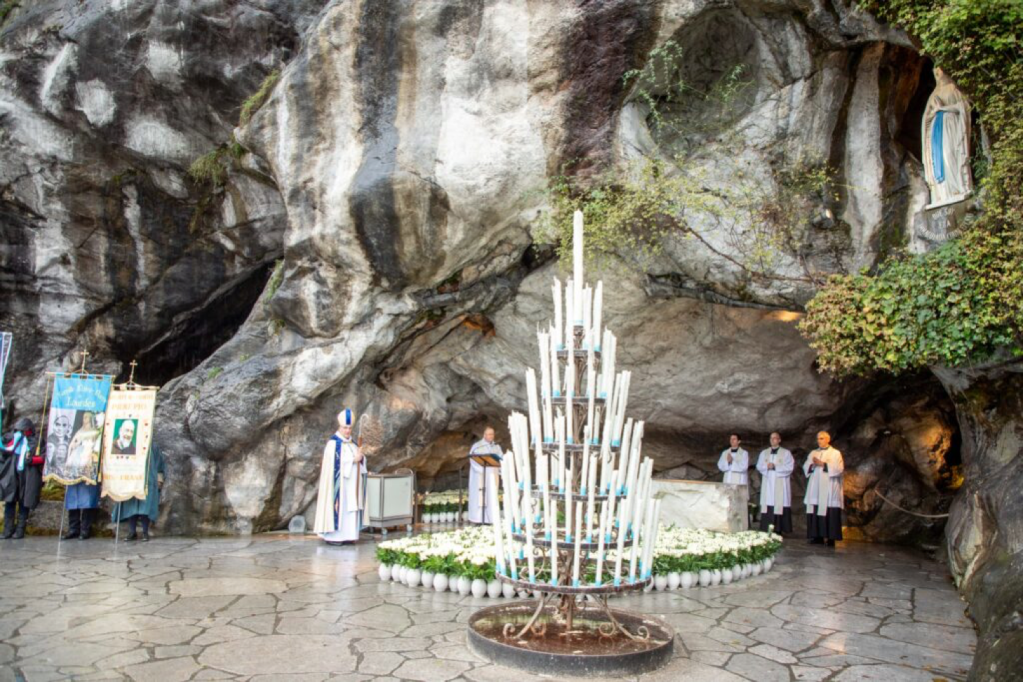
Outdoor Mass at the Lourdes’ Grotte de Massabielle on the 8th of December.

Photo source: https://www.lourdes-france.com

This is perhaps most fulsomely expressed at Lourdes, whose basilica is dedicated to this particular liturgical event. It was at Lourdes that the apparition of the Virgin Mary said to Bernadette ‘I am the Immaculate Conception’, and thus the feast has a special significance for this great sanctuary. The evening prior, a torch lit procession takes place follows Vespers and, on the day itself, white roses are placed within the grotto where the visions took place, followed by an Angelus, a Rosary service in the grotto, Vespers at the basilica and another torch lit procession around the sanctuary.[5] Although not strictly speaking in the Pyrenees, the Catalan capital of Barcelona traditionally has a wide array of shopfronts decorated with flowers and vegetation during Puríssima, and in the villages of Arenys de Mar and Arenys de Munt, children would smoke pipes with particular smoking mixtures made from local herbs, leading to the day being known as the ‘Mare de Déu Fumadora’.[6]

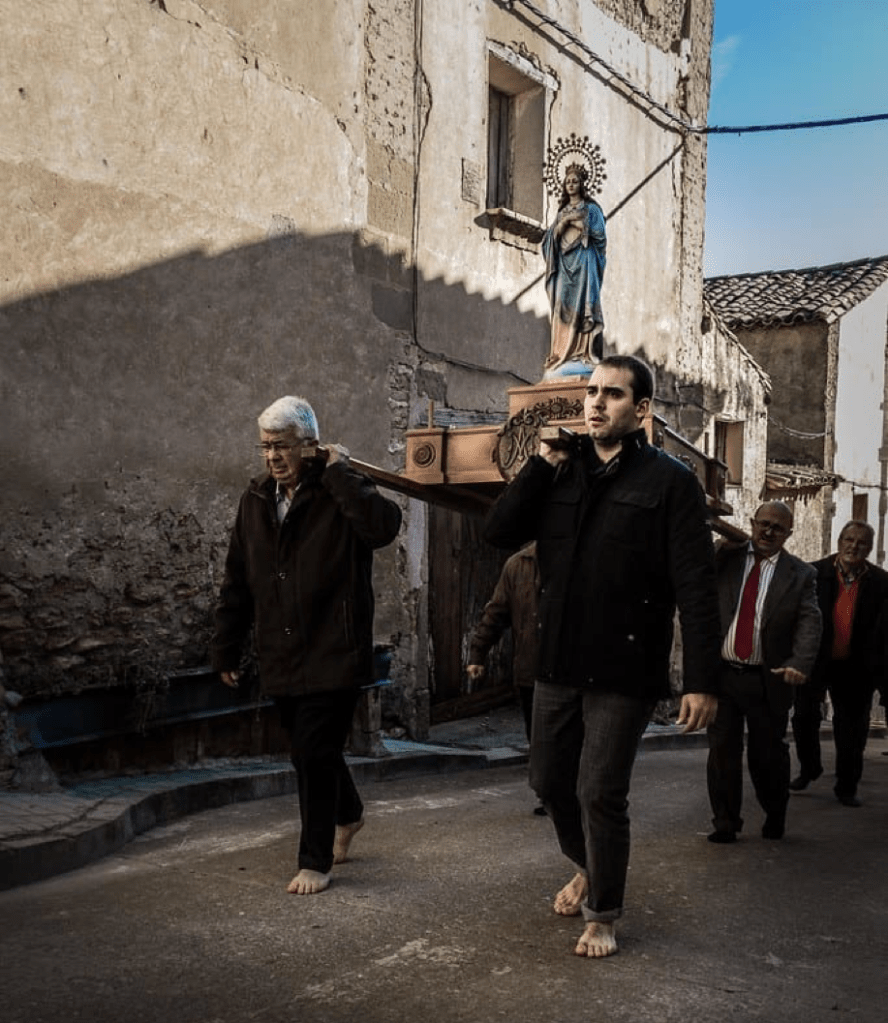
Procesión de los Descalzon in Lascellas.

Photo source: https://ganasdevivir.es

 In Lascellas (Huesca) this day is marked by a barefoot procession (Procesión de los Descalzon) in honour of a promise made by the village to the Virgin Mary during a time of plague in exchange for being spared. They carry an image of the Virgin of the Immaculate Conception, as well as images of Saint Anthony and the Virgin of the Rosary, and the barefoot receive a ‘panetic’ (a bread sprinkled with aniseed seeds) which is donated by various households in the village and blessed during Mass. It is during this time that the Tío de Nadal log in Huesca and the Catalan Pyrenees or the Nadau Tidunin the Pays du Luchon (Hautes-Pyrénées and the Haute-Garonne) and in the Val d’Aran, is brought inside, covered with a blanket and ‘fed’ until Christmas Day.


[1] This likely refers to the bitter snow in Advent, referred to in the following proverb.

[2] Saint Martin’s Day celebrates Saint Martin of Tours and falls on the 11th of November. It is also known as Martinmas and, in northern Europe, traditionally marked the end of Harvest season and the beginning of Winter.

[3] Capmany, Aureli, Calendari de Llegendes, Costumes i Festes Tradicionals Catalanes: De Juliol a Desembre (La Bisbal d’Empordà: Edicions Sidillà, 2019), p. 245. Translated by author.

[4] Saint Lucia or Saint Lucy (born c. 283, died c. 304) is a martyr and the patron saint of the blind, as well as seamstresses, tailors and dressmakers. According to the early Julian calendar, her feast fell on the longest night of the year. This timing may have relevance to pre-existing celebrations and also to the symbolism of candles and lamps attached to Saint Lucia, not only in terms of her association with sight but also in dispelling darkness, as well as the root of her name luc– sharing that of the Latin for light, lux. ‘We must remember that I the Julian calendar, which preceded the Gregorian (introduced by Pope Gregory XIII in 1585), the solstice occurred on December 13, with the result that Lucy was linked to all the traditions involving the solstice. Thus it was said of Lucy that “she shed the light of her eyes on the long night of the solstice”.’ Lanzi, Fernando & Lanzi, Gioia, Saints and Their Symbols (Collegeville, MN: Liturgical Press, 2004), p. 90

[5] Dompnier, Bernard, Les Cérémonies Extraordinaires du Catholicisme Baroque (Clermont-Ferrand: Presses Universitaires Blaise-Pascal, 2009).

[6] Amades, Joan, Guia de Festes Tradicionals de Catalunya (Barcelona: Editorial Aedos, 1958), p. 145.

A Trip to Aínsa

Recently I undertook a brief trip to the village of Aínsa in Huesca (Aragon); this lovely village with its Medieval arcades, square and fortified walls is well-known in Spain and France for its picturesque situation however its history is also extremely interesting. Legend places its founding in 724 by King Garci Ximénez (about whom many legends exist, including his spontaneous election as king by a gathering of monks who had not conferred about their choice beforehand), following his alleged reconquest of the Cinca Valley from Islamic occupation. It is from this (debated) event that the County of Sobrarbe comes, the name deriving from a red cross appearing to the king above the branches of a holm oak before battle; ‘sobre arbre’, ‘above the tree’. The oak with a fiery cross above it became Aínsa’s coat of arms, and in the seventeenth century a covered cross was built just outside the town’s walls on the alleged site of the oaken vision.

Aínsa (stock photo, as the village was so busy on our visit I could not get a decent picture of the overall square!)

Aínsa is situated on a promontory above the confluence of the Cinca and Ara rivers, making it an ideal location for keeping watch of who is traversing the Cinca valley. Whilst no specific finds have been located on the site of the town, the valley and its surroundings possess a rich archaeological heritage stretching back to the Palaeolithic, particularly in the Vero Cultural Park, where rock art has been dated to 30,000 years BC. There are also a number of megalithic monuments in the broader area and Aínsa’s position is ideal for defence, making it extremely likely that it was settled in some capacity prior to King Garci Ximénez’s military endeavours. The Medieval village (which sits above several modern streets about the rivers’ banks) consists primarily of two parallel streets leading to the main square and the church, all of which are surrounded by eleventh-century walls. The square is arcaded on its northern and southern sides and, following a steep decline into poverty in the twentieth century from emigration, the loss of agricultural lands thanks to reservoirs and dams, the village has enjoyed a renaissance since the 1960s, when cultural and natural tourism begun to flourish in the region. This is also thanks to the creation of several national parks in the broader area, such as that of Ordesa and Monte Perdido, less than an hour’s drive away from Aínsa. Speaking of driving, the journey to and from Andorra was very beautiful, leading over the mountain port from La Seu d’Urgell to Sort, then via Tremp over a winding pass into Huesca, where Puente de Montañana, Benabarre and Abizanda led us through some stunning Autumnal scenery in the mountains, with churches and castles perched on almost every crag.

In Aínsa our first stop was a surprising one, at the Eco Museum. This museum is deeply tied into preservation efforts for the Quebrantohuesos (‘bone-breaker’ or the bearded vulture), and has dedicated many years to reintroducing these birds into various spots in the Iberian Peninsula via a novel system of hand-rearing chicks and using a vulture marionette, then releasing them into the wild at different points to reduce the risk of co-sanguinatity between birds. There were several lovely dioramas of Pyrenean fauna and one could even (quietly) visit an enclosure in which pairs of eagles, owls and vultures were kept whom had been injured, paralysed or in some way would not survive anymore in the wild.

An example of the diorama.

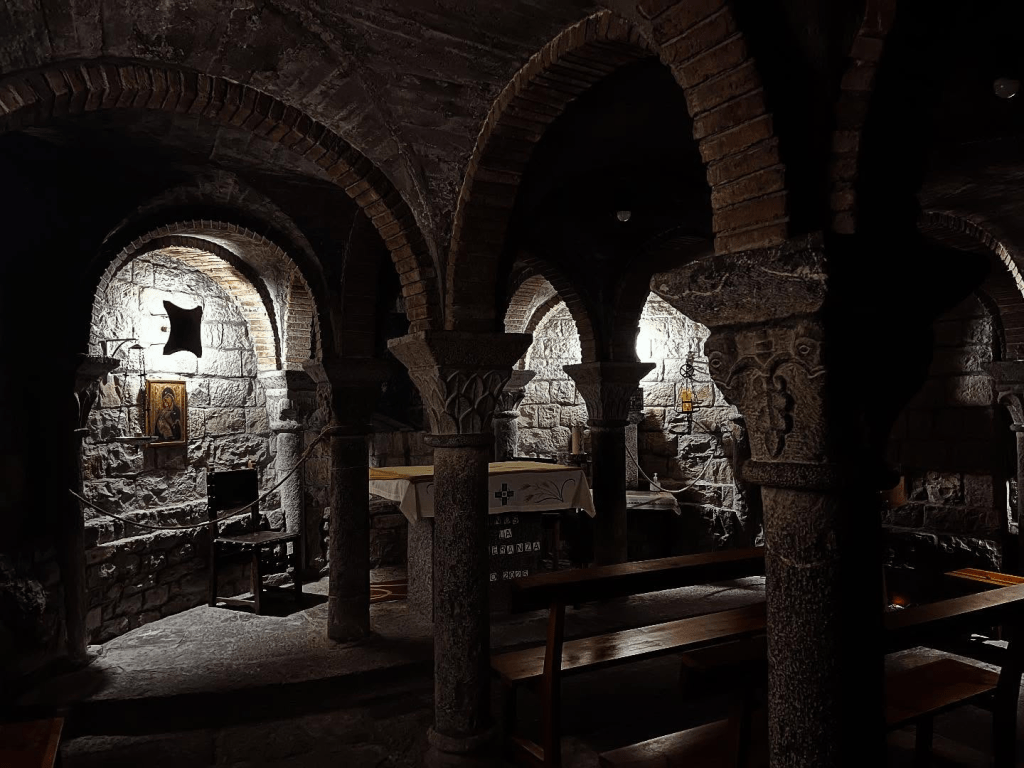
The collegiate church of Santa Maria possesses a very fine bell tower (with the most cramped stairs I have ever encountered, almost a crawl space in some parts), crypt and minute cloister. The church was completed in the mid twelfth century and consecrated in 1181, built in the Romanesque style, whereas the cloister was built in the fourteenth century, with enlargements made to the church in the sixteenth century with various chapels. It is an austere space with a thirteenth-century polychrome Virgin mounted in the apse and the crypt has many carvings on the capitals of its squat, smooth pillars. These are mainly reproductions of the originals, as the crypt was destroyed during the Spanish Civil War, a sad and regrettably not unusual phenomenon. The cloister was damaged at the same time but thankfully much of its original fabric survives and there are several small chapels within its space with central basins collecting water from the roofs, with which the various plants there are watered.

The church crypt with its numerous carved capitals.

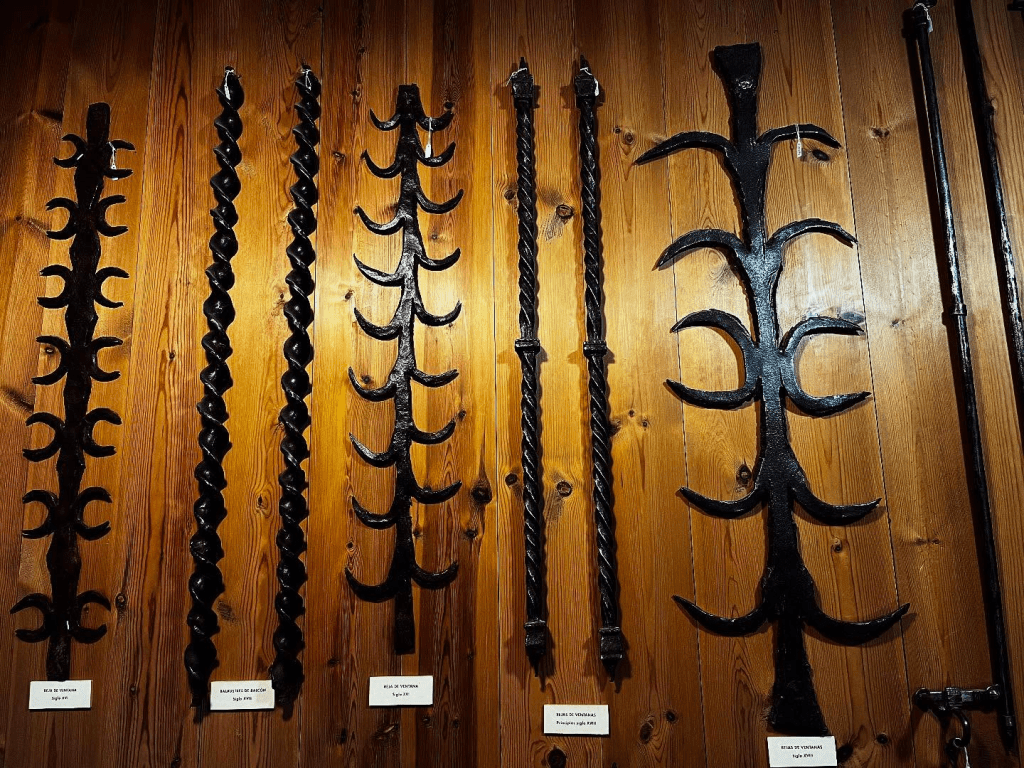
The Museum of Traditional Arts and Crafts has an extensive collection of ceramics, ironwork, wooden furniture and rush-woven baskets relating to local crafts and production; perhaps most impressive was the enormous collection of decorated locks and door-knockers, many of which bore decorative styles which have comparisons in Catalonia and Andorra. There were also a great many examples of furniture decorations in the form of symbols which can be found across the Pyrenees, such as the six-pointed Hexafoil, which featured on everything from cheese-presses to door panels and banisters. Finally, we visited the castle walls, the outer part of which can be walked along in the south and north-facing enclosure entrance to the village. The fortifications were first built in the eleventh century and then renovated and expanded in the seventeenth century, prior to the Treaty of the Pyrenees, at a time when the border between Aragon and France was a highly contested and flexible affair.

An array of traditional ‘jacket strippers’, used to prevent people gaining entry to a house through the smaller windows.

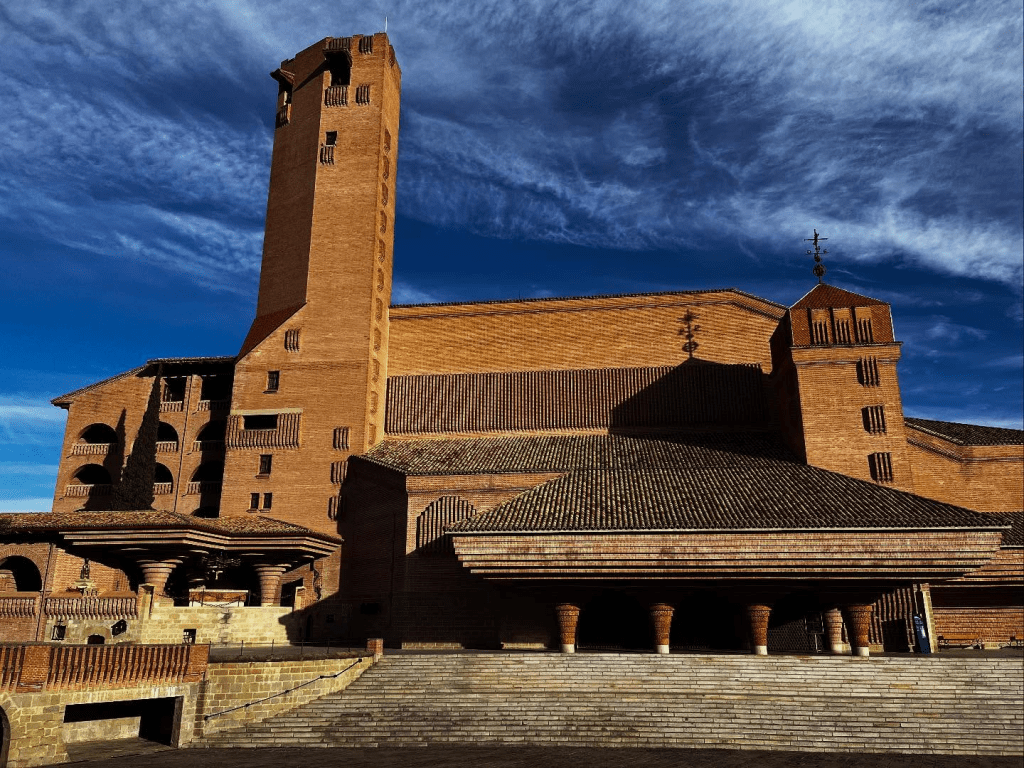
On the return to Andorra we stopped at the Sanctuary of Torreciudad, a massive complex of monumental brickwork constructed in the 1970s next to the original Medieval hermitage. The name ‘Torreciudad’ derives from an old watchtower built during the Islamic occupation of the region, located a few metres away from the old hermitage, which was constructed in Romanesque period. The Virgin of Torreciudad dates from the period and is now housed in the modern sanctuary; it is one of the ‘Black Virgins’ of the Pyrenees and depicts the Madonna seated with Child, having been venerated by locals for the better part of a millennia. The founder of the Opus Dei, Josemaria Escriva de Balaguer, was taken as an infant to the original hermitage by his mother to cure him from a serious illness; this seems to have worked and he was taken back to his home in Barbastro, where he made a full recovery. In the 1960s Josemaria decided to build a new sanctuary to the Virgin of Torreciudad in gratitude, with construction taking three months, from January to April in 1970. Exposed brick is omnipresent and, to my mind, has a peculiar yet beautiful mix of almost Soviet monumentalism, neo-Byzantine curves and a sort of ‘Church Militant’ effect, like an updated version of those churches and cathedrals built following the Albigensian Crusade, designed to impress strength and order over heresy. The original hermitage is a small, quiet affair on a nearby promontory overlooking the azure waters of a reservoir, with scarred pews and the Moorish watchtower overlooking its vault and bell tower. In the distance, Mont Perdido and other peaks can be seen (with dustings of snow). It is an exceptionally beautiful situation and much recommended for a visit.

The new sanctuary of Torreciudad.

The original sanctuary of Torreciudad and the tower.

A long overdue update.

Greetings everyone. As has been obvious, this blog or newsletter has been silent for quite some time whilst I have been writing different books. I should like to reinvigorate things slightly with an update as to progress on various fronts. So far, all of my fiction work which was published in hardback form with Mount Abraxas Press has been republished by my own Mons Culturae Press in unlimited paperback format. Going forward, all my fiction will be available this way. Two novels have been completed and are awaiting the layout/editing process:

The Heights of Perfection‘ – the story of an invalid in 1930s Mayfair who dreams of travelling the Alps and uses his extensive library of Alpine literature to do so, driving him to the edge of insanity and over into a sublime realm.

Last Feet in the Lane‘ – a follow-up of sorts to ‘The Boughs and Byways of Ytene’, featuring an anthropologist in late 1990s England who wishes to delve deeper in Aubrey Winslade’s manuscript, the past and present of the Vagabond Trust, and the Matter of Albion.

Both will be published in early and late 2026 respectively. I will announce their publication here.

Also, the research book ‘Highly Holy‘ (dealing with the histories, cultures and traditions of Christianity in the Pyrenees) is on its penultimate chapter. I should have the writing finished by Spring 2026, looking to publish later that year.

Finally, I have set up a Goodreads profile for those who are kind enough to leave reviews/feedback on my work. It can be found here: https://www.goodreads.com/martinlocker

All of this is done in a DIY fashion (without, I hope sacrificing quality of research or story-telling), and so I have come to the realisation that I need to up my game in terms of self promotion; something I am not fond of but must be done. So if anyone has any suggestions as to reliable blogs, podcasts etc. (or individuals) who would be reliable reviewers for work both present and future, do let me know in the comments section below!

More to come, and apologies for the silence.

Over and out.

Martin.

‘Protection & Property’ Monograph and Interview

In April the monograph ‘Protection & Property: Apotropaic Marks on Rural Andorran Buildings’ was published via Mons Culturae Press (see that tab for details). It is the result of 18 months research and fieldwork, and is richly illustrated with photographs of the marks in question.

Just recently I had the chance to be briefly interviewed on Andorran TV (in French) at one of the best sites for apotropaic door marks in Andorra, explaining the potential interpretations of the motifs found there and the rationale behind embarking on their research and archiving.

It can be viewed here:

https://www.andorradifusio.ad/noticies/expliquen-gravats-portes-bordes

Blog Update

As some may have realised, the blog has not been updated for quite some time. This is due to the focus of the project having shifted to books and (more recently) monographs rather than short articles. This is the approach which will be continued into 2023, however some bite-sized posts will also emerge on highly specific subjects related to the Pyrenees. It will also continue to be used to present short extracts from up-coming publications.

‘BOUNTIFUL BORDERLANDS’ EXTRACT #5: CHAPTER FIVE ‘UNDER COVER OF DARKNESS: THE SMUGGLER’

‘Within travel literature, the smuggler is typically presented as both rakish and rustic, unafraid to stand out in town but also possessed of deadly force and an intimate knowledge of his area; in a word, swashbuckling. It might be assumed that much of the affectations described were romantic inventions of the author, as it would be in their interest to retain a low visibility. However, enjoying the support and even protection of the local population, it is entirely conceivable that the Pyrenean smuggler had few qualms about standing out, and even living up to the image of an ‘outsider’. The following passage describes this characteristic in a tone that, as was so often the case, expresses no little affection for the smuggler and his air of a ‘loveable rogue’:

When he is seen in Pau,[1] he appears in a velveteen jacket, inexpressibles [sic] girt round his waist with a gay crimson sash, a conical felt hat with rakish rosettes, and a loose collar thrown back from his swelling sunburnt neck. He strides along with a bent knee, and the springy, free, elastic step of the hill-climber; and there are not wanting scandalous rumours that he makes use of the knowledge with which he tracks the izzard or the bear to their haunts, to convey a venture of tobacco bales across the frontiers, by paths and precipices, where even the carbineers[2] of the customs hardly care to follow him. He is seen in great perfection when escorting a troop of kicking, biting, devilish mules; or indulging in a siesta on some half-shaded bank, with a cigarrito between his lips, and a faint odour of “eau de vie” about him. People see in him a figure which recalls sundry dramatic reminiscences of carriages upset, long carbines and Fra Diavolo;[3] but we have only found him a merry, courteous fellow, always ready with a song or a joke, and with quite as little, or less, of the rogue about him, as his compatriots in the towns.[4]

Another feature we can note here is the characteristic of being unthreatening and even kind to those who either had nothing to steal or were uninvolved in smuggling, and smugglers were often credited with helping lost travellers (in some cases acting as guides):

The assassin has been my guide in the defiles of the boundaries of Italy; the smuggler of the Pyrenees has received me with a welcome in his secret paths. Armed, I should have been the enemy of both; unarmed, they have alike respected me.[5]

In the next century, this knowledge of secret paths and evading the authorities would help refugees across the escape routes that ran through the Pyrenees, but prior to this, two other qualities (possibly exaggerated) would emerge in the literature which further cemented the smuggler in folk legend as a benevolent influence. One was the purported extension of hospitality to travellers and the poor; the offering of bread, wine and whatever else the smuggler had to share with the lost and the hungry. The other quality which was often reported was the brotherhood which existed between the smugglers, one which bound Basque, Béarnese, Aragonese, Catalan, Gascon etc. together in cooperation; the movement of merchandise was of greater importance than one’s village of birth, particularly when pulling together against the authorities:

Picturesque fellows they are; clad in rough garments of leather, besashed, gay kerchiefs about their heads, decked with geegaws and armed to the teeth. A bit dirty and unkempt, perhaps, unshaven, their weather-beaten faces the colour of tan, their features as rough and gnarled and seamed as their beloved mountains. Desperate dare-devils, they are too, fearless, sure footed as goats, expert marksmen and proud and independent as grandees. Hard drinking, loud boasting chaps, yet most courteous and hospitable to those they trust; as ready to aid a distressed stranger as to slit his throat if they suspect him of being an enemy; willing to share their last crust of black bread or their last drop of wine with the poor wayfarer or to hold a well-to-do traveler for ransom; united into a blood brotherhood never violated or betrayed; living a wild, rough life; the idols of the peasants, the heroes of countless tales; carrying on their trade as much for the love of adventure and the devilment of the authorities as for profit, and ready at any moment to give battle to the carbineros or the guardias, whether French or Spanish. Few of them are true Spanish blood. The majority are Basques – members of that strange, ancient, proud race which has never really been conquered and whose tongue is perhaps the oldest of Europe, – Navarese, Catalans, with a few of Gipsy blood, but all forgetting their differences of race or station in the common bond of being Contrabandistas.

Among the interminable, intricate passes and defiles of the Pyrenees, among the towering peaks and vast bulwarks of the mountains, they dwell and hold their own, frequenting the wine shops, the wayside inns of mountains towns; threading their way along narrow zig-zag trails, mere shelves of rock with dizzying heights above and dim blue abysses below; winding through clefts between stupendous precipices; bending to the sweeping blasts of the cloud-hidden summits; wrapped in their sheep-skin cloaks as they face the driving icy gales above the timber line; bivouacking beside their fires in sheltered nooks; holding high revel in smoke-grimed, massively timbered mountains taverns, they laboriously traverse the way from Spain to France or France to Spain, driving their heavily laden mules and donkeys, cracking their whips, shouting picturesque Basque oaths, and earning a few pesos, a precarious living at risk of death and prison, at cost of hardships, endurance, terrific labor and the roughest of lives.[6]

No doubt another aspect which helped the feeling of community amidst contrabandistas were the harsh conditions in which they worked. Contrary to the shepherds and hunters who also frequented mountain passes and pastures, poor weather was a help rather than a hindrance to their activity, as was the difficulty of the route chosen. Such a combination of hazardous paths and precipitation would make the likelihood of encountering patrols of gendarmes a minimal one. This did however mean that the smuggler had to be dressed and equipped accordingly; their use of rough, thick sheepskin coats as well as gripping and climbing aids, which bore something of the mountaineer about them, was common:

Scarcely had we entered it [a valley], when I beheld upon the heights above us, a very stout fellow armed with a gun, and descending with an air of agility and boldness, which I could not enough admire. This was an Arragonese [sic] smuggler. As soon as he perceived us, he stopt [sic], and put himself on his guard; but seeing me approach him with confidence, and that I was not armed, he continued to descend, preserving however the advantage of the heights, until he had well observed us. He informed us that the snows of the pass were good, and that he had descended from the Breche de Roland with ease: but after all, a smuggler does not travel as a philosopher, and when I remarked his cramp-irons hanging from his sack, and the small hatchet which he carried at his side for hewing out his way in the ice, I could easily guess, that if he had not occasion for them, I might.

In the countenance of this man I could perceive a mixture of boldness and confidence; his thick and frizzled beard was continued up into his black and curling hair; his broad breast was open, his strong and nervous legs naked; all his clothing consisted of a simple vest; the covering of his feet, after the manner of the Romans and Goths, of a piece of cow’s skin applied to the sole of the foot, and bound round it like a purse, by means of two straps, which were afterwards crossed and fastened above the ancles [sic].[7]

The description of footwear comprising of cow hide bound around the foot corresponds to the abarca or albarca (Basque: abarka), a traditional Pyrenean and Cantabrian shoe, which was fashioned from a single piece of calf leather tied around the ankles and lower calves with braided woollen laces. Some versions of this shoe have wooden soles, much like a clog, however for the purposes of gripping slippery rocks and other unstable surfaces commonly encountered by smugglers, shepherds and hunters alike, the use of cow’s hide was preferable.

Footwear preference was not the only aspect shared by smugglers and shepherds. As mentioned above, many of the routes that straddled the post 1659 border made use of grazing lands and transhumance paths. What made these pathways so useful, aside from their passing far from the eyes of the law, was largely in connecting upper pastures and lower settlements in a manner which harked back to the pre-existing (and ancient) land rights which often did not correspond to the newer Spanish/Franco border. This allowed goods to be moved across from Spain to France, and visa-versa, by routes that not only allowed surreptitious and efficient contraband transport, but also between villages or towns which may not have felt sufficiently French or Spanish enough to be on good terms with the customs officials. Some of these crossings held particular significance for pastoralists, such as the Port d’Azun and its tradition of settling land right debates between rival herdsmen:[8]

At the Pierre St. Martin, which you pass on your left, the Spanish and French used to meet annually to settle disputes about cattle-liftings; and all who pass this way, in honour of St. Martin, contribute one stone to the pile. This port is very much frequented by contrabandists, and I suspect there is no pass in the Pyrenees through which so much smuggling is carried on, chiefly of silk and tobacco.[9]

The mountains offered many of the methods employed for transporting goods, however smugglers also made use of waterways, especially those which ran along the Franco-Spanish border, namely the Bidassoa: ‘Smuggling by water is a pastime practised upon the border river, the Bidassoa. It, also, is done chiefly at night, and the trade is, more times than not, in wines or strong spirits.’[10] Human smuggling also took place along this river during the Carlist wars,[11] with prices varying according to rank:

A Carlist is passed just like a bale of goods. There is a certain tariff, so much for a colonel, so much for an inferior officer. As soon as the bargain is struck, the contrabandist makes his appearance, carries off his man, passes him over the frontier, and smuggles him to his destination, as he would a dozen handkerchiefs or a hundred cigars.[12]

Smuggling along this river was popularly immortalised in the late 19th century novel Ramuntcho, a tale of love and adventure among the contrabandistas of the French Basque region, which went a long way to popularising the romantic and swashbuckling characterisation of the smuggler in various Parisian salons.[13]

Despite this literary propaganda, not everyone was so well disposed towards smugglers and their ways, particularly the men who were tasked with stopping their lucrative practices. One 19th century traveller in the Val de Carol (Ariège) happened upon the local gendarmes, the captain of which offered up some very blunt character judgements upon their prisoners:

‘What do you think of this company?’ said the gendarme; and without giving me time to reply, added, ‘you must certainly have some very particular business to bring you here; as for me, I would not stay a day in it, if I were not obliged by my office. I have guarded all the coasts of France, all the defiles of the Alps; I have even served in Italy during the blockade; but I assure you that I have never yet seen such smugglers as those of the valley of Carol. See, said he (pointing to the company) these are people who know the smallest crevice in the mountains, and who pass where neither you nor I would even dare to venture ourselves. And what kind of contraband do you think they carry on? – In the Jura, near Geneva, the mountaineers carry jewellery and watches, which are such small articles that it is natural they should not be seen. But these merely smuggle – what do you think? – wool! And we can hardly ever catch them. In fact they climb the mountains on the south side, and when they have reached the summit they throw down the bales, which roll down the north side, when others receive and carry them through the defiles into the plain. It is in vain that we watch them, they always escape us. It is a very different thing with sugar and coffee; as for those goods, they introduce them as the ladies in the sea-ports do Vanilla, in their bags. They are an untractable and wicked people, whom we have the greatest difficulty to keep under restraint, who are neither French nor Spanish, and who only look for one thing, which is a rise in the price of commodities. Would you believe it, they are almost all Bonapartists, though they had no more connection with the government of Bonaparte than with that of the king? But I will tell you the reason; sugar and coffee were dearer then, and smuggling was more profitable.’ [14]

The folklore surrounding smugglers mainly revolves around the characters themselves; whilst it is likely that there was (and still is) lore among the contrabandistas in terms of luck-bringing acts, this area remains very much a ‘closed book in terms of the literary record. However, there are some figures whose exploits reveal some of the supernatural aspects ascribed to smugglers by locals and the law alike.

To begin with the profane, the figure of ‘Don Q.’ is quintessentially folkloric, marrying the sacred and the profane as a smuggler cleric. He comes across as a fairly ruthless and cunning man, not above exploiting both his flock and his colleagues, the latter in terms of ransom:

There was Don Q., who, legend has it, was a renegade priest, and, like many another robber and lawless character, ever looked upon the clergy as his special prey and enjoyed nothing more than forcing some stout and easy-loving padre to toil weary miles through the mountains, to dwell in a bare and rocky cave and subsist on the coarsest food exposed to jeers and insults of the smuggler-brigands while awaiting a ransom worthy of a king. And, also, according to story, Don Q found his earlier experience in the Church of utmost value in his profession. Garbed as a friar, he could quite safely enter the towns, hear the carbineros’ plan for his capture, acquaint himself with the doings of the citizens, the market for goods, and even make secret arrangements with his agents and customers, with never a suspicion that the shaven-headed, cassocked priest was the outlaw for whose apprehension the guardias would have figuratively given their heads.[15]

It is worth noting that this local legend may be the inspiration behind the ‘Don Q.’ who featured in several story collections by author and explorer Hesketh Hesketh-Prichard.[16] In these stories, Don Q. is recast as a Robin Hood figure, frequently dressed as a padre and stealing from dastardly rich lords so that he might give openly to the poor. Hesketh-Prichard claimed that the ‘Q’ was short for ‘Quebra Huesos’, the Spanish term for the bone-breaker vulture, the lammergeier, because of his protagonists’ severe appearance, which may see the conflation either in Hesketh-Prichard’s mind or, perhaps, that of the locals, between the ‘historical’ Don Q. and the figure of ‘Don Sebastian’, to whom we shall turn to next.

The enigmatic ‘Don Sebastian’ appears to have entrenched himself firmly in Pyrenean smuggling lore, primarily due to his success and perceived supernatural abilities. We also see once again the link between smugglers and Carlists, in this case ascribing Don Sebastian an aristocratic background from that house which along with his command of witchcraft paints him as a great mythical folk-hero. The lengthy quote below provides a wealth of detail:

Even more fascinating and picturesque was that other famed and partly fabulous smuggler chief of the Pyrenees, one, Don Sebastian, who, like Don Q, was as much bandit as smuggler. Of him the peasants still speak with much of awe in their tones and with crossed fingers, for the superstitious folk credit him with having possessed the evil-eye, with delving into sorcery and witchcraft, and with being under the personal protection of the devil himself.

Who he was no one knew, and Don Sebastian never divulged. Indeed, it is said certain over-curious persons who enquired too closely into the ancestry and antecedents of the bandit-smuggler, vanished most effectually and mysteriously, utterly destroyed by witchcraft, whisked away amid blue flames and a smell of brimstone, or dropped over a convenient cliff, according to the individual fancy of the story teller. But whether made away with by occult or corporeal methods, their fate served as a deterrent for others, and the natives satisfied their imagination and their love of the romantic by weaving a tale wherein Don Sebastian was the scion of a great and noble family, one of the Carlistas who had been robbed of home, family and estates by the Spanish government. […] Seldom, however, was he known as Don Sebastian. Instead, he was nicknamed “Quebra Huesos” [sic][17] (bone-breaker), not that he was given to fracturing the bones of his enemies, but because of his striking resemblance to the huge mountain vultures, the “Quebra Huesos” of the Spaniards. […] He was loved, respected, admired by the peasantry as greatly as he was feared, hated and sought by the officials, despite the people’s dread of occult things. Never did he molest the humble or the poor. He might appear like a wraith at a tiny, poverty-stricken cottage and help himself to food and shelter, but when he had gone, had vanished into the night or the morning mists, a bag of silver or a handful of gold pieces would be left in return for what he had taken. Men, women or children, if ordinary mortals, could wander as freely and as safely through the mountains where Quebra Huesos had his lairs as about their own doorways. They could even seek and receive shelter and food from his men, and if mounted and their sorry ponies or donkeys gave out, a new mount would always be forthcoming from the famed smuggler’s stables. Once, an aged mountaineer lost his foothold, and falling, broke his leg. Upon the shoulders of two of Don Sebastian’s men he was borne to his hut, and within a few hours, a bound and terrified surgeon, kidnapped from the nearest town, was brought to the injured man’s bedside. Under the gleaming eyes and levelled pistols of Quebra Huesos himself, he set the fractured limb, after which he was rewarded by a bag of gold – ten times the fee he would have charged a patient – and was carried in safety to his home.[18]

It is in this figure that we find the archetypal Pyrenean smuggler; a far cry from the reality of a lucrative but arduous profession which while dangerous, also held its fair share of monotony, waiting in comfortless perches and lugging goods in driving rain, ever watchful for the gendarmes’ lanterns. The smuggler captain is transformed into a rough diamond, capable of great and noble acts to the unfortunate and holding the powers of nature at his command. The question as to why is a harder one to answer, but much like the figure of the witch, a great deal lies in the act of being marginal, living outside of society, holding an intimate knowledge of the wild Pyrenean landscapes, engaging in hazardous work that brings great reward and in rarely being seen (at least, by those whom the smuggler wished to avoid; the authorities). Coupled with the economic benefits that smuggling brought to various rural communities, it is not surprising that the smuggler attained an aura of magic and adventure. It should also be noted that the descriptions by visitors hold, to varying degrees, an element of wistful envy; many of these travellers were middle-class and likely led reasonably regulated lives, and thus many projected their own romantic desires of an adventurous life onto their encounters and reports of the contrabandistas.[19]

It is worth touching on an aspect which is unexpectedly present in many descriptions and actions of the smugglers; their political sympathies. While undoubtedly payment features in the motivation to become involved in protecting or escorting a political or royal dissident across the border, the risks entailed would be enormous, and this suggests that some level of affinity and sympathy for the cause itself would feature in the decision to accept such an undertaking. The mention of a mythical Carlist background of Don Sebastian, for example, gives a clue towards these sympathies, as does the point raised by the customs officer quoted above, where he mentions that Bonapartism finds a particular root within many smugglers. However, it should be clarified here that many smugglers enjoyed the perpetuity of Napoleon’s campaigns not due to any great love of Imperial France, but rather due to the pressure and shortages placed on various goods markets, which made the demand for smuggled items soar and thus provided them with a lucrative trade across the frontier.’


[1] Pau is a small city and capital of the Pyrénées-Atlantiques, and also of the historic Béarn region. It takes its name from the Béarnese term pau meaning ‘stockade’, which surrounded the city’s castle built in the 11th century.

[2] This is an Anglicised version of carbineros or carabiniers, terms used for companies of light infantry regiments and also a specific unit of gendarmes and customs officers whose duties included fighting smugglers.

[3] Fra Diavolo (‘Brother Devil’) was the nickname given to Michel Pezza (1771 – 1806), a popular Napolese guerrilla fighter and leader of the resistance movement against the French occupation of Naples. His inspirational exploits earned him an enduring place in local folklore and even in the works of Alexandre Dumas, so quickly did his posthumous legend grow. Thus, by the 19th century, his name had become a byword for romantic buccaneering anti-establishmentism.

[4] Johnson, Frederick, A Winter’s Sketches in the South of France and the Pyrenees (London: Chapman & Hall, 1857), pp. 141 – 142.

[5] Ramond, Louis-François, Travels in the Pyrenees; Containing a Description of the Principal Summits, F. Gold (trans.) (London: Longman & Co., 1813), pp. 116 – 117.

[6] Verrill, Alpheus, Smugglers and Smuggling (New York, NY: Duffield and Co., 1924), pp. 152 – 153. Available here: https://archive.org/details/smugglerssmuggli00verr

[7] Ramond, 1813, pp. 102 – 103.

[8] The particular ritual associated with the age-old practice is discussed in Chapter One.

[9] Packe, Charles, A Guide to the Pyrenees: Specially Intended for the Use of Mountaineers (London: Longmans, Green, and Co., 1867), p. 24.

[10] Ewing Oakley, Amy, Hill-Towns of the Pyrenees (New York, NY: Century Company Publishing, 1923), p. 403.

[11] For a detailed analysis of the First Carlist War, see: Lawrence, Mark, Spain’s First Carlist War, 1833 – 40 (London: Palgrave Macmillan, 2014).

[12] Gautier, Théophile, Wanderings in Spain (London: Ingram, Cooke and Co., 1853), p. 13.

[13] The book also features some excellent ethnographic observations on local Franc-Basque culture: Loti, Pierre, Ramuntcho (Paris: C. Lévy, 1897).

[14] Thiers, Louis Adolphe, The Pyrenees and the South of France During the Months of November and December 1822 (London: Treuttel and Würtz, 1823), pp. 140 – 142.

[15] Verrill, 1924, pp. 156 – 157.

[16] Hesketh Hesketh-Prichard (17th November, 1876 – 14th June, 1922) was an English soldier, writer, explorer, cricketer and hunter who travelled extensively in both military and private capacities, frequently using his experiences and local lore to weave his stories. These are classic of the period, primarily concerned with adventure, romance and daring-do.

[17] This should be ‘Quiebra Huesos’.

[18] Verrill, 1924, pp. 158 – 163.

[19] Another famous example of smuggler literature can be found in Joseph Conrad’s The Arrow of Gold, a tale set in Marseilles during the 1870s amidst the Third Carlist War, in which a love triangle revolves around the female leader of a band of ammunition smugglers, with the usual array of betrayals, adventures and mishaps typical of the period. The smugglers are supporters of the Carlist cause, which is unsurprising given the fact that Conrad himself helped smuggle guns for the Carlists during the late 1870s. See: Conrad, Joseph, The Arrow of Gold (London: T. Fisher Unwin, 1919).

‘BOUNTIFUL BORDERLANDS’ EXTRACT #4: CHAPTER FOUR ‘HAMMER & TONGS: THE MINER, SMELTER & SMITH’

‘We now turn to the figure of the blacksmith, in terms of his industrial, social and folkloric role within the Pyrenees.[1] By and large, the Pyrenean blacksmith used a bellows driven forge, anvil and a handheld hammer, in contrast to the water driven sledgehammers found in many local forges, and was responsible for a myriad of ironmongery. These ranged from highly practical services such as the reparation of agricultural tools, shoeing horses (both making and fitting the ‘shoes’ and seeing to any hoof related ailments), making domestic implements such as pots or griddles, shepherd tools such as wolf traps, dog collars protective against bear attacks, shears etc., and of course, weaponry, through to ornamental products, such as the wrought iron gates within churches and the Estripagecs (‘jacket strippers’) found in so many traditional rural houses and huts across the (primarily Catalan and Andorran) Pyrenees. The latter are flat metal bars cut along their length to make curved spikes which protrude from their sides. They are fixed in window frames and designed to tear (or ‘strip’) the clothing of any thief trying to gain access, particularly their jackets (‘gecs’).

Depending upon the region, the village blacksmith was either completely independent, taking on business as and when, or under defined obligations from the community (and/or feudal lord) to fulfil certain tasks for free. Testimonies from the 14th and 15th centuries indicate that, for example, in Comminges (Gascony) and Vicdessos (Ariège) the blacksmith was obliged to repair agricultural equipment, in Foix (Ariège) he had to sharpen tools,[2] and between the 15th and 19th centuries in Andorra the blacksmith was forced to have certain fixed prices in order to gain exclusive labour rights within the village community.[3] The blacksmith was thus a vital figure within the community who fulfilled a multifaceted role of smith, hoof doctor, mechanic and public servant, deeply tied into the social contract of give and take that held rural life together.[4]

Curiously the Pyrenees, in general, has a lack of recorded folklore attributed to the smithy, however the very word ‘recorded’ may explain this, as oral transmission would have been the primary method of keeping knowledge and traditions alive, and perhaps guarding certain elements from public discourse. This is particularly seen in evidence from the Basque Country, in which a very deep-time signature of ‘smith-magic’ can be detected, and given the movement across the Pyrenees by Basque peoples (detected by various toponym examples, even as far down as Andorra),[5] it is possible that such concepts were spread across the valleys orally. However, aside from such speculation, let us briefly examine Basque smithing in its context.[6]

The figure of Basajaun is a popular one in Basque folklore and mythology, being most commonly portrayed as a wild, huge and hairy figure who acts as a protector both of the forests and flocks which graze there. He is also attributed as being the first miller and the first blacksmith, from whom the secret of the forge was stolen by Martin Txiki (or San Martinico), particularly the technique of making a saw, and also soldering iron:

Thanks equally to the use of a trick, San Martinico managed to steal from the baxajaun (from the devil according to other versions) the secret of the making of the saw, the soldering of iron, and the axle of the mill wheel. The baxajaun was making the saw, according to a certain legend from the region of Oyarzun (Oiartzun); San Martinico could not do it because he lacked a model for it. Wanting to know the secret, he sent a servant to announce in the town that San Martinico had constructed a saw. On hearing this, the baxajaun asked him, “Has your master seen the leaf of the chestnut tree?” “He hasn’t seen it but he will,” answered the servant, who later told San Martinico what had happened. This is how the technique for making the saw was spread throughout the world. With the same trick, San Martinico succeeded in learning how the baxajaun soldered two pieces of iron together, according to a legend from Cortézubi (Kortezubi). He ordered the herald to announce that he had discovered the process for soldering iron. The baxajaun asked the herald, “Did San Martinico sprinkle the pieces of iron with water from potter’s clay?” “He didn’t, but he will,” was the reply. And as a consequence of this new secret stolen from Baxajaun or the devil, the technique of soldering iron was spread throughout the world.[7]

Martin is also responsible for stealing the secrets of wheat cultivation, water-mill construction and welding from Basajaun; in the case of the latter the Basajaun gave away the trick of sprinkling clay water upon the pieces of iron. This relates to the technique of using a clay suspension in the water during soldering.

Whilst the Basajaun is famous beyond the Basque borders, Martin Txiki is less well known, yet just as crucial to the world of the Basque smithy. The origins of Martin are tangled, yet offer tantalising clues of a ‘character’ in whom many aspects are married. Archetypal Promethean aspects can be detected, in stealing vital secrets from the divine so that man might thrive, and also a Puckish or Loki-esque trickster element in his manner of fooling the Basajaun into revealing these secrets. One theory revolves around the possibility of Martin (and other Basque ‘cunning-men’ figures) being an echo in the folk-consciousness of travelling Celtiberian healers from the Moncavo area, in particular the region now known as San Martín de la Virgen de Moncavo, whom may have treated people with tools made from bronze, iron and copper. This is, however, a very difficult theory to square with the presence of Basque metallurgy sites in the archaeological record, which seem to co-exist chronologically with those of other cultures sharing the same mountain range; unless the perceived healing properties of these metals were unknown to the Vascons.[8] Folk-etymology and origin stories are both difficult to unpick and determine their definitive sources, allowing much speculative theorising; however, this one is so particular that it seems worthy of inclusion here.

Another aspect of Martin is in his saintly guise, Saint Martin (San Martín), one of whose symbols is the horseshoe, which also happens to be a traditional stock-in-trade of the blacksmith. This symbol was used for Saint Martin because of his horse, from which he gave a beggar half of his cloak. We also see an echoed link between the blacksmith and the horse, whose hooves he was qualified to care for should a horse be lame. A curious feature of this saint can also be found in Polish folklore; during his feast-day (11th November) horseshoe shaped biscuits are baked for his white horse, who would come riding through the snow when least expected.[9] Clearly Saint Martin’s horse is a large feature in his folkloric presence, and if extrapolated both to blacksmiths and general Basque lore we may find two things. Firstly, the role of the horse in Basque folklore is potent, particularly in a white or ghostly context. The Ireluak are spirits or genius loci, which in some cases are said to take the form of a white horse, such as at the cave of Laxarrigibel near Soule (Pyrénées-Atlantiques), and the Zamari Zuria is a white headless horse that portents death when seen.[10] Could it be that these figures have merged with Saint Martin’s horse in the folkloric/mythic record over the centuries, thereby instilling the horse both in the Basque spirit landscape and also in the link between the blacksmith and the horse? Another aspect is the (albeit tangential) similarity in the Basque smith’s relationship with horse via the Saint Martin/Martin Txiki motif, and two groups of rural specialists in rural Britain; the Society of the Horseman’s Word in Scotland, and the ‘Toadmen’ of East Anglia.

Both were comprised of rural workers and ‘cunning-men’, and both of whom claimed to exercise unusual and ‘magical’ powers over horses, albeit via different methods, but both held blacksmiths in their ranks. The Society of the Horseman’s Word was a 19th-century fraternal secret society spread throughout Scotland and eastern England which focussed on the labour protection of its members (those who worked draft-horses), guarding the secrets of horse-control (many were known as ‘horse-whisperers’) and the ‘horseman’s word’, which would grant this control. Initiation ceremonies typically took place at night in barns or stables, and were presided over by the ‘High Horseman’ who held a goat’s hoof in one hand, during which various oaths were spoken.[11] [12] The ‘Toadmen’ were individuals in East Anglia who allegedly made a deal with the Devil in order to gain control over horses via a very specific rite, recorded in an interview with a Norfolk horseman, born in 1886:

Well, the toads that we used for this are actually in the Yarmouth area in an around Fritton. We get these toads alive and bring them home. They have a ring around their neck and are what they call walking toads. We bring them home, kill them, and put them on a whitethorn bush; They are there for twenty four hours ‘till they dry. Then we bury the toad in an ant-hill; and it’s there for a full month, ‘till the moon is at the full. Then you get it out; and it’s only a skeleton. You take it down to a running stream when the moon is at the full. You watch it carefully, particular not to take your eyes off it. There’s a certain bone, a little crotch bone it is, it leaves the rest of the skeleton and floats uphill against the stream, take it home, bake it, powder it and put it in a box.[13]

Whilst there seems to be no documentary evidence for a similar rite among blacksmiths in the Basque Country, there are elements which stand out; namely, the affinity (both practical and folkloric/magical) with horses, and also the importance of the toad, which held a special place in the eyes of the Devil in Basque witchcraft, and also features in the following legend:

On a number of occasions, someone asked advice of Mari and her predictions turned out to be accurate and beneficial. Thus, the ironmonger of Iraeta saw that his foundry was not working and presented himself to Mari in the cave of Amboto. She explained the cause and the remedy for the malfunction, and the ironmonger was able to get his factory working again. A similar case occurred in the foundry of Zubillaga, and thanks to the oracle of Amboto, production was able to start up again.[14]

In at least one of these cases the problem was the presence of a toad under the anvil; this may have been preventing the proper functioning of the forge due to some mal-intent on behalf of the toad, or it may have been due to the toad’s protection from any harm from the hammering etc., due to his status in Basque witchcraft.[15]

The Devil, too, forms a link with the blacksmith in Basque folklore; at least in the folkloric sense than the Judeo-Christian ‘Devil’. We can read a very famous legend, ‘The Devil and the Blacksmith’, which is widespread throughout Europe and finds its own Basque rendition. Broadly speaking, a smith enters into a pact with the Devil in order to gain wealth and superior smithing skills, in exchange for his soul. When the Devil returns years later to keep the bargain, the smith tricks him into captivity, only freeing him when the Devil reneges on his bargain.[16] However there is another ‘devilish’ figure associated with the Basque blacksmith whose origin lies far beyond the Devil; that of Aatxe or Etsai, the latter term dating to the early 16th century and meaning ‘enemy’ or ‘adversary’.[17] Aatxe can appear in various forms, particularly a red bull, a man, a goat or a horse (zaldi), and is said to be a representative of the Basque arch-goddess Mari, inhabiting caves and hollows; this also ties in with the theme of the blacksmith visiting Mari for advice on the malfunction of his forge.[18]

When talking of Mari it impossible to ignore her consort, Sugaar, a serpentine figure which in many instances of Basque folklore embodies lightening and, crucially, fire. Sugaar was a ‘divinity’[19] that was, and is, bound to blacksmith fraternities and guilds in the Basque Country; one which challenged both one’s wit and skill, just like the iron worked in the forge. Much in Basque folklore links the two, however there is one tale in particular that illustrates the bond between the smith and the ‘serpent’ Sugaar. If Sugaar wished to put his skills to the test, he would ask a fox[20] to present him with a challenge. The fox would invariably direct Sugaar towards a forge, to test his strength against the resident blacksmith. In one case, the smith asked Sugaar to wait a while, during which the smith placed his tongs in the fire and then suddenly grasped the serpent by his head; Sugaar cried out in pain, and begged for his life, after which the smith, perhaps recognising him for his supernatural form, let him go, despite Sugaar vowing revenge. It is important to realise that Sugaar relates, via his lightening connection, to the element of fire, and this is obviously of fundamental importance to the smith. It is perhaps possible, too, that the smith’s work which involves all four elements renders him, in folklore, well acquainted with the supernatural, and thus recognised Sugaar for himself and the test he proffered, to which some terrible end might result for the loser. [21]

We also see the 19th century Basque intellectual Agosti Xaho attributing the ancestry of the Basques to Tubal Cain, the ‘first blacksmith’ in Biblical chronology, claiming that his descendant Aitor was the first common Basque patriarch.[22] Whilst on the surface this might be considered part of a European fanciful 19th century tradition of ascribing biblical origins to an ancestor group, usually to deepen its legitimacy, we see in this example something far more interesting and potent. Within traditional Basque culture, the blacksmith held a deep current of connection with both the land and the supernatural, and even today many of his secrets are communicated only within family groups and guilds, much like with other fraternal societies, including those mentioned above. Thus, the Basque forge was likely a place of mystery, along with communal service, and even the forging of such a seemingly ‘mundane’ item (to outsiders) as pot hooks by Basque smiths would have been a highly-charged process, given its symbolism within Basque households:

The pot hook, like the hearth, is in some cases a symbol representing the house: the coals deposited beneath the boundary stones of a plot of land represent the limit of the property belonging to the house; when a cat is brought to the house as a purchase or gift, they walk it around the pothook in the kitchen three times so it won’t run away to look for a different place to live. Servants do this as well when they first come to work in the house, according to a custom in Liguinaga. [23]

Given the nature of the work carried out by miners and blacksmiths across the Pyrenees, not to mention the trade secrets which kept their livelihood impervious to ‘outsiders’, such as the behaviour of the miners of Raincie, it seems probable that, even though they were often obliged to serve the community maintaining tools etc., their role in the village did not detract from their ‘otherness’ and secrecy, not to mention an aura of magic.

There are other folkloric instances of iron being used in protective or magical contexts in the Pyrenees. In the 17th century, it was recorded that in the Navarre, it was customary to stick iron pins or needles in a specific tree ‘belonging to the church of Saint Christopher, situated on a high mountain above the city of Pampeluna [sic].’[24] In Luchon (Haute-Garonne), an iron axe was carried into the yard to protect against lightening and hail, lain edge upwards against the house’s threshold, and should lightning strike ‘the spot was visited and an attempt was made to dig out the thunderstone; if it was not to be found, the place was marked, as the thunderstone comes up to the surface after seven years and can then easily be found. The thunderstone protects the house against lightning and brings good luck.[25] [26] We also see these themes in Basque folklore:

Certain names for lightning, such as oneztarri, tximistarri, and ozpinarri (probably ozkar, ozkarri, and inhar, as well) which mean “lightning stone,” correspond to an ancient myth known widely in European countries in which lightning is a special stone (Neolithic axe, knife, or point of flint) that sinks down to the depth of seven states or levels upon falling to the earth. After seven years it slowly begins to rise one state per year until after seven years it reaches the surface. From then on it protects the house where it is found against evil spirits or Aide-Gaizto, which is lightning itself. This myth includes the Indo-European idea of Thor’s hammer and Jupiter’s arrows. In some places in the Basque Country, however, it is thought that lightning is made of bronze; in others they say it is made of iron. The current custom of placing steel axes with the sharp edge facing upward on thresholds during storms in order to protect houses from lightning derives from the veneration of the stone axe and belief in its supernatural powers. Before the discovery of steel axes, those made of bronze must have served the same function: in the entrance to the cave of Zabalaitz (in the mountains of Aizkorri), an axe from the bronze age was found stuck in the floor of the cave with the blade facing up. [27]

It is also possible to see the use of iron horse shoes as wards against evil and protectors against storms on the doors of various Pyrenean huts and houses, however specific reference to this in the context of the Pyrenees is lacking in the available literature.[28]


[1] An excellent French resource on blacksmiths, which is sadly difficult to obtain is: Jean-Dupont, Claude, L’Artisan Forgeron Quebec: Les Presses de l’Université Laval, 1979).

[2] Verna, Catherine, ‘Forgerons de Village: Quelques Témoignages Béarnais des XIve et XIe Siècles’ in L’Artisan au Village: Dans l’Europe Médiévale et Moderne, Mireille Mousnier (Ed.) (Toulouse: Presses Universitaires du Midi, 2000). Available here: https://books.openedition.org/pumi/24131

[3] Bosch, 2004, p. 11.

[4] For a microcosmic example of Pyrenean village socio-economics, featuring the blacksmith, see: Bonnain, Roland, ‘Household Mind and the Ecology of the Central Pyrenees in the 19th Century: Fathers, Sons, and Collective Landed Property’, History of the Family, Vol. 10, 2005, pp. 249 – 270.

[5] An example is the village Aixovall, which roughly translates to ‘valley valley’ using two difference Basque words for ‘valley’.

[6] My thanks here to María Martínez Pisón, an expert in Basque ethnography and a practitioner of Basque traditional ways, for her insights and information: Martínez Pisón, María, 2020, pers. comms.

[7] de Barandiarán, José, Selected Writings of José Miguel de Barandiarán (Reno, NV: University of Nevada, 2007), p. 131. Available here: https://scholarworks.unr.edu/bitstream/handle/11714/750/Barandiaran_SelectedWritings.pdf?sequence=1&isAllowed=y

[8] This theory is not supported by any reference.

[9] Taylor, Demetria, The Cook’s Blessings (New York, NY: Random House, 1965).

[10] de Marliave, Olivier, Trésor de la Mythologie Pyrénéen (Bordeaux: Éditions Sud-Ouest, 2005).

[11] Neat, Timothy, The Horseman’s Word: Blacksmiths and Horsemanship in Twentieth-Century Scotland. Edinburgh: Birlinn, 2002), p. 53.

[12] An excellent account of this society can be found in: Fernee, Ben, The Society of the Horseman’s Word (Hinckley: The Society of Esoteric Endeavour, 2009).

[13] Evans, George, The Pattern Under the Plough (London: Faber & Faber, 1967), quoted in Pearson, Nigel The Devil’s Plantation: East Anglian Lore, Witchcraft and Folk-Magic (London: Troy Books, 2015), pp. 123 – 124.

[14] de Barandiarán, 2007, p. 103.

[15] de Marliave, Olivier, Magie et Sorciellerie dans les Pyrénées (Bordeaux: Éditions, Sud Ouest, 2006), p. 111.

[16] In the 2007 Basque film Errementari, based upon the local version of this tale, the blacksmith tortures the Devil in revenge for all his troubles. I have been unable to verify if this is in the original Basque tale.

[17] Martínez Pisón, 2020, pers. comms.

[18] It should be noted that Basajaun is recorded as being known in French as homme du boc/bouc, which may provide a further conflation with the Devil and the origin of man’s use of iron, due to the infamous lande du bouc, a region in Lannemezan (Hautes-Pyrénées) in which the Witches’ Sabbath was meant to take place. For a more detailed exploration of this subject see: Locker, Martin, The Tears of Pyrene (Andorra: Mons Culturae Press, 2019), pp. 114 – 116.

[19] This is a categorical crude simplification of Sugaar but sufficient in a brief overview. For more information on this figure see: Locker, 2019, pp. 112, 200.

[20] Another creature renowned throughout Europe for its cunning abilities.

[21] Martínez Pisón, María, ‘Serpents & Dragons’, Hidden in the Brambles (podcast), 2020. Available on the Patreon account Above all the Brambles: https://www.patreon.com/posts/hidden-in-7-40716481

[22] This theory is presented out in: Xaho, Agosti, ‘Aïtor – Kantabriar Kondaira’, Ariel, 1845.

[23] de Barandiarán, 2007, p. 206.

[24] Hartland, E., ‘Pin-Wheels and Rag Bushes’, Folklore, Vol. IV, 1893, p. 457.

[25] Blinkenberg, Christopher, The Thunderweapon in Religion and Folklore (Cambridge: Cambridge University Press, 1911), p. 104.

[26] One can also see the use of iron by Basque shepherds as a lightening deterrent in the sarobes; see Chapter One.

[27] de Barandiarán, 2007, p. 115.

[28] Some blacksmiths counted themselves as specialists in horse shoes, and during the early 19th century those who made both the shoes and the nails in the commune of Arget (Pyrénées-Atlantiques) dubbed themselves chevaliers (‘knights’) due to their productivity. Baring-Gould, Sabine, A Book of the Pyrenees (London: Methuen & Co., 1907), p. 253.

‘Bountiful Borderlands’ Extract #3: Chapter Three ‘Glimpsed Through the Pines: Woodcutters and Charcoal Burners’

In comparison to the Ariège, the ‘Old Regime’[1] forest laws of the Pyrénées-Orientales were stricter, although the records tend to indicate that the Pyrenean disregard for laws detrimental to the peasantry held sway. This is may be due to a more forgiving landscape which allowed agriculture to play a far greater role in the lives of the locals, and thus local nobles felt less inclined to be lenient than for example in the lower Comté de Foix.[2] The municipal archives for St Laurent de Cerdans in 1604 state that:

Nobody may cut, or remove any tree or green wood or dead wood from the said territory of the forests of Folgons, nor may they make charcoal there, under the penalty of a fine of two hundred ducats, and if the guilty party is a miserable nobody who cannot pay, they will incur the penalty of one hundred crowns and two years of galley-work.[3]

Whilst infractions of these rules did not always lead to being forced aboard a ship, the legislation and heavy fines attest to the importance attributed by the royal owner of the forest to its preservation and exclusion. However, going by the records of various viguerie,[4] the wary peasantry decided to takes chances in this regard nonetheless, with one example from Conflent-Caspir in 1780 claiming that they had committed ‘very considerable crimes, [clearing or felling] an immense quantity of trees, pine wood, by the inhabitants of Caudiès’.[5] It also appears that the imposition of the threatened fines by the authorities upon the ‘criminals’ in these cases tended to be rather sporadic. One forest owner is recorded in a series of letters throughout 1790 as complaining bitterly that the commune of St Laurent de Cerdans was incapable of either restoring order or applying punishments regarding woodland infractions, in reference to the ‘devastation of my woods’ and ‘the impossibility in which this municipality finds itself to repress the cuts and devastation in the woods of Sieurs father and son Campdoras’.[6] In the same commune, prohibitions on grazing animals in woodlands reached back to at least the 17th century, being mentioned in the municipal records of 1604.[7]

These attempts to restrict access (as can be seen below through the 1827 ‘Forest Code’ in the Ariège) continued well into the 19th century, and an interesting source confirms that it was not only the theft or destruction of wood that was of concern to the owners of these forests. Beyond the Pyrenees, to the east, the département of Gard in 1872 listed grass removal, broom removal, mule grazing, pasturing twenty sheep, grazing twenty-five woollen animals, hunting outside of permitted times (seasons) and the removal of acorns as being ‘forest crimes’ punishable through fines, and it is probable that similar categories existed in and around the Pyrenees, given the centralised application of laws following the fall of more diverse feudal governance. The degree to which the locals lived by these laws however is debatable, or even doubtful, given their intimate knowledge of the local woodlands and paths which allowed unseen access.[8]

As we see above, there were certain laws and regulations under the Old Regime that prohibited certain species being felled, or certain forests being used at all, however in the higher areas of the Pyrenees the laws tended to be more lax as the peasantry relied on the forest for the majority of their survival. In terms of access restrictions to these higher areas of the forest which were traditionally ‘up for grabs’, one example (and its consequences) from the upper Ariège is of particular note. Prior to the 1827 ‘Forest Code’, the woodlands of Saint-Lary were free for the Ariégeois peasantry to gather as much wood as they felt they needed (while typically ignoring certain limitations implemented by the Old Regime).  However, the Code decreed this privilege should belong to forest owners and charcoal-burners, the latter being instrumental in the iron industry that enriched several local industrialists. This former freedom was vital for many to continue their pastoral and agricultural way of life, and unsurprisingly the local peasantry took umbrage at these restrictions, resulting in one of the most peculiar examples of French peasant revolts in the 19th century, and proof that the figure of the charcoal burner was not one that was universally popular throughout the period. This is a brief summary of the (oddly transvestite) ‘The War of the Demoiselles’, during which

[…] peasants in the French Pyrenees disguised themselves as women and attacked forest guards sent to enforce the 1827 Forest Code, which favored commercial charcoal burners and the iron industry by creating property rights in the forests where local people had previously exercised customary rights to gathering fuelwood and pasturing their animals.[9]

The imposition of the Forest Code, which was codified in 1827 and then strictly enforced in 1829, prohibited the local peasantry of the Ariège from gathering wood, cutting wood and pasturing, which given the fact that (as described earlier) this was a ‘wood civilisation’ severely impacted their traditional way of life. The purpose of the code was to favour charcoal burners, ironmasters and the owners of these forests, and in order to enforce this law forest guards and gendarmes were employed to guard both the trees and also the charcoal kilns. The rebellion lasted until 1872, however it was between 1829 and 1833 that a unified and concerted effort took place, after which smaller and sporadic skirmishes typified the movement. In the first year, up to four hundred individuals were involved in entering the forests, typically at night, and destroying the kilns and lodges of various charbonnières, whom the peasants accused of exploiting the forests. Forest guards and charbonnières were chased out of their homes, confronted in the forests and threatened with violence, and when shepherds were arrested by guards when allowing their flocks to graze in the forests, the ‘Maidens’ would rush out with scythes, batons and rifles demanding their freedom. One guard rather dryly related seeing ‘three women of a size much larger than is expected of this sex’ before they attacked.[10] According to reports they would often gather to the sound of a seashell.[11] The most curious facet of these ‘forest rebels’, and the reason behind the term ‘War of the Demoiselles’, was their garb. Whilst some would wear rag-tag uniforms, often styling themselves as ‘captains’ or similar military ranks, the vast majority disguised themselves as women, wearing scarves or wigs, long shirts, sheepskins. As one prefect reported:

The disguise consists only in darkening the face with red or black, wearing a white shirt outside the clothes instead of leaving it tucked in, tightening the waist with a coloured band, which gives the impression of a skirt, and finally placing on the head a handkerchief or a woman’s headpiece.[12]

Masks were also worn, variously painting their faces in symmetrical patterns of red and black, draping sheets of material over their faces, using handkerchiefs pierced with three holes for the eyes and mouth, sheets of paper, sieves tied with string, left-over carnival masks, woollen bonnets and even sheep or fox skins. They would refer to themselves as Demoiselles (‘Maidens’) in a self-ironic nod to their own sense of honour.[13]

During the French Revolution, all bets were off in terms of any existing feudal control of the forests, and subsequently a free-for-all had taken place by the peasantry across France, resulting in significant woodland devastation, and in order to combat this and implement a profitable scheme, post-Revolutionary France saw a series of laws come into play that would favour commercial exploitation and the construction of ironworks in these traditionally lax areas. Privately owned forests would begin to be culled at a frightening rate, and thus the implementation of the Forest Code sought to eliminate any non-profitable use of these woodlands by the local peasantry:

Collective opposition to royal and private forest guards was an ancient tradition in the villages which came to form the Ariège, as it was in the Pyrenees more generally. Under the Old Regime, as long as the royal forest administration remained a distant and relatively tolerant authority, villagers tended to subvert its formal regulations, while frequently disputing among themselves their pasturing and firewood rights to the forest. […] Yet it was only after the Revolution, with the stricter application of new forest legislation limiting pasturing rights and forcing village communities to take their wood in predesignated areas, that forest riots occurred with greater frequency.[14]

These attacks on property and production sites within the forests of the Ariège, beginning in Castillonnais and the Massat valley, intensified between 1830 and 1832, spreading to Cabannes and Ax, and even into the Haute-Garonne (Val d’Arbas), before becoming more sporadic until the last recorded incidence in 1877. What is also noteworthy, apart from their manner of dress, was the highly-organised nature of these attacks, being coordinated by smoke-signals and horns, and also the way in which the ‘Demoiselles’ made rather theatrical use of the local belief in fairies to elevate the dramatic nature of their attacks. As Sahlins puts it: ‘this dexterous relation to fairy beliefs was part of the drama which the Demoiselles enacted; the white-robed figures appearing in the forest at night were the actors, while the guards and charcoal-makers – peasants themselves – were the audience and victims.’[15] Sadly, it appears that whilst impactful on those that experienced them, these attacks and the revolt in general did little to alter the implementation of the Forest Code in general, however it is unlikely that this prevented the pugnacious Ariégeois from exercising their ancient rights when threatened. In this vein, it has been argued that this period of ‘forest rebellion’ should not be viewed as an isolated incident, but rather as part of a larger series of popular revolts across the Pyrenees beginning before the 19th century, against what was perceived as the ‘centralizing enterprise of the state’, in which ancient land rights were jettisoned in favour of profitable enclosure and privatisation.[16] Whilst referring to the Ariégeois, this sentiment could apply across the Pyrenees: ‘Affected in their most vital interests, the Ariège mountain dwellers had then proven their ability to defend rights of immemorial use.’[17]


[1] This is the typical epithet for pre-Revolutionary France.

[2] However, laws here were also becoming stricter.

[3] Criées of 15th July, 1604, Municipal Archives, St Laurent de Cerdans. From: Noël, Michel, L’Homme et la Forêt en Languedoc-Rousillon (Perpignan: Press Universitaires de Perpignan, 1996), pp, 91 – 140. Translated by Martin Locker. ‘Galley-work’, as in working on board a ship under hard conditions is an imperfect translation of galère, however it will have to suffice in this case. Chapter Four, from which this information is taken, is available here: https://books.openedition.org/pupvd/5799?lang=fr#ftn15

[4] A medieval administrative court typical of southern France.

[5] Noël, 1996, pp. 91 – 140.

[6] Ibid.

[7] Ibid.

[8] Ibid.

[9] Menzies, Nicholas, Our Forest, Your Ecosystem, Their Timber: Communities, Conservation, and the State in Community-Based Forest Management (New York, NY: Columbia University Press, 2007), p. 90.

[10] Sahlins, Peter, Forest Rites: The War of the Demoiselles in Nineteenth-Century France (Cambridge, MA: Harvard University Press, 1994), p. ix.

[11]Ibid., p. 5.

[12] Ibid.

[13] Ibid.

[14] Ibid., pp. 19 – 20.

[15]Ibid., p. 47.

[16] Soulet, Jean-François, Les Pyrénées au XIXe Siecle: L’Éveil d’une Société Civile (Luçon: Sud Ouest, 2004), p. 708.

[17] Translated from the entry of the ‘Ariège’ in the Encylopédie Régionale (Chamalières: Éditions Bonneton, 1996), p. 72.