With December’s beginning being just around the corner it is time for another update and to share a small extract from the forthcoming ‘Highly Holy’ book regarding the beginning of Advent in the Pyrenees. The final chapter (Chapter Seven) is on the verge of being finished, just leaving work on the Introduction, Concluding Remarks, Bibliography, image sourcing, proofreading, layout etce. This will end up being a fairly long book, given the subject matter, and I hope to have it published by the end of next year.
My next novel to be published under the Mons Culturae Press banner will be ‘The Heights of Perfection’, which is in the cover design and layout stage; this should be ready to purchase in Spring next year. Following this, ‘Last Feet in the Lane’ (the follow-up to ‘Boughs and Byways of Ytene’) will be published.
Musically, PYRE:NUMEN will see ‘A Winter’s Heart’ released in the next Winter batch by Under the Dark Soil, a cassette version of Ambient Crenellations’ ‘Formless Churches’ will kick off a six-part ambient series based on Christian mysticism on Hidden Crypt Records, and some other releases/ surprises are also (theoretically) in store for the Winter season.
Another update/seasonal best wishes missive will be provided prior to Christmas, and then a series of extracts from ‘Highly Holy’ will be provided on a monthly basis to give a flavour for the book as a whole prior to its publication.
Extract from ‘Chapter Six: The Festive Cycle‘
Advent can be thought of as a period rather than a single celebration, it taking place over four weeks rather than on a specific day. It is generally a rather austere period in terms of weather, as by late November Winter has largely closed its grip around the Pyrenees with the first flurries of snow, freezing nights and cold winds. The livestock are grazing on the lower, frosty pastures or stabled in barns and in Catalonia there are a number of homely proverbs which relate to the weather and agriculture in Advent:
Per l’advent, posa’t al sol I guarda’t del vent.
(For Advent, lay in the sun and protect yourself from the wind.)
Cada cosa a son temps, naps I cols a l’advent.
(Everything in its season, turnips and cabbages in Advent.)
La neu a advent gela molt fàcilment.
(The snow of Advent freezes very easily.)
Per l’advent, naps i cols a trencadent.
(For Advent, turnips and cabbages in tooth-breakers.)[1]
La neu del mes d’advent glaça les dents.
(The snow in the month of Advent freezes your teeth.)
Si vols all coent, planta’l per l’advent; si el vols bo i fi, sembra’l per sant Martí. Però si el vols vertader, fes-ho pel gener.
(If you want cooking garlic, plant it in Advent; if you want it good and fine, sow it on Saint Martin’s day. But if you want it to be true, do it in January.)[2]
Malalt de l’advent, que es guardi del vent.
(For sickness in Advent, beware of the wind.)
Les coses al seu senyor i els naps a l’advent.
(The things to their lord and the turnips to Advent.)[3]
In terms of liturgy, Sunday Mass will involve the lighting of a new Advent candle on the altar, sermons relating to the coming birth of Christ and the use of purple in clerical vestments. Within the period of Advent are the feasts of the Immaculate Conception (December 8th) and of Saint Lucia (13th December).[4] Puríssima (as the Immaculate Conception is colloquially know in Catalan) has now become the traditional day for opening ski slopes in the Pyrenees and often forms part of a bank holiday weekend, during which Christmas markets begin to open and other, commercial ventures relating to the Christmas season begin to open their doors. Frequently these markets are also seen as an opportunity to celebrate regional foods, which may originate both from the desire maintain local culinary identity and also to inject a little cheer into the onset of Winter. There may also be a link to the post-Martinmas season of ‘winter revels’. For example, in Gorliz (Biscay), there is an annual contest of snails ‘a la Vizcaína’, a sauce traditionally prepared by grandmothers for special celebrations. More ecclesiastically, the Feast of the Immaculate Conception is marked by a special Mass in churches across the Pyrenees and processions, often bearing a Marian image throughout the town of village.
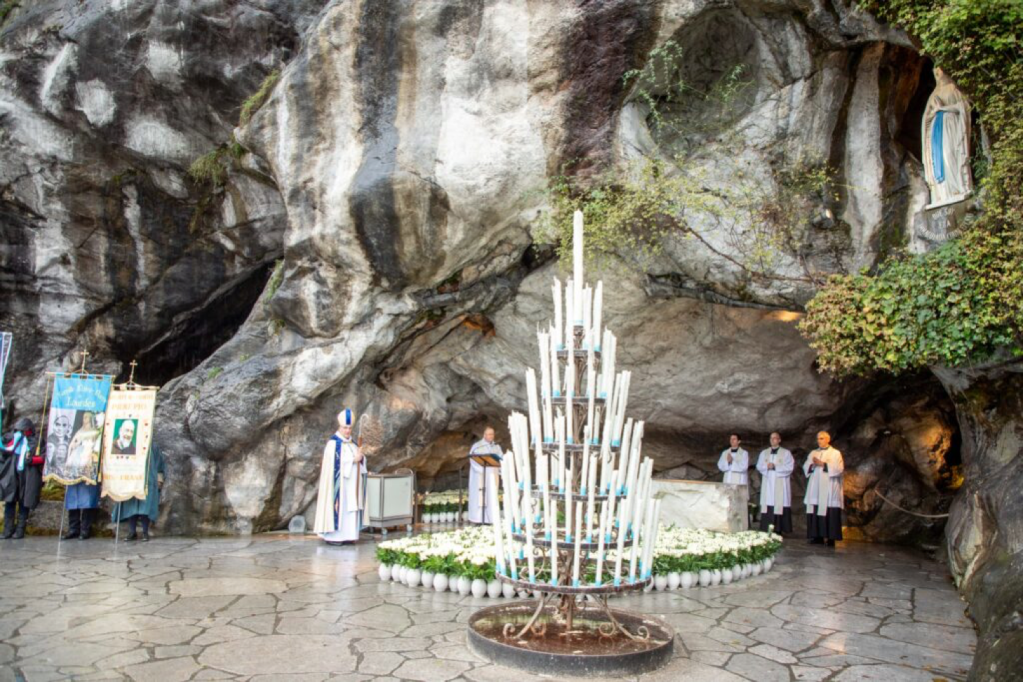
Outdoor Mass at the Lourdes’ Grotte de Massabielle on the 8th of December.
Photo source: https://www.lourdes-france.com
This is perhaps most fulsomely expressed at Lourdes, whose basilica is dedicated to this particular liturgical event. It was at Lourdes that the apparition of the Virgin Mary said to Bernadette ‘I am the Immaculate Conception’, and thus the feast has a special significance for this great sanctuary. The evening prior, a torch lit procession takes place follows Vespers and, on the day itself, white roses are placed within the grotto where the visions took place, followed by an Angelus, a Rosary service in the grotto, Vespers at the basilica and another torch lit procession around the sanctuary.[5] Although not strictly speaking in the Pyrenees, the Catalan capital of Barcelona traditionally has a wide array of shopfronts decorated with flowers and vegetation during Puríssima, and in the villages of Arenys de Mar and Arenys de Munt, children would smoke pipes with particular smoking mixtures made from local herbs, leading to the day being known as the ‘Mare de Déu Fumadora’.[6]
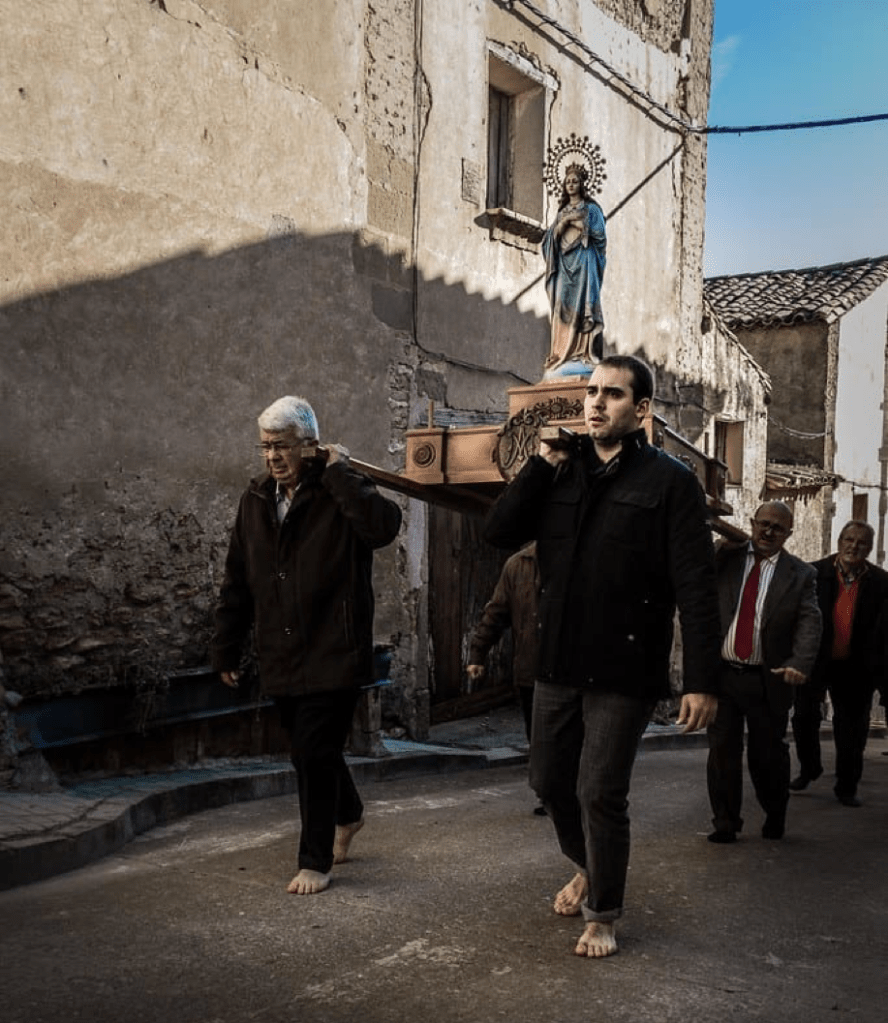
Procesión de los Descalzon in Lascellas.
Photo source: https://ganasdevivir.es
In Lascellas (Huesca) this day is marked by a barefoot procession (Procesión de los Descalzon) in honour of a promise made by the village to the Virgin Mary during a time of plague in exchange for being spared. They carry an image of the Virgin of the Immaculate Conception, as well as images of Saint Anthony and the Virgin of the Rosary, and the barefoot receive a ‘panetic’ (a bread sprinkled with aniseed seeds) which is donated by various households in the village and blessed during Mass. It is during this time that the Tío de Nadal log in Huesca and the Catalan Pyrenees or the Nadau Tidunin the Pays du Luchon (Hautes-Pyrénées and the Haute-Garonne) and in the Val d’Aran, is brought inside, covered with a blanket and ‘fed’ until Christmas Day.
[1] This likely refers to the bitter snow in Advent, referred to in the following proverb.
[2] Saint Martin’s Day celebrates Saint Martin of Tours and falls on the 11th of November. It is also known as Martinmas and, in northern Europe, traditionally marked the end of Harvest season and the beginning of Winter.
[3] Capmany, Aureli, Calendari de Llegendes, Costumes i Festes Tradicionals Catalanes: De Juliol a Desembre (La Bisbal d’Empordà: Edicions Sidillà, 2019), p. 245. Translated by author.
[4] Saint Lucia or Saint Lucy (born c. 283, died c. 304) is a martyr and the patron saint of the blind, as well as seamstresses, tailors and dressmakers. According to the early Julian calendar, her feast fell on the longest night of the year. This timing may have relevance to pre-existing celebrations and also to the symbolism of candles and lamps attached to Saint Lucia, not only in terms of her association with sight but also in dispelling darkness, as well as the root of her name luc– sharing that of the Latin for light, lux. ‘We must remember that I the Julian calendar, which preceded the Gregorian (introduced by Pope Gregory XIII in 1585), the solstice occurred on December 13, with the result that Lucy was linked to all the traditions involving the solstice. Thus it was said of Lucy that “she shed the light of her eyes on the long night of the solstice”.’ Lanzi, Fernando & Lanzi, Gioia, Saints and Their Symbols (Collegeville, MN: Liturgical Press, 2004), p. 90
[5] Dompnier, Bernard, Les Cérémonies Extraordinaires du Catholicisme Baroque (Clermont-Ferrand: Presses Universitaires Blaise-Pascal, 2009).
[6] Amades, Joan, Guia de Festes Tradicionals de Catalunya (Barcelona: Editorial Aedos, 1958), p. 145.

 Perennial Pyrenees